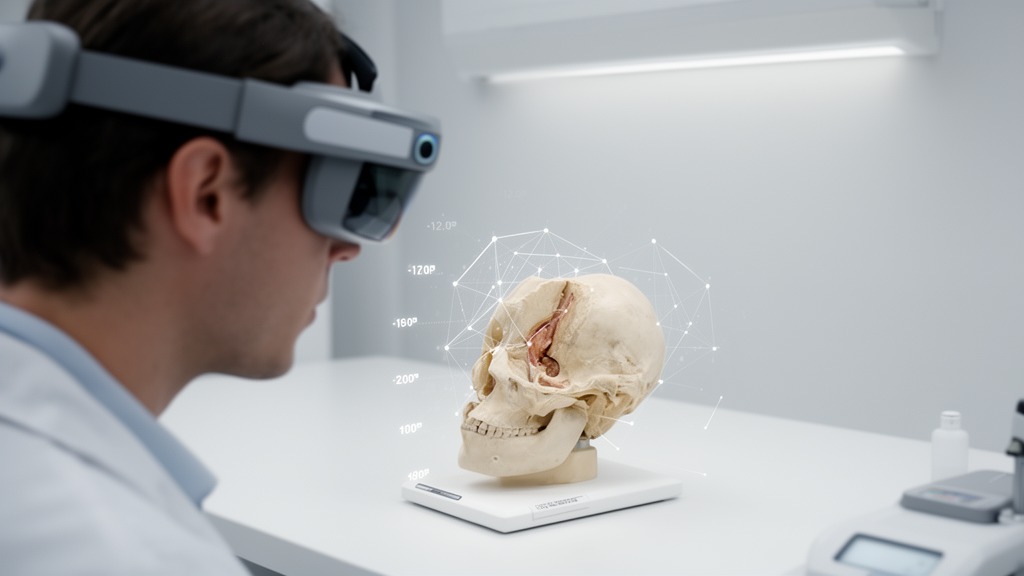
A research team from KU Leuven has developed and evaluated a prototype markerless augmented reality system designed to overlay preoperative anatomical models directly onto the surgical field during mastoidectomy procedures. Mastoidectomy forms an essential and technically demanding stage of cochlear implantation, requiring surgeons to drill through the mastoid section of the temporal bone to create an access path for electrode insertion. Because vital structures such as the facial nerve and chorda tympani run through this confined bony corridor within sub-millimeter tolerances, inadvertent structural contact can cause severe complications, including permanent facial paralysis. Traditional computer-assisted navigation systems rely on invasive bone-anchored fiducial screws, adhesive optical markers, or bulky external tracking cameras that disrupt the operating room workflow and suffer from line-of-sight occlusions. To explore an alternative approach, the investigators engineered an automated optical tracking pipeline that operates through a single commercial head-mounted display and off-board graphics processing, registering patient-specific three-dimensional anatomy without requiring artificial fiducials or manual intraoperative landmark identification.
The experimental platform distributes its computational and rendering workload between a Magic Leap 2 optical see-through headset and an external workstation equipped with an NVIDIA RTX 5090 graphics processing unit. The head-mounted display continuously captures the operative field using its integrated red-green-blue camera alongside an onboard time-of-flight depth sensor, streaming raw visual and range data over a dedicated wireless local network linked to the workstation via Gigabit Ethernet. To resolve intrinsic geometric discrepancies between the sensors, the researchers implemented a GPU-accelerated spatial alignment algorithm that projects time-of-flight depth samples directly onto the color image plane in parallel using a joint bilateral filter to preserve boundary definitions. Preoperative preparation begins with triangulated surface meshes segmented from high-resolution computed tomography scans.
During intraoperative initialization, the workstation processes incoming video frames using the Segment Anything Model 3, which isolates the operative anatomical target using the descriptive text prompt of a white organic-shaped object. This automated semantic mask isolates the region of interest before passing the masked image into FoundationPose, a neural six-degree-of-freedom object pose estimation architecture. FoundationPose evaluates candidate spatial alignments against rendered appearances of the colored model, sampling viewpoints across an angular cone within forty-five degrees of the anatomical model axis. Once the six-degree-of-freedom pose of the temporal bone is estimated, transformation matrices convert the coordinate representation from the right-handed OpenCV camera frame into the left-handed Unity coordinate space used by the headset display engine. To prevent virtual overlays from drifting during surgeon head movements, an asynchronous rendering loop recalculates the model pose relative to real-time inertial measurement unit data at fifty frames per second, while a five-frame sliding window temporal filter suppresses frame-to-frame tracking jitter.
To rigorously evaluate the registration accuracy of the markerless pipeline, the authors fabricated rigid physical evaluation models on a consumer fused-deposition three-dimensional printer using polylactic acid filament at a layer height of 0.1 millimeters. A custom handheld measurement pointer equipped with two calibrated AprilTag fiducial markers was tracked by the headset world cameras to serve as a measurement instrument. A non-clinical operator performed nine complete measurement sessions across three nominal working distances of 40, 45, and 50 centimeters and three distinct viewing perspectives, collecting twenty-four individual alignment measurements per session by manually aligning the rendered virtual pointer tip with each physical divot three consecutive times.
Analysis across all nine test sessions revealed a mean lateral target registration error magnitude of 1.56 ± 1.01 millimeters, corresponding to a root-mean-square lateral error of 1.82 millimeters. The authors observed that this rotational precision restricted leverage-induced spatial error magnification; even when extrapolated across an extended lever arm of 30 millimeters, the observed angular error contributed less than 0.45 millimeters of secondary displacement to deeper anatomical structures.
In marked contrast to the sub-two-millimeter lateral tracking performance, localization error along the optical viewing axis remained substantial, yielding an overall mean depth deviation of 6.90 ± 3.41 millimeters across the experimental grid. Statistical tests, including one-way analysis of variance and non-parametric Kruskal-Wallis evaluations, confirmed that variations in viewing angle produced no statistically significant influence on depth error, leaving physical sensor distance as the primary operational factor governing axial variance.
To isolate whether depth deviations originated from software estimation errors or physical display limitations, the team conducted a complementary image-space reprojection analysis across twenty-seven video frames, extracting two hundred and sixteen divot projections. Unlike the perceived depth discrepancies observed through the headset optics, this image-space reprojection error remained virtually constant across the entire testing grid, exhibiting a low coefficient of variation of 27 percent compared to 52 percent for the perceived target registration error. Because the two-dimensional reprojection method by mathematical construction assumes predicted depth values, it could not independently measure axial translation along the optical axis, leaving the precise underlying allocation of depth error between sensor calibration drift, algorithm bias, and human visual perception unresolved.
To contextualize these measurement tolerances within surgical anatomy, the investigators computationally propagated the fitted six-degree-of-freedom pose errors to a simulated critical landmark representing the facial nerve near the facial recess, situated approximately 20 millimeters beneath the cortical bone surface and 16.1 millimeters from the anatomical model origin. Rotational errors accounted for only 0.10 to 0.27 millimeters of total spatial error at this anatomical depth, confirming that translational registration discrepancies rather than rotational tilts dominate navigational error in deep temporal bone recesses.
Latency profiling over 547 consecutive tracking frames within an active tracking session demonstrated an average software pipeline execution duration of 153.4 milliseconds, with a median of 153.6 milliseconds and a ninetieth-percentile duration of 179.5 milliseconds. The FoundationPose inference stage represented the largest computational bottleneck, consuming an average of 87.9 milliseconds per frame, while bidirectional network transport over the local wireless link required 34.9 milliseconds. Depth-to-RGB image alignment, pose queueing, and application-level transformation updates accounted for the remaining processing span. Although the computational workstation sustained approximately ten pose updates per second, the realized data streaming throughput was capped at 4.0 frames per second by the capture configuration of the mobile headset. While asynchronous head-pose compensation updated the projected visual overlay at fifty frames per second to eliminate perceived swimming during rapid head turns, uncompensated physical motion of the anatomy at five millimeters per second would introduce approximately 0.8 millimeters of translational lag during the processing interval.
Following the identical photogrammetric color-transfer and mesh-alignment protocol, the markerless system successfully established initial six-degree-of-freedom spatial alignment against natural human bone and maintained continuous visual overlay stability even when parts of the bony surface were manually occluded. While this biological demonstration verified that the underlying visual feature-matching pipeline is not restricted to synthetic polymers, the authors emphasized that the test lacked an external ground-truth tracking frame, precluding quantitative metric verification on real human bone tissue.
When compared against existing skull base and otologic computer-assisted navigation systems, the experimental system exhibits unique trade-offs between invasiveness and navigational precision. Clinically deployed robotic cochlear implantation systems utilizing bone-anchored fiducial screws and external optical tracking achieve drilling accuracies of 0.2 millimeters and proximity prediction within 0.1 millimeters of critical nerves, while specialized microscope-integrated augmented reality platforms achieve sub-millimeter tracking by requiring manual selection of multiple anatomical landmarks. While the present markerless pipeline improves lateral accuracy approximately sevenfold over that earlier wearable benchmark without requiring bone screws or external tracking cameras, its 1.56-millimeter lateral error and nearly 7-millimeter depth error substantially exceed standard otologic surgical margins, where clearances between high-speed drills and vulnerable neural conduits measure only tenths of a millimeter.
Consequently, the authors emphasize that the current wearable configuration cannot serve as an intraoperative depth stop or hard keep-out safety boundary during active drilling. Instead, its immediate utility lies in non-invasive surgical planning, anatomical orientation, and training simulation on intact bone surfaces prior to cortical resection. Critical translational hurdles remain before clinical deployment can be considered, including adapting the registration pipeline to handle bone dust, continuous irrigation, blood pooling, specular lighting artifacts, and progressive architectural loss as mastoid bone is drilled away. Future investigations aim to integrate real-time drill-tip tracking to establish hard depth constraints, implement online photometric texturing to eliminate preoperative photogrammetry steps, and conduct rigorous multi-operator clinical trials on irrigated cadaveric specimens under realistic operating room conditions.
Subject of Research: Feasibility and accuracy evaluation of markerless augmented reality navigation for mastoidectomy using a head-mounted display
Article Title: Markerless augmented reality guidance for mastoidectomy: a phantom feasibility study using a head-mounted display
Article References: Li, Y., Putzeys, T., Rodríguez-Guerrero, C., & Verhaert, N. (2026). Markerless augmented reality guidance for mastoidectomy: a phantom feasibility study using a head-mounted display. Frontiers in Virtual Reality, 7, Article 1887382. https://doi.org/10.3389/frvir.2026.1887382
Image Credits: AI Generated
DOI: 10.3389/frvir.2026.1887382
Keywords: augmented reality, cochlear implantation, mastoidectomy, head-mounted display, Magic Leap 2, FoundationPose, Segment Anything Model, target registration error, temporal bone, surgical navigation, photogrammetry, computer vision, medical robotics, surgical simulation, otologic surgery, depth sensing
News Source: Denise Maddox. (November 24, 2026). Wearable Markerless Augmented Reality System Tracks Temporal Bone Phantoms Within Millimeters. Scienmag.