A research team led by Qiuyan Yan, alongside Jianqiang Guo, Junfeng Xu, and Yanan Zhang from the School of Intelligent Engineering at Xiangtan Institute of Technology, has developed a mechanical fault diagnosis architecture known as the multiple domain fuzzy matrix machine to resolve critical vulnerabilities in multi-objective machinery monitoring. Mechanical fault diagnosis plays an essential role in contemporary industrial automation and engineering systems, where uninterrupted operations are required to safeguard production workflows, prevent equipment breakdowns, and avoid catastrophic structural failures that incur profound economic damage. Conventional diagnostic frameworks that rely on single-task learning generally focus on isolated fault modes, creating models trained specifically for individual defect profiles under narrow operating conditions. While traditional algorithms such as support vector machines effectively manage linearly separable data representations, their classification capacity drops markedly when confronting high-dimensional, nonlinear machinery observations. Matrix-based alternatives, specifically support matrix machines that apply the nuclear norm as a convex approximation of matrix rank, capture structural correlations in multi-dimensional signals with greater fidelity, yet conventional implementations remain fundamentally restricted to single-task paradigms that fail when tasked with multi-objective fault identification across heterogeneous industrial equipment.
To overcome the architectural shortcomings of isolated diagnostic models, multi-task learning frameworks have gained widespread traction by allowing computational algorithms to evaluate multiple related targets simultaneously while sharing common informational patterns across separate operational streams. Under standard multi-task regimes, concurrent learning objectives complement one another, enabling the predictive network to extract joint representations alongside domain-specific distinctions, which significantly enhances generalisation capacity even when training sets are constrained. Several previous multi-task variants have been established to handle structural risk minimization and computational overhead, including multi-task twin bounded support vector machines, multi-task non-parallel support vector machines that incorporate insensitive loss formulations, and specialized multi-task matrix extensions such as multiple task nonparallel embedded matrix machines and fuzzy cross-domain matrix machines. Nevertheless, these conventional multi-task systems inherit baseline vulnerabilities from classical support vector architectures and support matrix methods, most notably an acute sensitivity to disparate background noise. In practical manufacturing environments, the background noise signatures across divergent mechanical components vary substantially, distorting feature boundaries, corrupting model training, and degrading diagnostic reliability across diverse mechanical assemblies.
Addressing the confounding influence of heterogeneous noise and boundary ambiguity, the investigators formulated the multiple domain fuzzy matrix machine, abbreviated as MDFMM, to achieve collaborative cross-domain diagnosis while safeguarding task-specific fault profiles. Within the MDFMM architecture, independent fuzzy hyperplanes are constructed for each diagnostic target, establishing a tailored mathematical space where fuzzy attributes dynamically assign unique noise robustness levels to distinct tasks. By integrating fuzzy membership values directly into the learning framework, the model dramatically enhances its discriminative ability across boundary regions where inter-class overlap frequently compromises conventional hard-margin classifiers. The collaborative learning structure simultaneously optimizes shared representations across multiple target domains without eroding the distinct mechanical patterns characteristic of individual operational modes. Consequently, the algorithmic design addresses the chronic inability of traditional fuzzy factors to handle complex multi-task workflows, generating a mathematically stable framework capable of maintaining rigorous diagnostic reliability even when tested against unseen operating conditions or distinct mechanical assemblies.
The mathematical formulation of the multiple domain fuzzy matrix machine operates on multi-task matrix samples where each diagnostic task is assigned structured positive and negative training collections. The architecture extracts both shared common features and component-specific individual features across the target domains to formulate objective optimization functions governing two non-parallel hyperplanes. Within these objective equations, the algorithm incorporates task numbers, penalty parameters, relaxation variables, and a specialized diagonal matrix populated by fuzzy membership values calculated for each task. These fuzzy values are systematically defined using the category center, the maximum distance separating individual sample points from that center, and an infinitesimal positive regularization constant to ensure numerical stability. Because the mathematical optimization functions associated with the dual non-parallel hyperplanes operate independently without reciprocal interference, the system resolves the inequality constraints through the Lagrange multiplier method. By computing partial differentials and substituting the resulting equalities back into the Lagrangian function, the framework establishes dual problem formulations that are subsequently transformed into explicit decision functions capable of classifying unlabeled matrix samples across each target domain.
To convert raw vibration signals into structured multi-dimensional inputs suitable for matrix computation, the researchers applied symplectic geometry similarity transformations. This preprocessing pipeline executes necessary dimensional transformations while strictly preserving the intrinsic geometric structures and physical correlation characteristics embedded in original mechanical vibration series. The diagnostic capabilities of the MDFMM framework were initially evaluated using experimental data gathered from the rolling mill vibration characteristic test bench located at Anhui University of Technology. During this experimental validation phase, vibration measurements were captured at an operational shaft speed of 1200 revolutions per minute under an applied mechanical load of 2 kilonewtons, utilizing an analytical sampling frequency established at 8192 hertz. The data acquisition protocol collected 200 distinct samples for each operational state, with every individual sample consisting of exactly 1024 discrete observation points, establishing a balanced foundation for multi-objective classification analysis.
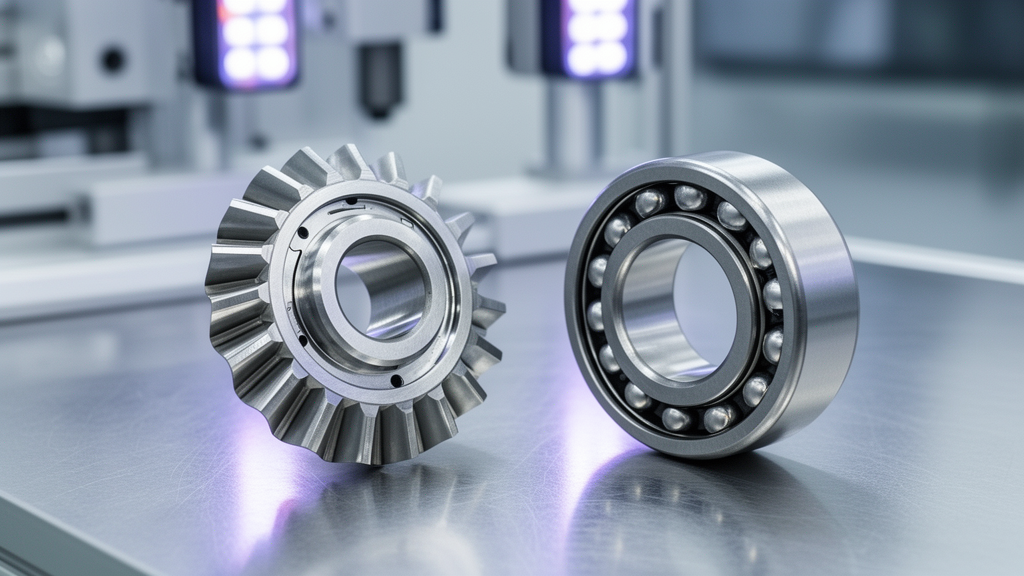
The Anhui University of Technology test bench experiment incorporated two completely independent mechanical targets, comprising rolling bearing elements and industrial gear systems with distinct mechanical defect categories. The rolling bearing dataset encompassed four specific fault classifications: inner ring ball defects, combined inner and outer ring ball defects, simultaneous inner and outer ring defects, and isolated outer ring defects. In parallel, the gear defect dataset featured four challenging operational failure modes, specifically low-speed shaft gear peeling, high-speed shaft gear peeling, catastrophic gear tooth loss, and severe gear surface wear. The diagnostic performance of MDFMM was benchmarked against three established comparative algorithms, including the multi-task collaborative enhancement matrix machine, the multi-task twin bounded support vector machine, and the multi-task non-parallel support vector machine. Evaluation criteria comprised five quantitative statistical metrics: classification accuracy, precision, recall, F1-score, and Cohen’s kappa coefficient, the latter providing a rigorous statistical gauge of classification consistency and operational robustness across complex mechanical domains.
To eliminate statistical anomalies and test algorithmic resilience against randomized data distributions, the researchers conducted five repeated trials with randomly shuffled training and testing splits on the Anhui University of Technology experimental datasets. In the rolling bearing fault diagnosis benchmark, MDFMM achieved flawless classification across all evaluated indicators, recording an accuracy of 100% plus or minus 0.00%, a kappa coefficient of 100% plus or minus 0.00%, a recall of 100% plus or minus 0.00%, an F1-score of 100% plus or minus 0.00%, and a precision of 100% plus or minus 0.00%. In comparison, MT-TBSVM demonstrated strong secondary performance, posting an accuracy of 99.45% plus or minus 0.57%, a kappa coefficient of 99.27% plus or minus 0.76%, a recall of 99.45% plus or minus 0.57%, an F1-score of 99.46% plus or minus 0.55%, and a precision of 99.45% plus or minus 0.54%. MTCEMM followed closely with an accuracy of 99.00% plus or minus 0.64%, a kappa coefficient of 98.67% plus or minus 0.85%, a recall of 99.00% plus or minus 0.64%, an F1-score of 99.02% plus or minus 0.62%, and a precision of 99.05% plus or minus 0.60%. The conventional MTNPSVM framework trailed all competing models, yielding an accuracy of 96.90% plus or minus 0.72%, a kappa coefficient of 95.87% plus or minus 0.96%, a recall of 96.90% plus or minus 0.72%, an F1-score of 97.08% plus or minus 0.64%, and a precision of 97.25% plus or minus 0.57%.
The performance divergence widened significantly when evaluating the gear fault benchmark, where structural vibration signals typically exhibit heightened complexity, pronounced background noise, and substantial feature overlap. Across five repeated shuffling iterations on the gear dataset, MDFMM sustained remarkable stability, achieving an overall classification accuracy of 99.80% plus or minus 0.27%, a kappa coefficient of 99.73% plus or minus 0.37%, a recall of 99.80% plus or minus 0.27%, an F1-score of 99.80% plus or minus 0.27%, and a precision of 99.80% plus or minus 0.27%. Conversely, the performance of the comparative models deteriorated markedly under gear vibration interference. MTCEMM recorded an accuracy of 97.05% plus or minus 1.92%, a kappa coefficient of 96.07% plus or minus 2.55%, a recall of 97.05% plus or minus 1.92%, an F1-score of 97.14% plus or minus 1.81%, and a precision of 97.21% plus or minus 1.69%. MT-TBSVM produced an accuracy of 96.65% plus or minus 1.23%, a kappa coefficient of 95.55% plus or minus 1.64%, a recall of 96.65% plus or minus 1.23%, an F1-score of 96.86% plus or minus 1.10%, and a precision of 97.08% plus or minus 0.97%. MTNPSVM experienced dramatic degradation, securing an accuracy of only 86.10% plus or minus 0.88%, a kappa coefficient of 81.47% plus or minus 1.17%, a recall of 86.10% plus or minus 0.88%, an F1-score of 88.51% plus or minus 0.64%, and a precision of 91.07% plus or minus 0.37%, highlighting its acute vulnerability to nonlinear boundary distributions.
To establish the broader transferability and operational generalisation of the architecture, the researchers executed a second extensive experimental trial utilizing vibration records acquired from the mechanical test bench at Shandong University of Science and Technology. This validation phase examined distinct multi-class operational states across independent bearing and gear apparatuses subjected to varying mechanical loads and rotational velocities. The Shandong bearing dataset investigated five distinct health classifications operating at a rotational speed of 3000 revolutions per minute under a electrical load parameter of 40 volts: class one represented fault-free components, class two denoted inner ring damage at a 0.2-millimeter defect depth, class three captured inner ring damage at a 0.4-millimeter defect depth, class four tracked outer ring damage at a 0.2-millimeter defect depth, and class five represented outer ring damage at a 0.4-millimeter defect depth. The accompanying gear dataset similarly categorized five separate operational health conditions evaluated at 2000 revolutions per minute with a current load of 0.5 amperes: class one represented normal operating conditions, class two corresponded to solar gear pitting, class three represented sun gear wear and tear, class four captured planetary gear pitting, and class five designated severe planetary gear tooth fracture.
Comprehensive analysis of the Shandong University of Science and Technology experimental benchmarks confirmed the systematic superiority of the proposed framework across multi-objective diagnostic environments. Quantitative radar and circular graph assessments tracking average outcomes across five repeated shuffling trials revealed that MDFMM produced a pronounced outward expansion envelope that spanned all five core evaluation indicators across both datasets, covering an analytical domain substantially wider than all competing algorithms. In stark contrast, MTNPSVM contracted to the innermost perimeter on both bearing and gear data streams, particularly across recall and kappa coefficients, demonstrating an inherent propensity toward missed detections when operating under multi-condition mechanical environments. Although MTCEMM and MT-TBSVM outperformed MTNPSVM, their diagnostic coverage remained measurably below MDFMM, particularly on gear kappa evaluations where their classification boundaries struggled to resolve overlapping feature distributions. Despite these demonstrated advantages, the authors documented specific algorithmic constraints within the current architecture, emphasizing that challenges regarding model interpretability and class imbalance remain unresolved. Moving forward, the research team plans to conduct further investigations into the underlying physical meaning of diagnostic objects and evaluate the differential contributions of specific classes to resolve these operational limitations in automated industrial monitoring.
Subject of Research: Multiple domain fuzzy matrix machine for multi-objective mechanical fault diagnosis
Article Title: Research on cross domain fuzzy multi-task matrix classification network for multi-objective fault diagnosis
Article References: Yan, Q., Guo, J., Xu, J., & Zhang, Y. (2026). Research on cross domain fuzzy multi-task matrix classification network for multi-objective fault diagnosis. Frontiers in Mechanical Engineering, 12, Article 2046343. https://doi.org/10.3389/fmech.2026.2046343
Image Credits: AI Generated
DOI: 10.3389/fmech.2026.2046343
Keywords: fault diagnosis, mechanical engineering, multiple domain fuzzy matrix machine, multi-task learning, rolling bearings, gear fault diagnosis, fuzzy hyperplanes, support matrix machines, symplectic geometry, vibration analysis, industrial automation, pattern recognition, cross-domain diagnosis, noise robustness, classification accuracy, twin support vector machines
News Source: Ophelia Keating. (November 24, 2026). Fuzzy Multi-Task Matrix Machine Improves Diagnostic Accuracy Across Bearings and Gears. Scienmag.