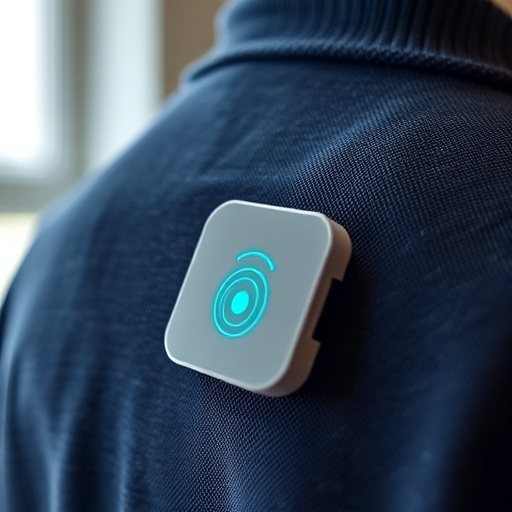
In an era rapidly turning towards decentralized medical diagnostics, the latest advancement in wearable technology promises to revolutionize cardiac and pulmonary monitoring. A team of researchers led by Dang, T.B., Nguyen, C.C., and Heo, S.Y., has unveiled a groundbreaking wearable device equipped with a novel cantilever pressure transducer, fitting snugly as an auscultation patch to record heart and lung sounds with remarkable fidelity. This development, detailed in the recently published article in Nature Communications, addresses long-standing limitations of traditional stethoscopes and offers profound implications for remote healthcare delivery.
The innovation lies in the integration of a broadband auscultation patch, designed to capture a wide spectrum of acoustic signals emanating from the human thorax. Conventional stethoscopes, albeit invaluable, suffer from bulky structure, dependency on the examiner’s expertise, and limited reproducibility. By contrast, the patch’s wearable form factor enables continuous, non-invasive monitoring without impeding the patient’s daily activities, thereby opening doors to a more comprehensive and granular assessment of cardiovascular and respiratory function over extended periods.
Central to this device’s performance is the cantilever pressure transducer embedded within the patch architecture. This transducer elegantly converts the mechanical vibrations induced by physiological sounds into electrical signals with unprecedented sensitivity across a broad frequency range. Unlike piezoelectric or traditional microphone-based sensors, the cantilever modality ensures enhanced bandwidth and accuracy, vital for detecting subtle anomalies such as murmurs or adventitious lung sounds that often escape intermittent clinical auscultation.
The research team meticulously engineered the cantilever to maximize responsiveness while minimizing noise interference. Using state-of-the-art microfabrication techniques, the device incorporates ultra-thin flexible materials ensuring intimate skin contact and patient comfort. Such engineering finesse enables the patch to cling seamlessly to various thoracic regions, adapting dynamically to movements without signal degradation. This flexibility also makes it suitable for diverse patient populations, from ambulatory adults to neonates.
Complementing the hardware is an advanced signal processing algorithm developed to interpret the rich acoustic data. By deploying machine learning models trained on large datasets of annotated heart and lung sounds, the system can differentiate between normal and pathological signals with high specificity. This automated diagnostic support is critical in telemedicine contexts, where remote clinicians rely on accurate data to guide patient management and timely interventions.
Perhaps one of the most remarkable features of this device is its broadband capacity. Traditional auscultation devices often suffer from frequency limitations that obscure low-frequency heart valve sounds or high-frequency lung crackles. The broadband approach employed here captures both ends of the acoustic spectrum, preserving the integrity of clinical murmurs and respiratory adventitious sounds, empowering clinicians to identify early-stage diseases that might otherwise remain undetected during routine check-ups.
The device’s real-world applicability was demonstrated in extensive clinical trials involving patients with a variety of cardiopulmonary conditions. These trials confirmed the patch’s ability to continuously monitor and record lung and heart sounds over days and weeks without signal loss or patient discomfort. Moreover, the data acquired allowed for the early detection of pulmonary exacerbations in chronic obstructive pulmonary disease (COPD) patients, as well as the identification of valvular heart diseases, underscoring its diagnostic potential.
Remote healthcare monitoring, a domain exponentially accelerated by the COVID-19 pandemic, stands to benefit enormously from this technology. Patients in rural or underserved areas can now be equipped with this lightweight patch, transmitting high-quality biomedical signals directly to medical professionals. This capability minimizes the need for frequent hospital visits and reduces healthcare costs while simultaneously enhancing disease management through timely and informed clinical decisions.
Furthermore, this auscultation patch integrates seamlessly with existing Internet of Medical Things (IoMT) infrastructures. It supports wireless data transmission protocols compatible with smartphones and health cloud platforms, ensuring secure and real-time data access. Such interoperability is crucial in establishing scalable telemedicine networks and fostering patient empowerment through self-monitoring and early symptom detection.
Importantly, the development team also addressed potential challenges related to data privacy and device longevity. Encryption protocols were embedded to safeguard patient information, and the patch material was selected for durability and biocompatibility, allowing for extended use without skin irritation or loss of sensitivity. These considerations emphasize the balanced integration of technology and patient-centric design.
Beyond cardiopulmonary monitoring, the scalable nature of the cantilever pressure sensor hints at future multiparameter health assessments. The transducer could potentially be adapted to sense other physiological signals, such as gastrointestinal sounds or vascular flow dynamics, fostering a new generation of multifunctional wearable health monitors. This evolution could profoundly transform preventive medicine and chronic disease management paradigms.
The combination of advanced materials science, microelectromechanical systems (MEMS) engineering, and artificial intelligence exemplifies the multidisciplinary effort required to push the boundaries of medical technology today. This auscultation patch stands as a testament to how synergy between these fields can overcome traditional barriers in clinical diagnostics, creating solutions that are not only technologically superior but also profoundly human-centric.
Looking ahead, the researchers suggest that further integration of biochemical sensors alongside acoustic monitoring could develop into holistic wearable devices capable of comprehensive physiological profiling. Such innovations could provide real-time feedback loops enabling personalized medicine approaches, aligning treatments more closely with individual patient needs and improving outcomes.
In conclusion, the wearable broadband auscultation patch developed by Dang and colleagues heralds a new era in remote healthcare monitoring. Its innovation is multifaceted: from leveraging cantilever pressure transducers for enhanced acoustic sensitivity to applying machine learning for automated diagnostics, and seamlessly embedding into telemedicine ecosystems. As wearable technologies continue to mature, devices like this will be pivotal in democratizing healthcare, enabling continuous, accessible, and accurate monitoring that can fundamentally improve patient care around the globe.
Subject of Research: Wearable broadband auscultation patch for remote healthcare monitoring
Article Title: Wearable, broadband auscultation patch with cantilever pressure transducer for remote healthcare monitoring
Article References:
Dang, T.B., Nguyen, C.C., Heo, S.Y. et al. Wearable, broadband auscultation patch with cantilever pressure transducer for remote healthcare monitoring. Nat Commun 17, 4918 (2026). https://doi.org/10.1038/s41467-026-73636-6
Image Credits: AI Generated
DOI: https://doi.org/10.1038/s41467-026-73636-6
Tags: advanced respiratory function assessmentbroadband acoustic signal capture in medicinecantilever pressure transducer in healthcarecontinuous non-invasive heart monitoringdecentralized medical diagnostics wearablehigh-fidelity heart and lung sound recordingnovel auscultation technology innovationpulmonary sound detection deviceremote cardiac monitoring technologyremote patient health monitoring solutionswearable broadband auscultation patchwearable medical device for cardiovascular health