• HOME
  • NEWS
  • EXPLORE
    • CAREER
      • Companies
      • Jobs
    • EVENTS
    • iGEM
      • News
      • Team
    • PHOTOS
    • VIDEO
    • WIKI
  • BLOG
  • COMMUNITY
    • FACEBOOK
    • INSTAGRAM
    • TWITTER
Friday, June 26, 2026
BIOENGINEER.ORG
No Result
View All Result
  • Login
  • HOME
  • NEWS
  • EXPLORE
    • CAREER
      • Companies
      • Jobs
        • Lecturer
        • PhD Studentship
        • Postdoc
        • Research Assistant
    • EVENTS
    • iGEM
      • News
      • Team
    • PHOTOS
    • VIDEO
    • WIKI
  • BLOG
  • COMMUNITY
    • FACEBOOK
    • INSTAGRAM
    • TWITTER
  • HOME
  • NEWS
  • EXPLORE
    • CAREER
      • Companies
      • Jobs
        • Lecturer
        • PhD Studentship
        • Postdoc
        • Research Assistant
    • EVENTS
    • iGEM
      • News
      • Team
    • PHOTOS
    • VIDEO
    • WIKI
  • BLOG
  • COMMUNITY
    • FACEBOOK
    • INSTAGRAM
    • TWITTER
No Result
View All Result
Bioengineer.org
No Result
View All Result
Home NEWS Science News Chemistry

‘We marry disorder with order’

Bioengineer by Bioengineer
March 17, 2021
in Chemistry
Reading Time: 2 mins read
0
IMAGE
Share on FacebookShare on TwitterShare on LinkedinShare on RedditShare on Telegram

Physicists able to determine properties of mesoporous materials more precisely
IMAGE

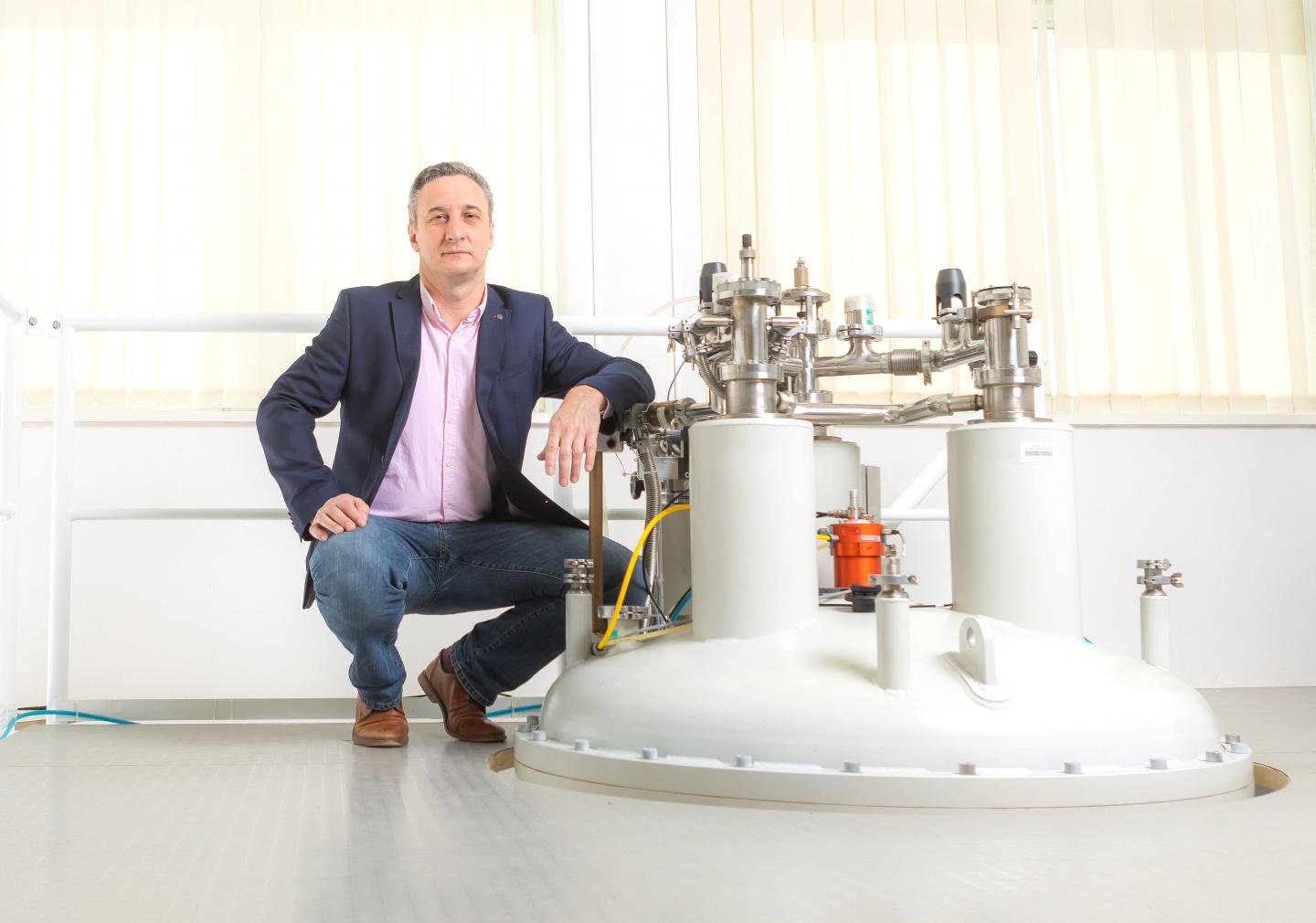
Credit: Photo: Swen Reichhold, Leipzig University

He and his research group have found a way to more precisely determine the properties of these materials, because they can better account for the underlying disorder. Their article has been designated “ACS Editors’ Choice” by the editors of the American Chemical Society journals, who recognise the “importance to the global scientific community” of the Leipzig researchers’ work and see it as a breakthrough in the accurate description of phase transition phenomena in disordered porous materials.

In mesoporous materials, the pore openings are far smaller than in a normal sponge: their diameters range from 2 to 50 nanometres and are invisible to the naked eye. Nevertheless, they have a number of interesting properties, including with regard to separating substances. This occurs as a function of molecule and pore size, for example.

Until now, scientific experiments have only been able to approximate the desired properties of these materials. “So it is more down to experience whether you can determine which of the structures can be used for which applications,” says the physicist. The problem is that these materials are mostly disordered, which means that pores of different sizes in the material form a complex network structure.

Researchers at Leipzig University developed a model that determines the features that can be observed in such complex pore networks. Professor Valiullin describes the approach as follows: “We can statistically describe how the individual pores in these networks are coupled to each other. We marry disorder with order.” This makes it possible to determine the physical phenomena that need to be understood in gas-liquid and solid-liquid phase transitions, for example. And not only in theory: using special mesoporous modelling, it was possible to prove with the aid of modern nuclear magnetic resonance methods that the theoretical results can also be directly applied in practice.

This should make it easier to use such materials in the future, for example to help release drugs into the human body over an extended period – precisely when necessary and desired. Other potential applications for such materials include sensor technology or energy storage and conversion.

###

Original title of the publication in the American Chemical Society journal Langmuir:

“Impact of Geometrical Disorder on Phase Equilibria of Fluids and Solids Confined in Mesoporous Materials”, doi.org/10.1021/acs.langmuir.0c03047

Jörg Aberger

Media Contact
Prof. Dr. Rustem Valiullin
[email protected]

Original Source

http://www.uni-leipzig.de/en/newsdetail/artikel/wir-vermaehlen-die-unordnung-mit-der-ordnung-2021-03-17//

Related Journal Article

http://dx.doi.org/10.1021/acs.langmuir.0c03047

Tags: Atomic/Molecular/Particle PhysicsChemistry/Physics/Materials SciencesMaterialsNanotechnology/MicromachinesParticle Physics
Share12Tweet8Share2ShareShareShare2

Related Posts

AI and Physics Collaborate to Design Advanced Hydrogen Storage Materials

June 25, 2026

International Team Including Dresden Scientists Develops Novel Designer Proteins for Advanced Study of Living Tissue

June 25, 2026

New Study Uncovers Key Factors Driving Water Chemistry in Nanoscale Environments

June 25, 2026

Plasma Technology Extends Catalyst Lifespan in Hydrogen Production

June 24, 2026
Please login to join discussion

POPULAR NEWS

  • Saying Goodbye to PGY-6: Pediatric Fellowship Realities

    103 shares
    Share 41 Tweet 26
  • Multi-Hospital Study Reveals Long Covid Burden Is Twice as High as Current Estimates

    92 shares
    Share 36 Tweet 23
  • Detection of EDCs in Breast Milk and Infant Urine Up to Six Months Highlights Early Exposure Risks

    77 shares
    Share 31 Tweet 19
  • New Drug Candidate Developed at McMaster Shows Potential for Treating Brain Cancer

    58 shares
    Share 23 Tweet 15

About

We bring you the latest biotechnology news from best research centers and universities around the world. Check our website.

Follow us

Recent News

Tracking Lanthanide-Labeled Microplastics in Plants

POSTECH Researchers Slash Cost of Reconstituted Cell-Free Systems by 95%

AI and Physics Collaborate to Design Advanced Hydrogen Storage Materials

Subscribe to Blog via Email

Success! An email was just sent to confirm your subscription. Please find the email now and click 'Confirm' to start subscribing.

Join 82 other subscribers
  • Contact Us

Bioengineer.org © Copyright 2023 All Rights Reserved.

Welcome Back!

Login to your account below

Forgotten Password?

Retrieve your password

Please enter your username or email address to reset your password.

Log In
No Result
View All Result
  • Homepages
    • Home Page 1
    • Home Page 2
  • News
  • National
  • Business
  • Health
  • Lifestyle
  • Science

Bioengineer.org © Copyright 2023 All Rights Reserved.