


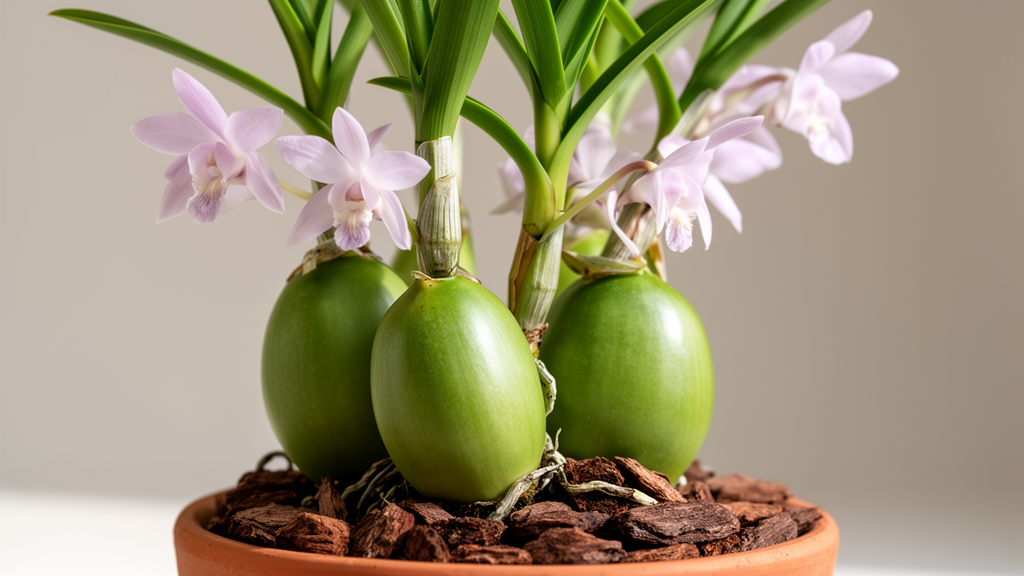
Epiphytic orchids in the genus Dendrobium survive in tree canopies where water and nutrients are scarce and unpredictable, and they rely on two specialized organs to do so: swollen pseudobulbs that store water and carbohydrates, and succulent roots that absorb moisture. A new study of 37 Dendrobium species has now quantified the anatomical traits that determine the size of these organs and found that the two organs vary together across species, suggesting a coordinated water-use strategy shaped by environmental selection rather than shared ancestry.
The research, published in Botanical Studies, measured seven pseudobulb traits and 13 root traits in cultivated plants grown under uniform conditions for three years at the Kunming Botanical Garden in China. By raising all species in a common environment, the researchers aimed to minimize environmentally induced phenotypic plasticity and detect genetically based differences in anatomy. They then used regression analyses, hierarchical partitioning, Pearson correlations, and phylogenetically independent contrasts to identify which tissues drive organ size and whether trait relationships persist after accounting for evolutionary relatedness among species.
The results show that all measured traits varied considerably among species, but the two organs differed sharply in how labile their anatomy is. Pseudobulb traits were more variable than root traits, with parenchyma area showing the highest coefficient of variation at 83.29 percent and vascular bundle area close behind at 74.03 percent, while epidermis thickness varied least at 33.72 percent. Among root traits, velamen area varied most at 56.81 percent, followed by velamen thickness at 37.56 percent and vascular bundle area at 35.90 percent, whereas exodermis thickness was the most conserved trait at just 10.03 percent variation. The authors interpret this contrast as divergent adaptive strategies: pseudobulbs adjust their storage capacity in response to fluctuating resources, while root structures remain functionally conserved to sustain water absorption, fixation, and mechanical support.
Phylogenetic signal analysis revealed that all measured traits had weak signals, with K statistics below 1, indicating that environmental selection is the dominant force shaping anatomical differentiation across Dendrobium species rather than phylogenetic constraint. The one exception was pseudobulb epidermis thickness, which showed a significant but still weak phylogenetic signal, with K equal to 0.842 and P equal to 0.001. This pattern suggests that species-level variation in these orchids reflects adaptive radiation into different canopy microhabitats rather than inheritance of traits from common ancestors.
When the researchers examined what determines pseudobulb size, parenchyma tissue emerged as the clear driver. Pseudobulb radius was significantly and positively related to parenchyma area, with an R-squared of 0.95, as well as to total vascular bundle area at 0.65, area of individual vascular bundles at 0.54, number of vascular bundles at 0.47, area of parenchyma cells at 0.34, and epidermis thickness at 0.25. Hierarchical partitioning confirmed that parenchyma area contributed the most to pseudobulb size, accounting for 44.40 percent of the explained variance. After correcting for phylogenetic effects using independent contrasts, the relationship between epidermis thickness and pseudobulb radius became non-significant, dropping to an R-squared of 0.03 with P equal to 0.32, while the associations with parenchyma and vascular bundle traits held regardless of correction.
Root size followed a different anatomical logic centered on the velamen, the multi-layered epidermal tissue of dead, lignified cells that forms a porous network for rapid water uptake and retention. Root radius was most strongly related to velamen area, with an R-squared of 0.91, followed by velamen thickness at 0.76, number of velamen layers at 0.72, area of velamen cells at 0.66, velamen cell length at 0.57, and velamen cell width at 0.56. Root radius also correlated with cortex thickness at 0.53, number of exodermis cells at 0.60, exodermis area at 0.61, number of endodermis cells at 0.16, and vascular bundle area at 0.62. Exodermis thickness showed the weakest association at 0.16, and after phylogenetic correction this relationship became non-significant, with an R-squared of 0.06 and P equal to 0.16. Velamen area made the largest contribution to root size, explaining 20.25 percent of the variance in the hierarchical partitioning analysis.
The most striking finding, according to the authors, is the consistent positive correlation between functionally analogous traits in the two organs. Pseudobulb radius was positively correlated with root radius both before and after phylogenetic correction, an association the researchers describe as an evolved functional syndrome that matches water storage capacity with water acquisition efficiency under variable epiphytic conditions. Pseudobulb vascular bundle area correlated positively with root vascular bundle area and root exodermis area after phylogenetic correction, and pseudobulb parenchyma area remained significantly correlated with root cortex thickness, velamen area, and velamen cell area regardless of phylogenetic correction. These cross-organ relationships support a whole-plant functional coordination hypothesis, in which plants evolve integrated trait syndromes across organs to maximize fitness in limiting environments.
The authors link these anatomical patterns to developmental regulation. Parenchyma tissue in Dendrobium pseudobulbs consists of large, vacuolated cells specialized for water and carbohydrate storage, and its dimensions are shaped by hormone signaling cascades involving auxin, abscisic acid, and cytokinin, along with cell wall modification genes such as expansins and XTHs that modulate cell wall relaxation and vacuolar expansion. Similarly, velamen development is governed by epidermal cell fate specification and cell expansion pathways. The tight correlations between tissue dimensions and organ size suggest that the developmental programs governing storage tissue formation are coordinated with those regulating vascular and absorptive tissue development, integrating storage, transport, and absorption functions within each organ.
The study also proposes an ecological interpretation for how species in different microhabitats might combine these traits. Species inhabiting drier canopy microhabitats may evolve larger allocations of large-volume parenchyma cells to enhance water and carbohydrate reserves for enduring prolonged drought, while taxa in more humid environments may prioritize vascular tissue allocation to improve transport efficiency. Combined with the cross-organ correlations, the authors suggest that dry-habitat species pair large storage pseudobulbs with highly developed absorptive roots, whereas humid-habitat species coordinate relatively small storage organs with transport-oriented tissues. The researchers note that similar inter-organ coordination has been documented in other epiphytic plants, including ferns, where leaf and root traits form a plant economics spectrum, and in epiphytic bromeliads, where root size correlates with water absorption and storage traits.
By quantifying the cellular and tissue dimensions that underpin organ morphology in a diverse epiphytic lineage, the study provides empirical support for the idea that tissue allocation strategy evolves in response to habitat moisture availability. The authors conclude that Dendrobium organ size is determined by tissue-level adaptive architecture, with pseudobulb size depending primarily on water-storage parenchyma and root size tightly linked to absorptive velamen, and they suggest that future work partitioning trait variation by clade, habitat, or rainfall could reveal broader evolutionary ramifications of these coordinated hydraulic strategies in epiphytic plants.
Subject of Research: Anatomical determinants of pseudobulb and root size and their coordinated trait associations in Dendrobium orchids
Article Title: Anatomical drivers of organ size and trait coordinated association between pseudobulbs and roots in Dendrobium
Article References: Zhang, F.-P., Lǚ, D.-Q., Li, H.-R., & Zhang, S.-B. (2026). Anatomical drivers of organ size and trait coordinated association between pseudobulbs and roots in Dendrobium. Botanical Studies, 67(1), Article 8. https://doi.org/10.1186/s40529-026-00495-1
Image Credits: AI Generated
DOI: 10.1186/s40529-026-00495-1
Keywords: Dendrobium, orchids, pseudobulbs, roots, velamen, parenchyma, anatomy, phylogenetic independent contrasts, epiphytes, trait coordination, water storage, organ size
News Source: Drew Townsend. (October 28, 2026). Water-storing tissue drives pseudobulb size in Dendrobium orchids. Scienmag.



