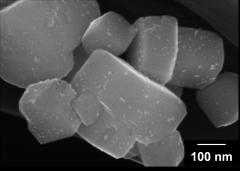
Credit: Cited from Wang, Z., Luo, Y., Hisatomi, T. et al. Sequential cocatalyst decoration on BaTaO2N towards highly-active Z-scheme water splitting. Nat Commun 12, 1005 (2021). Copyright © 2021, The Authors….
In order to enable large-scale hydrogen production using solar energy, particulate photocatalysts are being researched as a simple and cost-effective solution to splitting water into hydrogen and oxygen. It is necessary to develop a photocatalyst that can efficiently use visible light, which accounts for a large part of solar energy, in the water decomposition reaction. Barium tantalum oxynitride (BaTaO2N) is an oxynitride semiconductor material that absorbs visible light up to 650 nm and has a band structure capable of decomposing water into hydrogen and oxygen. Until very recently, it had not been possible to load BaTaO2N granules with co-catalyst fine particles, which are reaction active sites, with good adhesion and high dispersion.
In this study led by the Research Initiative for Supra-Materials of Shinshu University, the co-catalyst fine particles were found to be highly dispersed on the surface of the single crystal fine particles of BaTaO2N synthesized by the flux method when the impregnation-reduction method and the photodeposition method were sequentially applied (Fig. 1). As a result, the efficiency of the hydrogenation reaction using the BaTaO2N photocatalyst has been improved to nearly 100 times that of the conventional one, and the efficiency of the two-step excitation type (Z scheme type) water decomposition reaction in combination with the oxygen generation photocatalyst has also been improved. Transient absorption spectroscopy reveals that the Pt-assisted catalyst microparticles supported by the new method are less likely to induce recombination of electrons and holes because they efficiently extract electrons from the BaTaO2N photocatalyst (Fig. 2).
By supporting a small amount of Pt co-catalyst by the impregnation-reduction method in advance, the reduction reaction on the photocatalyst is promoted without agglutination of Pt fine particles. As a result, Pt cocatalyst fine particles are evenly supported by photodeposition on BaTaO2N particles. As a result, it is considered that the extraction of electricity by Pt co-catalyst fine granules proceeded efficiently.
It was also confirmed that the use of BaTaO2N, which is synthesized using an appropriate flux and has a low density of defects, is also important for supporting a highly dispersed Pt co-catalyst. This study dramatically improved the activity of the BaTaO2N photocatalyst and clarified its mechanism. The results of this research are expected to lead to the development of long-wavelength-responsive photocatalysts that drive the water decomposition reaction with high efficiency.
###
This research was conducted in collaboration with the Japan Technological Research Association of Artificial Photosynthetic Chemical Process (ARPChem), and is part of the “Artificial Photosynthesis Project” of the New Energy and Industrial Technology Development Organization (NEDO).
Sequential cocatalyst decoration on BaTaO2N towards highly-active Z-scheme water splitting
Authors: Zheng Wang, Ying Luo, Takashi Hisatomi, Junie Jhon M. Vequizo, Sayaka Suzuki, Shanshan Chen, Mamiko Nakabayashi, Lihua Lin, Zhenhua Pan, Nobuko Kariya, Akira Yamakata, Naoya Shibata, Tsuyoshi Takata, Katsuya Teshima, and Kazunari Domen
Journal: Nature Communications, (2021)
DOI: https:/
Acknowledgements
This work was financially supported by the Artificial Photosynthesis Project of the New Energy and Industrial Technology Development Organization (NEDO). A part of this work was conducted at the Advanced Characterization Nanotechnology Platform of the University of Tokyo, supported by the Nanotechnology Platform of the Ministry of Education, Culture, Sports, Science, and Technology (MEXT), Japan (grant number: JPMXP09A-19-UT-0023). The authors thank Ms. Michiko Obata of Shinshu University for her assistance with XPS measurements.
Media Contact
Hitomi Thompson
intl_ac@shinshu-u.ac.jp
Related Journal Article
http://dx.