Wherever people are living, hormones used in e.g. contraceptives or agriculture enter the wastewater. Steroid hormones, such as sex hormones and corticosteroids, may accumulate in the environment and adversely affect humans and animals, as they impair behavioral development and fertility. Sex hormones, for instance, may cause male fish to develop female sexual characteristics. It is therefore important to remove hormones, together with other micropollutants, from the wastewater before they enter the natural water cycle again, from which drinking water is extracted. “Supplying people with clean drinking water presently is one of the most important challenges worldwide,” says Professor Andrea Iris Schäfer, Head of KIT’s Institute for Advanced Membrane Technology (IAMT). “Micropollutants represent a big threat for our future, as they impair our fertility and brain function.”
Credit: Markus Breig, KIT
Wherever people are living, hormones used in e.g. contraceptives or agriculture enter the wastewater. Steroid hormones, such as sex hormones and corticosteroids, may accumulate in the environment and adversely affect humans and animals, as they impair behavioral development and fertility. Sex hormones, for instance, may cause male fish to develop female sexual characteristics. It is therefore important to remove hormones, together with other micropollutants, from the wastewater before they enter the natural water cycle again, from which drinking water is extracted. “Supplying people with clean drinking water presently is one of the most important challenges worldwide,” says Professor Andrea Iris Schäfer, Head of KIT’s Institute for Advanced Membrane Technology (IAMT). “Micropollutants represent a big threat for our future, as they impair our fertility and brain function.”
Inspired by Solar Cell Technology
For years, Schäfer has studied water processing by nanofiltration. For this purpose, she uses polymer membranes with nanometer-sized pores. However, nanofiltration requires high pressure and, hence, much energy. Moreover, micropollutants may accumulate in the polymer membrane materials and gradually enter the filtered water. Even if the pollutants are separated completely, a flow of concentrated pollutants may develop and require further treatment.
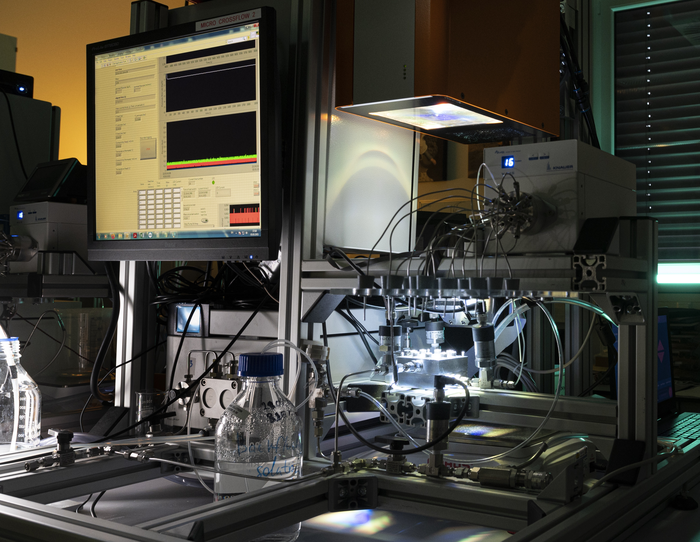
Inspired by solar cell technology, the field of work of Professor Bryce S. Richards from KIT, Schäfer had the idea to coat polymer membranes with titanium dioxide and to design photocatalytic membranes. Photocatalytically active titanium dioxide nanoparticles are applied to microfiltration membranes, whose pores are somewhat larger than in nanofiltration. Irradiation with light then triggers a chemical reaction, as a result of which steroid hormones are degraded on the membranes. Together with her team at IAMT and colleagues from the Leibniz Institute of Surface Engineering (IOM), Leipzig, Schäfer has now realized her idea and presented the new technology in Nature Nanotechnology.
Catalyst for Water
“We have developed a catalyst for water,” Schäfer summarizes her work. Using the photocatalytic polymer membranes, steroid hormones were removed in the continuous flow mode down to the analytical detection limit of 4 ng/l. In fact, the concentrations measured were very close to 1 ng/l, the limit given in the new Drinking Water Guideline of the WHO. The researchers are now optimizing their technology by reducing the time needed and energy consumed. Moreover, their focus lies on using natural light. In particular, their research is aimed at degrading other pollutants by photocatalysis, such as industrial chemicals like perfluoro-alkylated and polyfluorinated substances (PFAS) or pesticides, such as glyphosate. Another goal is to upscale the technology. (or)
Journal
Nature Nanotechnology
DOI
10.1038/s41565-022-01074-8
Method of Research
Experimental study
Subject of Research
Not applicable
Article Title
Photocatalytic degradation of steroid hormone micropollutants by TiO2-coated polyethersulfone membranes in a continuous flow-through process
Article Publication Date
31-Mar-2022