• HOME
  • NEWS
  • EXPLORE
    • CAREER
      • Companies
      • Jobs
    • EVENTS
    • iGEM
      • News
      • Team
    • PHOTOS
    • VIDEO
    • WIKI
  • BLOG
  • COMMUNITY
    • FACEBOOK
    • INSTAGRAM
    • TWITTER
Saturday, May 16, 2026
BIOENGINEER.ORG
No Result
View All Result
  • Login
  • HOME
  • NEWS
  • EXPLORE
    • CAREER
      • Companies
      • Jobs
        • Lecturer
        • PhD Studentship
        • Postdoc
        • Research Assistant
    • EVENTS
    • iGEM
      • News
      • Team
    • PHOTOS
    • VIDEO
    • WIKI
  • BLOG
  • COMMUNITY
    • FACEBOOK
    • INSTAGRAM
    • TWITTER
  • HOME
  • NEWS
  • EXPLORE
    • CAREER
      • Companies
      • Jobs
        • Lecturer
        • PhD Studentship
        • Postdoc
        • Research Assistant
    • EVENTS
    • iGEM
      • News
      • Team
    • PHOTOS
    • VIDEO
    • WIKI
  • BLOG
  • COMMUNITY
    • FACEBOOK
    • INSTAGRAM
    • TWITTER
No Result
View All Result
Bioengineer.org
No Result
View All Result
Home NEWS Science News

Water is surprisingly ordered on the nanoscale

Bioengineer by Bioengineer
May 24, 2017
in Science News
Reading Time: 2 mins read
0
Share on FacebookShare on TwitterShare on LinkedinShare on RedditShare on Telegram
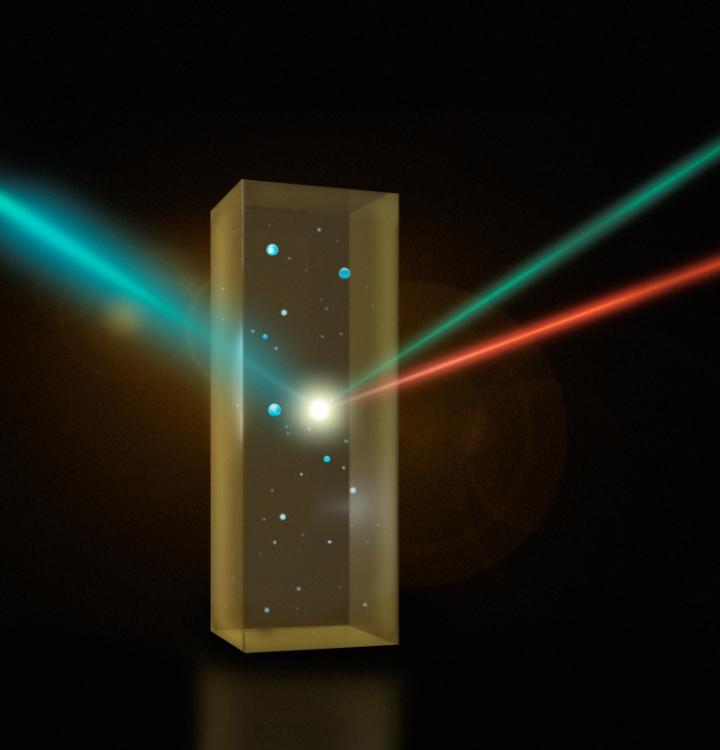
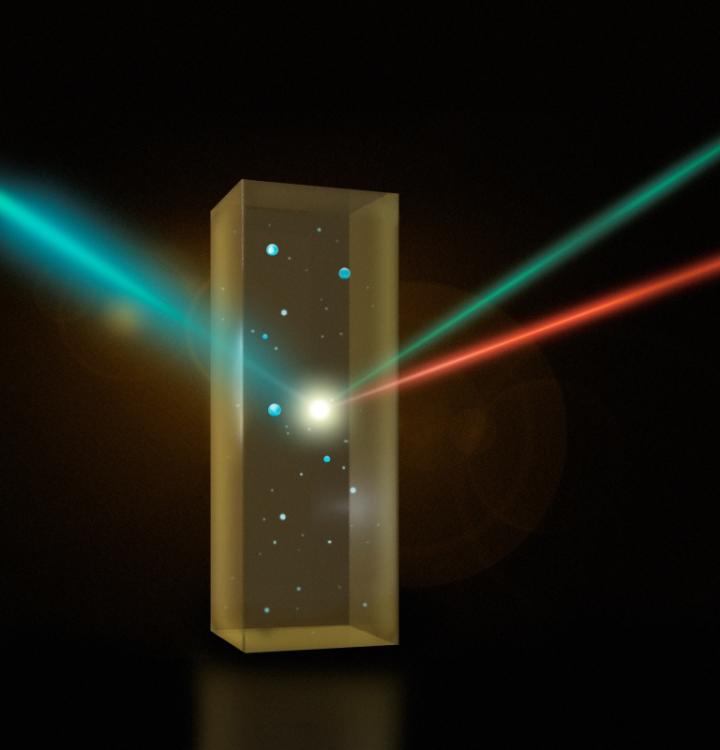
IMAGE

Credit: © EPFL/Julia Jacobi Chair of Photomedicine – Laboratory for Fundamental BioPhotonic

Nanometric-sized water drops are everywhere – in the air as droplets or aerosols, in our bodies as medication, and in the earth, within rocks and oil fields. To understand the behavior of these drops, it is necessary to know how they interact with their hydrophobic environment. This interaction takes places at the curved droplet interface, a sub-nanometric region that surrounds the small pocket of water. Researchers from EPFL, in collaboration with the institute AMOLF in the Netherlands, were able to observe what was going on in this particular region. They discovered that molecules on the surface of the drops were much more ordered than expected. Their surprising results have been published in Nature Communications. They pave the way to a better understanding of atmospheric, biological and geological processes.

Unique perspective on miniscule droplets

At EPFL, Sylvie Roke, director of the Julia Jacobi Chair of Photomedicine –

Laboratory for Fundamental BioPhotonics, has developed a unique method for examining the surface of these droplets that are as thick as one thousandth of a hair, with a volume of an attoliter (18 zeros behind the comma). "The method involves overlapping ultrashort laser pulses in a mixture of water droplets in liquid oil and detecting photons that are scattered only from the interface", explains Roke. "These photons have the sum frequency of the incoming photons and are thus of a different color. With this newly generated color we can know the structure of the only the interface."

Hydrogen bonding as strong as in ice

The surface of the water droplets turns out to be much more ordered than that of normal water and is comparable to super cooled (liquid

Chemical processes

This research provides valuable insight into the properties of nanometric water drops. "The chemical properties of these drops depend on how the water molecules are organized on the surface, so it's really important to understand what's going on there," explained Roke. Further research could target the surface properties of water droplets with adding salt, a more realistic model of marine aerosols that consist of salty water surrounded by a hydrophobic environment. Salt may either enhance the water network or reduce its strength. "Or, it may not do anything at all. Given the surprising results found here, we can only speculate", says Roke.

###

Article in Nature communications : The interfacial structure of water droplets in a hydrophobic liquid

Media Contact

Sylvie Roke
[email protected]
41-216-931-191
@EPFL_en

http://www.epfl.ch/index.en.html

############

Story Source: Materials provided by Scienmag

Share12Tweet8Share2ShareShareShare2

Related Posts

New Actinomycin Derivatives Target Malaria More Selectively

May 16, 2026

Mobile App Enhances Exercise for Older Adults’ Cognition

May 16, 2026

Botulinum Toxin Reduces Urinary Retention Post-Hemorrhoidopexy

May 16, 2026

Blood Metal Exposure Linked to Puberty Timing

May 16, 2026
Please login to join discussion

POPULAR NEWS

  • Research Indicates Potential Connection Between Prenatal Medication Exposure and Elevated Autism Risk

    843 shares
    Share 337 Tweet 211
  • New Study Reveals Plants Can Detect the Sound of Rain

    730 shares
    Share 291 Tweet 182
  • Salmonella Haem Blocks Macrophages, Boosts Infection

    62 shares
    Share 25 Tweet 16
  • Breastmilk Balances E. coli and Beneficial Bacteria in Infant Gut Microbiomes

    58 shares
    Share 23 Tweet 15

About

We bring you the latest biotechnology news from best research centers and universities around the world. Check our website.

Follow us

Recent News

New Actinomycin Derivatives Target Malaria More Selectively

Mobile App Enhances Exercise for Older Adults’ Cognition

Botulinum Toxin Reduces Urinary Retention Post-Hemorrhoidopexy

Subscribe to Blog via Email

Enter your email address to subscribe to this blog and receive notifications of new posts by email.

Join 82 other subscribers
  • Contact Us

Bioengineer.org © Copyright 2023 All Rights Reserved.

Welcome Back!

Login to your account below

Forgotten Password?

Retrieve your password

Please enter your username or email address to reset your password.

Log In
No Result
View All Result
  • Homepages
    • Home Page 1
    • Home Page 2
  • News
  • National
  • Business
  • Health
  • Lifestyle
  • Science

Bioengineer.org © Copyright 2023 All Rights Reserved.