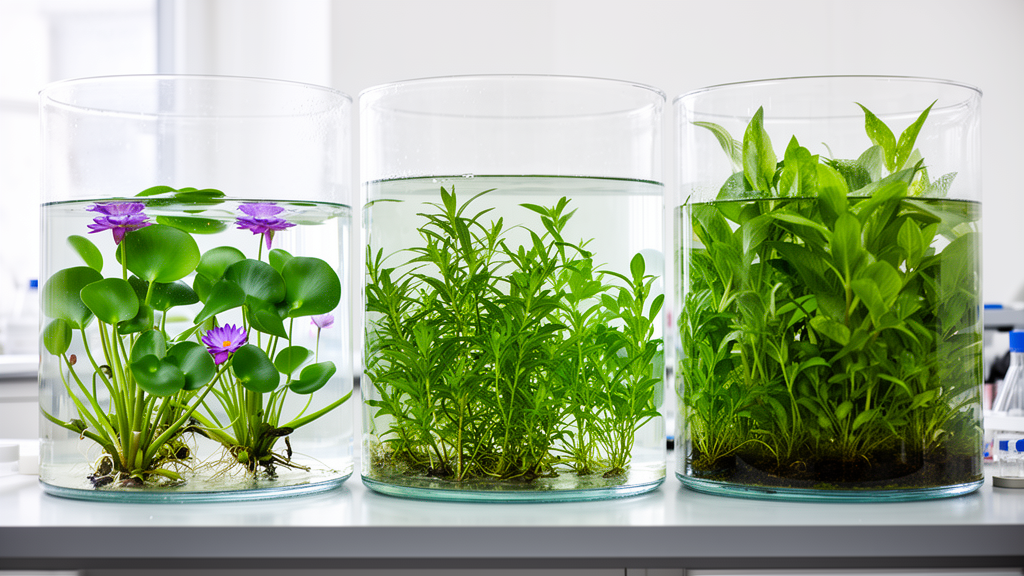
The research, led by Selim Z. Heneidy and colleagues, examined how the naturalized water hyacinth interacts with Hydrocotyle umbellata L. and Salvinia auriculata Aubl. under controlled mixed-culture conditions.
The team grew the three species together in two contrasting environmental setups: deep water tanks and constructed wetlands. All cultures were irrigated with water drawn from the El-Mahmoudia Canal, allowing the researchers to evaluate interspecific competition and growth performance under conditions resembling those of affected waterways.
The outcome was striking. In all mixed cultures, P. crassipes rapidly declined and died within three months, suggesting limited competitive ability under the tested conditions. At the same time, the study reported that water hyacinth had a generally positive effect on the growth of H. umbellata, indicating that the relationships among these species are more complex than simple one-sided dominance.
H. umbellata responded strongly to the constructed wetland environment. The researchers recorded significantly enhanced growth there compared with deep water, including increases in petiole length, laminae index and rhizoid length. According to the authors, these patterns indicate the species’ adaptability and competitive potential in structured aquatic environments such as engineered wetlands.
S. auriculata told a somewhat different story. Although the study found no statistically significant differences in its performance between the constructed wetland and deep water setups, the species consistently performed slightly better in the constructed wetlands. More notably, it demonstrated a competitive edge by displacing P. crassipes in mixed cultures, reinforcing the picture of a water hyacinth that struggled to hold its ground against either introduced species.
When the two introduced species were grown together, however, both experienced reduced growth, particularly in petiole and rhizoid length. This mutual suppression highlights the impact of interspecific competition even between species that individually outcompeted water hyacinth, and it suggests that co-occurrence of the two introduced hydrophytes carries growth costs for both partners.
The authors frame these findings as directly relevant to the management of aquatic plant communities. Because P. crassipes showed no clear evidence of a competitive effect under the experimental conditions examined, the interactions between H. umbellata and S. auriculata deserve particular attention in management planning, especially in constructed wetlands where such species may be deliberately or accidentally introduced.
The study is an open-access research article published on 20 October 2026, and the version shared carries a permanent DOI as an accepted manuscript subject to further edits before the final version of record. As with any experimental study, the results reflect the specific conditions tested — open-air mixed cultures supplied with El-Mahmoudia Canal water over a three-month period — and the authors present them as findings for management consideration rather than as field-verified outcomes.
By documenting which species prevail, which decline, and where each performs best, the experiment offers a measured baseline for understanding how introduced macrophytes may reshape aquatic communities through competition, and it underscores that competitive hierarchies among alien aquatic plants can shift sharply depending on the environment in which they are grown.
Subject of Research: Interspecific competition between water hyacinth and two introduced aquatic macrophytes in experimental deep-water and constructed-wetland cultures
Article Title: Competitive performance of two introduced hydrophytes with invasive species Pontederia crassipes Mart.: implications for management of aquatic species invasion
Article References: Heneidy, S. Z., El-Makawy, A. M., Fakhry, A. M., & Halmy, M. W. A. (2026). Competitive performance of two introduced hydrophytes with invasive species Pontederia crassipes Mart.: implications for management of aquatic species invasion. BMC Ecology and Evolution. https://doi.org/10.1186/s12862-026-02593-x
Image Credits: AI Generated
DOI: 10.1186/s12862-026-02593-x
Keywords: water hyacinth, Pontederia crassipes, Hydrocotyle umbellata, Salvinia auriculata, invasive species, aquatic macrophytes, interspecific competition, constructed wetlands, El-Mahmoudia Canal, BMC Ecology and Evolution, Competitive, performance
News Source: Gavin Prescott. (October 28, 2026). Water hyacinth loses out to two introduced aquatic plants in mixed-culture experiment. Scienmag.