• HOME
  • NEWS
  • EXPLORE
    • CAREER
      • Companies
      • Jobs
    • EVENTS
    • iGEM
      • News
      • Team
    • PHOTOS
    • VIDEO
    • WIKI
  • BLOG
  • COMMUNITY
    • FACEBOOK
    • INSTAGRAM
    • TWITTER
Sunday, May 10, 2026
BIOENGINEER.ORG
No Result
View All Result
  • Login
  • HOME
  • NEWS
  • EXPLORE
    • CAREER
      • Companies
      • Jobs
        • Lecturer
        • PhD Studentship
        • Postdoc
        • Research Assistant
    • EVENTS
    • iGEM
      • News
      • Team
    • PHOTOS
    • VIDEO
    • WIKI
  • BLOG
  • COMMUNITY
    • FACEBOOK
    • INSTAGRAM
    • TWITTER
  • HOME
  • NEWS
  • EXPLORE
    • CAREER
      • Companies
      • Jobs
        • Lecturer
        • PhD Studentship
        • Postdoc
        • Research Assistant
    • EVENTS
    • iGEM
      • News
      • Team
    • PHOTOS
    • VIDEO
    • WIKI
  • BLOG
  • COMMUNITY
    • FACEBOOK
    • INSTAGRAM
    • TWITTER
No Result
View All Result
Bioengineer.org
No Result
View All Result
Home NEWS Science News Chemistry

Water formation on the Moon demonstrated by UH Manoa scientists

Bioengineer by Bioengineer
May 21, 2019
in Chemistry
Reading Time: 3 mins read
0
IMAGE
Share on FacebookShare on TwitterShare on LinkedinShare on RedditShare on Telegram

IMAGE

Credit: University of Hawaii at Manoa

For the first time, a cross-disciplinary study has shown chemical, physical, and material evidence for water formation on the Moon. Two teams from the University of Hawai?i at Manoa collaborated on the project: physical chemists at the UH Manoa Department of Chemistry’s W.M. Keck Research Laboratory in Astrochemistry and planetary scientists at the Hawaii Institute of Geophysics and Planetology (HIGP).

Although recent discoveries by orbiting spacecraft such as the Lunar Prospector and the hard lander Lunar Crater Observation and Sensing Satellite suggest the existence of water ice at the poles the Moon, the origin of this water has remained uncertain. Lunar water represents one of the key requirements for permanent colonization of the Moon as a feedstock for fuel and energy generation (hydrogen, oxygen) and also as “drinking water.”

The breakthrough research is outlined in “Untangling the formation and liberation of water in the lunar regolith,” lead-authored by UH Manoa postdoctoral fellow Cheng Zhu and colleagues in the Proceedings of the National Academy of Sciences.

Chemistry Professor Ralf I. Kaiser and HIGP’s Jeffrey Gillis-Davis designed the experiments to test the synergy between hydrogen protons from solar wind, lunar minerals, and micrometeorite impacts. Zhu irradiated samples of olivine, a dry mineral that serves as a surrogate of lunar material, with deuterium ions as a proxy for solar wind protons.

Deuterium irradiated only “experiments did not reveal any trace of water formation, even after increasing the temperature to lunar mid-latitude daytime temperatures,” Zhu explained. “But when we warmed the sample, we detected molecular deuterium, suggesting that deuterium – or hydrogen – implanted from the solar wind can be stored in the lunar rock.”

Kaiser added, “Therefore, another high-energy source might be necessary to trigger water formation within the Moon’s minerals followed by its release as a gas that can be detected.”

The second set of deuterium irradiation experiments was followed by laser heating to simulate the thermal effects of micrometeorite impacts. A burst of ions with mass-to-charge ratios matching that of singly ionized heavy water was observed in the gas phase during the laser pulses. “Water continued to be produced during laser pulses after the temperature was increased, suggesting that the olivine was storing precursors to heavy water that were released by laser heating,” said Zhu.

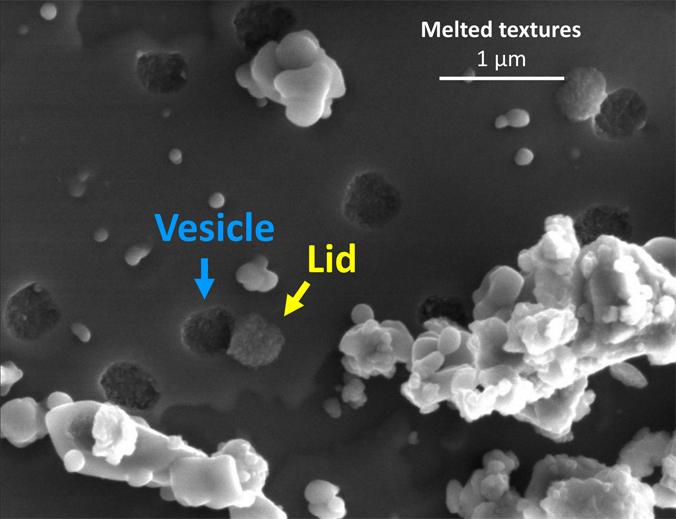
To image these processes and interpret the broader impact on the Moon and other bodies, HIGP’s Hope Ishii and John Bradley used focused ion beam-scanning electron microscopy and transmission electron microscopy in the Advanced Electron Microscopy Center. They observed sub-micrometer-sized surface pits, some partially covered by lids, suggesting that water vapor builds up under the surface in vesicles until they burst, releasing water from lunar silicates upon micrometeorite impact.

“Overall, this study advances our understanding on the origin of water as detected on the Moon and other airless bodies in our Solar System such as Mercury and asteroids and provides, for the first time, a scientifically sound and proven mechanism of water formation,” HIGP’s Jeffrey Gillis-Davis concluded.

###

Media Contact
Ralf I. Kaiser
[email protected]

Related Journal Article

http://dx.doi.org/10.1073/pnas.1819600116

Tags: Chemistry/Physics/Materials SciencesGeophysicsPlanets/MoonsSpace/Planetary Science
Share12Tweet8Share2ShareShareShare2

Related Posts

Miniature Sensor Uses Light to Detect Touch — Chemistry

Miniature Sensor Uses Light to Detect Touch

May 8, 2026
Iron Minerals Determine Whether Dissolved Organic Matter Fuels Microbes or Becomes Long-Term Carbon Storage — Chemistry

Iron Minerals Determine Whether Dissolved Organic Matter Fuels Microbes or Becomes Long-Term Carbon Storage

May 8, 2026

Kate Evans Appointed Associate Lab Director for Biological and Environmental Systems Science at ORNL

May 8, 2026

Advancing Multiscale Modeling and Overcoming Operational Challenges in Autothermal COâ‚‚-to-Methanol Reactors

May 8, 2026
Please login to join discussion

POPULAR NEWS

  • Research Indicates Potential Connection Between Prenatal Medication Exposure and Elevated Autism Risk

    840 shares
    Share 336 Tweet 210
  • New Study Reveals Plants Can Detect the Sound of Rain

    727 shares
    Share 290 Tweet 181
  • Scientists Investigate Possible Connection Between COVID-19 and Increased Lung Cancer Risk

    68 shares
    Share 27 Tweet 17
  • Salmonella Haem Blocks Macrophages, Boosts Infection

    61 shares
    Share 24 Tweet 15

About

We bring you the latest biotechnology news from best research centers and universities around the world. Check our website.

Follow us

Recent News

Evaluating Digoxin Use in Patients with Symptomatic Rheumatic Heart Disease

Evaluating the Effectiveness and Safety of Digitalis Glycosides in Treating Heart Failure

Urdu Fall Risk Questionnaire Adapted for Elderly

Subscribe to Blog via Email

Enter your email address to subscribe to this blog and receive notifications of new posts by email.

Join 82 other subscribers
  • Contact Us

Bioengineer.org © Copyright 2023 All Rights Reserved.

Welcome Back!

Login to your account below

Forgotten Password?

Retrieve your password

Please enter your username or email address to reset your password.

Log In
No Result
View All Result
  • Homepages
    • Home Page 1
    • Home Page 2
  • News
  • National
  • Business
  • Health
  • Lifestyle
  • Science

Bioengineer.org © Copyright 2023 All Rights Reserved.