Researchers in Ethiopia have shown that a modest dose of locally sourced volcanic scoria powder can push mortar past the strength of ordinary cement at later ages, and that pairing scoria with finely ground waste glass helps blended mortars hold up better under sulfate attack. The laboratory study, published in Discover Concrete and Cement, evaluated mortars in which up to 25% of the cement was replaced with scoria powder and up to 30% with glass–scoria powder blends, tracking workability, strength, microstructure and durability from 3 to 90 days of curing.
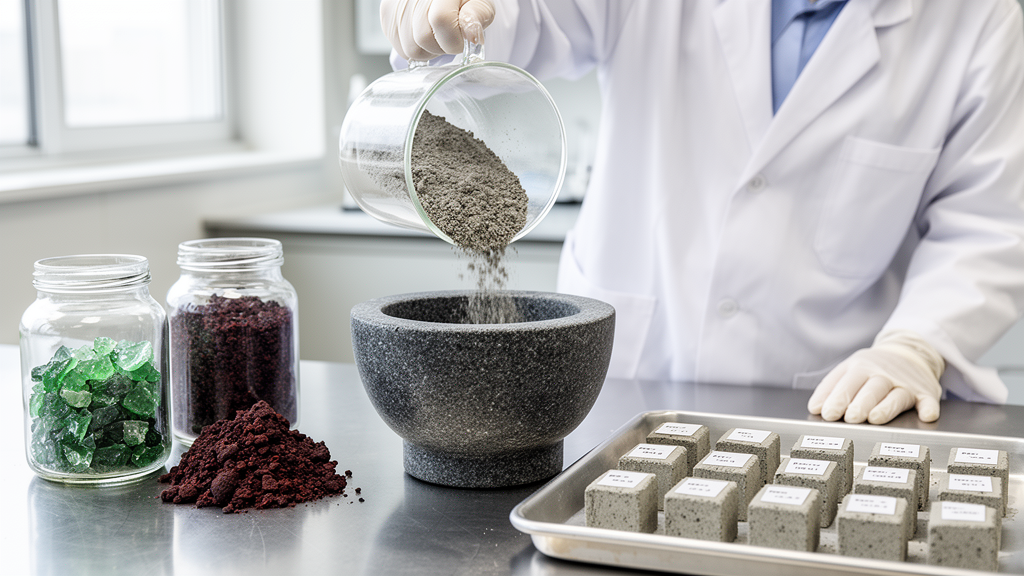
Both supplementary materials were sun-dried and ground in a disk mill until all particles passed a 150-micrometer sieve, with roughly 91–93% finer than 75 micrometers. Measured BET specific surface areas were 283.69 m²/kg for scoria powder, 564.69 m²/kg for waste glass powder, and 415.5 m²/kg for the cement, indicating that the glass powder was the finest of the three binders.
Chemical analysis at the Ethiopian Geological Survey Laboratory confirmed that both powders meet the requirements of ASTM C618 for Class N natural pozzolans. The combined silicon dioxide, aluminum oxide and iron oxide contents were 80.83% for the waste glass powder and 70.02% for the scoria powder, both above the 70% minimum, and the sulfur trioxide, moisture and loss-on-ignition values fell within the standard’s limits.
The fresh properties told a nuanced story. Water demand for standard consistency changed only marginally, rising just 0.7% even at 30% glass–scoria replacement, and both initial and final setting times increased slightly with replacement level, from 75 to 105 minutes and from 315 to 375 minutes respectively, all remaining within ASTM C150 limits. Workability, however, declined steadily as scoria content rose: slump flow fell by 1.3%, 3.37%, 10.37% and 20.27% for the 10%, 15%, 20% and 25% scoria mixes compared with the control, a consequence of the porous, angular scoria particles absorbing free water and increasing internal friction. In the ternary blends, increasing the glass powder proportion reversed this trend, with the smooth glassy particles of the GP75SP25 mix improving flow, and the largest ternary reduction in flow was 16.31% for GP25SP75.
Strength activity index testing at 7 days revealed a clear advantage for the blended systems. The binary mix containing 20% scoria achieved an SAI of 80.1%, exceeding the 75% minimum of ASTM C618, while the ternary mixtures reached 96.9%, an improvement of roughly 21% over the binary scoria mix. The authors attribute this to the highly amorphous nature of the glass powder and its alkali content, which raises the alkalinity of the pore solution and promotes the dissolution of reactive silica from both powders, driving the formation of additional calcium silicate hydrate gel.
Compressive strength followed the pattern expected for pozzolanic systems: slower early, stronger later. At 3 days, the scoria mixes were 9.8% to 32.7% weaker than the control, reflecting cement dilution and the slow early pozzolanic reaction. But as curing progressed, the amorphous silica and alumina in the scoria reacted with calcium hydroxide released during cement hydration, forming secondary C–S–H gel that densified the matrix. The SP10 mix surpassed the control at 28, 56 and 90 days, with strength gains of approximately 5.8%, 12.1% and 12.7% respectively, and SP15 also exceeded the control at those ages. Among the ternary blends, GP75SP25 performed best, achieving strengths comparable to SP20 and approaching the control at 90 days, demonstrating that glass powder can compensate for the slower strength development associated with higher scoria contents.
Microstructural measurements supported these strength trends. Ultrasonic pulse velocity increased with curing age for all mixtures, and at later ages the scoria mixes outperformed the control: after 90 days, SP10 and SP15 reached pulse velocities of 3125.0 and 3119 m/s against 3106 m/s for the control, consistent with pore refinement from additional C–S–H formation. A linear regression across 40 paired mean observations showed a strong relationship between compressive strength and pulse velocity, with a coefficient of determination of 0.90, though the authors caution that the equation is valid only within the tested range. Water absorption declined with curing time for all mixes, and at 90 days the blended systems showed only marginally higher values than the control, ranging from 9.7% to 10.9% for scoria and ternary mixes against 9.6% for the control, with the least workable mixes absorbing slightly more water due to reduced compaction.
Durability testing under sulfate exposure produced one of the study’s most striking results. Specimens immersed in a 5% sodium sulfate solution, renewed every two weeks, showed progressive strength deterioration after 28 days of exposure as expansive ettringite and gypsum formed within the matrix. At 90 days, the control mixture had lost 6% of its compressive strength and SP10 lost 5.2%, whereas the ternary blends GP75SP25 and GP50SP50 lost only 1.9% and 2.3% respectively. The authors attribute this improved retention to the pozzolanic consumption of portlandite, the reduced effective C3A content of the blended binder, and the denser pore structure that limits sulfate ingress.
Thermal and spectroscopic analyses confirmed the underlying chemistry. TGA-DTA showed total weight loss increasing from 7 to 28 days for all representative pastes, reaching 9.5% for SP25 and 8.2% for GP50SP50, while the intensity of the portlandite dehydroxylation peak near 490 °C decreased with increasing scoria content, indicating consumption of calcium hydroxide in pozzolanic reactions. FT-IR spectra revealed shifts in the silicon–oxygen stretching bands toward higher wavenumbers with curing age, from roughly 984–1001 cm⁻¹ at 7 days to 1007–1019 cm⁻¹ at 28 days, signaling progressive silicate polymerization and additional C–S–H development. Interestingly, SP25 and GP50SP50 formed more hydration products than SP15 yet achieved lower compressive strength, suggesting that the quantity of hydration products alone does not guarantee superior mechanical performance, and that reduced workability in these mixes impaired particle dispersion and consolidation, increasing porosity.
The authors conclude that scoria replacement levels of 10–15% offered the most balanced combination of workability, strength development and physical performance, while ternary blends richer in glass powder delivered the best compressive-strength retention under sulfate exposure. They also note the study’s limitations: the findings apply to laboratory-scale mortar specimens under controlled curing conditions, with no concrete-scale validation, and long-term durability aspects such as alkali–silica reaction and drying shrinkage were not investigated, nor were advanced microstructural techniques such as XRD and SEM employed. Future work, they suggest, should examine concrete-scale applications, lower replacement levels and mix-design optimization, including water adjustment or chemical admixtures, to make the most of these locally abundant volcanic and waste materials.
Subject of Research: Binary and ternary blended mortars incorporating waste glass powder and Ethiopian scoria powder as partial cement replacements
Article Title: Mechanical performance, durability, and hydration characteristics of binary and ternary blended mortars incorporating waste glass powder and Ethiopian scoria
Article References: Molla, K. A., Ali, K. S., & Teshome, A. G. (2026). Mechanical performance, durability, and hydration characteristics of binary and ternary blended mortars incorporating waste glass powder and Ethiopian scoria. Discover Concrete and Cement, 2(1), Article 86. https://doi.org/10.1007/s44416-026-00132-x
Image Credits: AI Generated
DOI: 10.1007/s44416-026-00132-x
Keywords: supplementary cementitious materials, scoria powder, waste glass powder, ternary blends, compressive strength, sulfate resistance, water absorption, TGA-DTA, FT-IR, mortar, Ethiopia, sustainable construction
News Source: Denise Maddox. (October 28, 2026). Waste glass and Ethiopian scoria powders strengthen sustainable mortar blends. Scienmag.