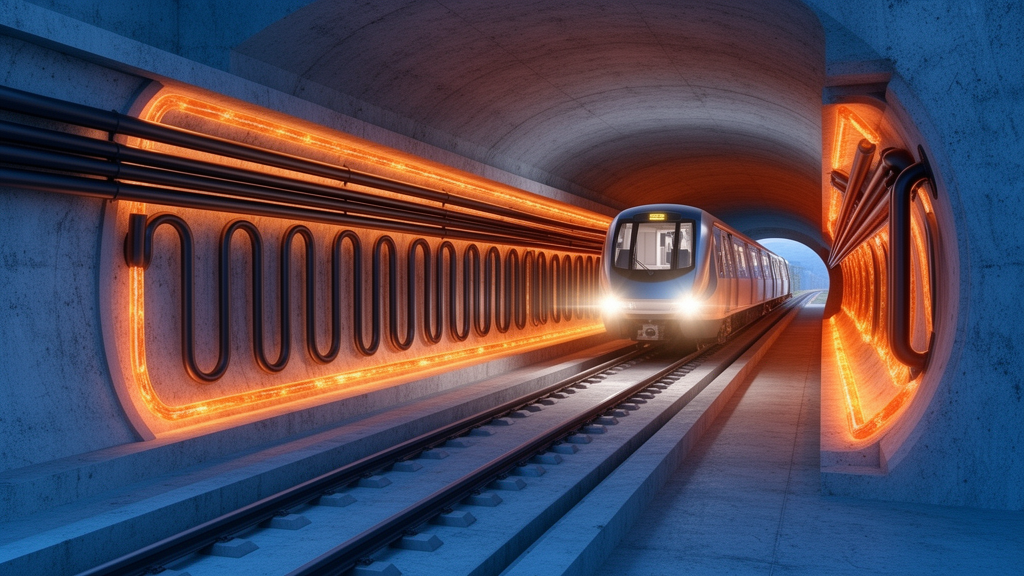
Energy tunnels are an emerging class of sustainable infrastructure that combines structural, geotechnical and energy functions in a single system, according to a Brief Report published in GeoEnergy Communications on 11 March 2026. The technology works by thermally activating tunnel linings, allowing engineers to extract, store and exchange geothermal heat for applications such as urban heating, cooling and infrastructure de-icing.
The report’s authors, Marco Barla and Alessandra Insana, argue that beyond improving energy efficiency, the technology contributes directly to the decarbonisation targets outlined in the European Green Deal. Their summary draws on recent advances and case studies, including the Turin Metro Line 2, the Brenner Base Tunnel and the Lyon–Turin connection, to illustrate how underground transport infrastructure could be transformed into renewable energy assets.
Among the strategic claims highlighted in the report, thermally activated tunnels could reduce CO₂ emissions by up to 60% in urban energy systems, and integrating energy tunnels with district heating networks and underground thermal energy storage (UTES) could unlock year-round, low-carbon urban energy storage. The report also frames energy tunnels as a way of turning transport infrastructure into renewable geothermal power sources for cities.
The Brief Report summarises the principles and design framework of the technology rather than presenting new experimental results. Its scope is strategic: it sets out how existing and planned tunnel projects could serve as case studies for a broader shift in which the linings of underground transport networks double as heat exchangers.
Its central message is that infrastructure already being built for mobility could, with thermal activation of its linings, simultaneously deliver heating, cooling and de-icing services to cities while supporting European decarbonisation goals.
Subject of Research: Thermal activation of tunnel linings to extract and store geothermal heat for sustainable urban energy
Article Title: Energy tunnels for a sustainable future
Article References: Barla, M., & Insana, A. (2026). Energy tunnels for a sustainable future. GeoEnergy Communications, 2(1), Article 4. https://doi.org/10.1007/s44421-026-00016-7
Image Credits: AI Generated
DOI: 10.1007/s44421-026-00016-7
Keywords: energy tunnels, geothermal energy, tunnel linings, thermal activation, district heating, UTES, decarbonisation, European Green Deal, Turin Metro Line 2, Brenner Base Tunnel, Lyon–Turin, sustainable infrastructure
News Source: Faith Mcneil. (October 29, 2026). Energy tunnels turn metro lines into geothermal power plants. Scienmag.