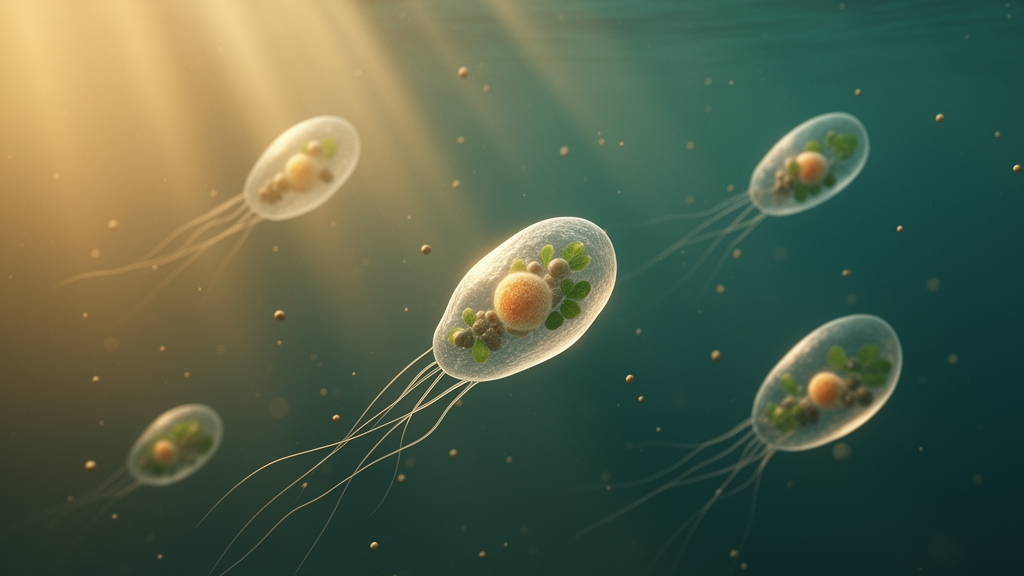
Marine microbes sit at the base of the ocean’s food web, and their fate under climate change has long been studied one stressor at a time. A new open-access study in the journal Microbial Ecology, led by Minerva García-Martínez of the Institut de Ciències del Mar (ICM-CSIC) in Barcelona together with Enric Saiz and Albert Calbet, takes a more realistic approach. The researchers asked what happens when planktonic protists face two pressures at once: chronically elevated or acutely spiked temperatures, and prey whose elemental composition is skewed by nitrogen or phosphorus scarcity. Their answer, published on 9 October 2026, is that the combined effects are anything but simple, and that a protist’s feeding strategy may determine whether it weathers the double blow or falters.
The team worked with three ecologically important single-celled predators: Oxyrrhis marina, a purely heterotrophic dinoflagellate; Karlodinium armiger, a mixotrophic dinoflagellate that can both eat prey and photosynthesize; and Strombidium arenicola, a heterotrophic ciliate. Each was exposed to two thermal scenarios, both three degrees Celsius above control conditions: a chronic warming treatment and an acute heat stress designed to mimic a marine heatwave. In parallel, the protists were fed prey with either balanced, nutrient-replete cellular stoichiometry or imbalanced, nutrient-limited stoichiometry, produced under nitrogen or phosphorus limitation. This factorial design allowed the researchers to disentangle how temperature and food quality interact, rather than merely add up.
The baseline result was deceptively straightforward. When prey were nutrient-replete, physiological rates increased under both warming treatments in all three species, consistent with the expectation that higher temperatures accelerate metabolic processes within thermal tolerance limits. Yet a subtler signal emerged in gross-growth efficiency, the fraction of ingested food converted into new biomass. In the two heterotrophs, this efficiency remained insensitive to temperature, but in the mixotrophic K. armiger it declined under warming. That distinction matters because gross-growth efficiency is a key currency in food-web models: if mixotrophs convert less of what they consume into growth as seas warm, energy transfer through microbial loops could shift in ways models have not anticipated.
Nitrogen limitation produced one of the study’s most counterintuitive findings. Under N-limited diets, both warming treatments generally increased growth rates in all protists while reducing ingestion rates relative to nutrient-replete conditions. In other words, the organisms ate less but grew proportionally better, and gross-growth efficiencies remained similar to or even higher than those measured with balanced diets. The authors interpret this as evidence that protists can partially compensate for poor food quality, extracting what they need from nutritionally diluted prey when temperatures push their metabolism along. For a warming ocean increasingly characterized by altered nutrient regimes, this suggests nitrogen stress alone may not cripple these predators as sharply as feared.
Phosphorus told a harsher story. P limitation reduced growth rates in the heterotrophs under both warming scenarios, with the ciliate S. arenicola suffering the most pronounced declines. The mixotroph K. armiger, by contrast, showed overall performance under phosphorus scarcity that was similar to its performance on nutrient-balanced food. This resilience likely reflects two factors highlighted by the authors: the weaker elemental regulation of dinoflagellates, which allows them to tolerate drift in their own carbon-to-nutrient ratios, and, in the case of K. armiger, its capacity to supplement its diet through photosynthesis when prey fall short. Mixotrophy, often treated as an ecological curiosity, here looks like a functional insurance policy against the worst-case combination of heat and phosphorus-poor food.
Cell size, a trait that cascades through food webs because it governs who can eat whom and how fast materials sink, responded in patterned ways. Under nutrient-replete conditions, cell volume decreased in all species under both warming treatments, echoing the well-documented tendency of plankton to shrink as temperatures rise. Under phosphorus limitation, however, cells were largest in all three protists, although the temperature responses varied among species. Larger, phosphorus-stressed cells may reflect slower division rates that allow biomass to accumulate, or dilution of cellular phosphorus across a bigger volume, a known strategy of weak elemental regulators stretching scarce nutrients.
The stoichiometric measurements sharpened the picture. Under phosphorus limitation, carbon-to-phosphorus and nitrogen-to-phosphorus ratios increased significantly in all species, confirming that P-starved protists become proportionally richer in carbon and nitrogen relative to phosphorus. Crucially, however, the combined effects of temperature and nutrient stress on these ratios differed among the three protists, meaning no single rule can describe how microbial body chemistry will shift as oceans warm and nutrients redistribute. This interspecific variability complicates biogeochemical modeling, because the elemental composition of microzooplankton influences the quality of organic matter recycled back into the water column and ultimately the efficiency of the biological carbon pump.
Synthesizing these threads, the authors conclude that among the species examined, the two dinoflagellates may be more tolerant of combined thermal and nutrient stress than the ciliate S. arenicola. Their greater tolerance may stem from weaker elemental homeostasis, letting them flex their internal chemistry as conditions change, and, for K. armiger specifically, from its mixotrophic capacity, particularly under phosphorus limitation and acute heat stress. The ciliate, apparently a stricter regulator of its own composition, had less slack to absorb the double insult. If such differences hold across broader communities, warming and nutrient stress could quietly reshuffle the dominance hierarchy of the microbial plankton, favoring dinoflagellates over ciliates in future oceans.
The broader implications reach well beyond three laboratory cultures. Protists in the microzooplankton are the principal grazers of phytoplankton in much of the ocean, channeling primary production into higher trophic levels and recycling nutrients in surface waters. Their growth efficiencies, body sizes, and elemental ratios collectively determine how much carbon is respired back to CO2, how much is packaged into sinking particles, and how nutritious the microbial food web is for fish larvae and other consumers. A study like this one shows that those quantities cannot be predicted from temperature alone or food quality alone; the interaction terms are large, species-specific, and sometimes opposite in sign depending on which nutrient is limiting.
There are also methodological lessons for the field. By combining chronic warming with an acute heatwave treatment, the design mirrors the reality of a climate that brings both gradual baseline warming and increasingly frequent extreme events. By manipulating prey stoichiometry independently of temperature, it isolates a variable that most thermal-performance experiments ignore. The work, conducted within the Marine Zooplankton Ecology Laboratory at ICM-CSIC and funded through Spanish national research programs including grants PID2020-118645RB-I00 and PID2023-150548NB-I00, was supported in part by the Severo Ochoa Centre of Excellence accreditation. As marine heatwaves lengthen and stratification tightens nutrient supply in many regions, experiments of this kind offer an early warning of how the ocean’s smallest predators, and the food webs they anchor, may reorganize in the decades ahead.
Subject of Research: Combined effects of temperature and prey nutrient limitation on the physiology of marine heterotrophic and mixotrophic protists
Article Title: Combined Effects of Thermal and Diet-Induced Stressors on the Physiology of Marine Heterotrophic and Mixotrophic Protists
Article References: García-Martínez, M., Saiz, E., & Calbet, A. (2026). Combined Effects of Thermal and Diet-Induced Stressors on the Physiology of Marine Heterotrophic and Mixotrophic Protists. Microbial Ecology. https://doi.org/10.1007/s00248-026-02912-1
Image Credits: AI Generated
DOI: 10.1007/s00248-026-02912-1
Keywords: marine protists, dinoflagellates, ciliates, ocean warming, marine heatwaves, nutrient limitation, stoichiometry, mixotrophy, microzooplankton, gross-growth efficiency, biogeochemical cycles, plankton ecology
News Source: Gavin Prescott. (October 9, 2026). Warming and Nutrient Stress Reshape the Physiology of Marine Protists. Scienmag.