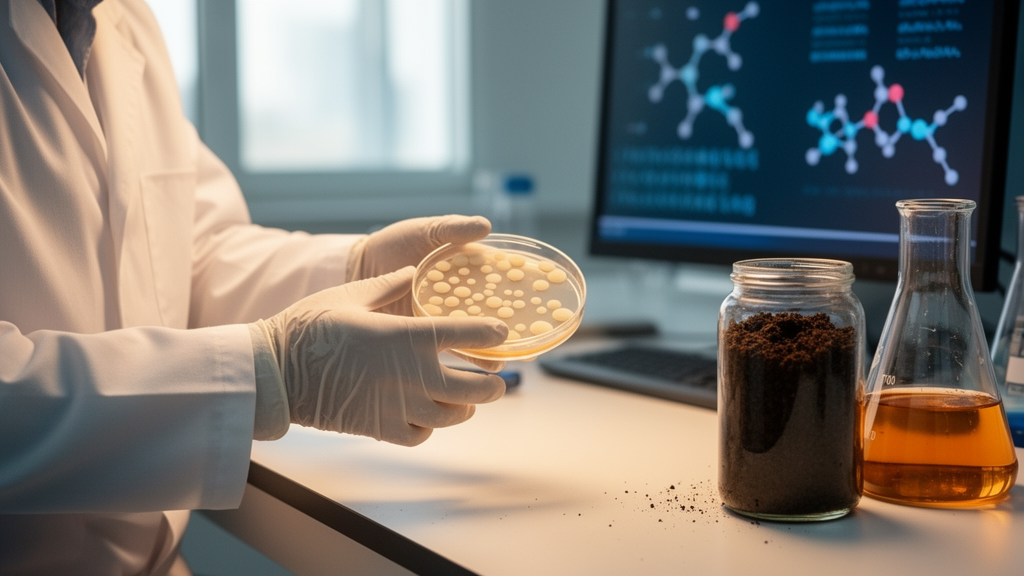
Soil is one of the most densely populated habitats on Earth, and the bacteria living inside it remain a largely unmapped reservoir of taxonomic and functional diversity. A research team based at C. V. Raman Global University in Bhubaneswar, together with a colleague from the Regional Institute of Biotechnology, has now published an unusually layered characterization of Bacillus bacteria recovered from three ecologically distinct regions of India. The study, published in Molecular Biology Reports, combines classical microbiology, DNA sequencing, evolutionary analysis and computational thermodynamics into a single portrait of eight bacterial isolates, three of which were characterized in depth as AMU-UP-1, AMU-K-1 and AMU-MY-1. The work illustrates both the promise and the limits of modern microbial identification when closely related species sit just below the resolution of the standard barcode gene.
The team began where microbiology has always begun: with morphology and biochemistry. All three representative isolates proved to be Gram-positive, catalase-positive and Voges-Proskauer-positive, a classic Bacillus signature that reflects a thick peptidoglycan cell wall, the ability to decompose hydrogen peroxide, and the capacity to ferment sugars into acetoin and related neutral products. Yet the tests were not merely confirmatory. The Methyl Red test, which detects stable mixed-acid fermentation, separated AMU-K-1 from AMU-UP-1 and AMU-MY-1, revealing genuine metabolic heterogeneity among bacteria that looked superficially alike. This kind of phenotypic split matters for anyone hoping to deploy soil bacilli in agriculture, because fermentation end products such as acetoin and 2,3-butanediol are directly relevant to industrial bioprocesses and to plant-microbe signaling in the rhizosphere.
Antimicrobial susceptibility testing added a second layer of differentiation. In agar well diffusion assays, the isolates produced clear inhibition zones against tetracycline, amoxicillin and azithromycin, indicating susceptibility to three clinically important antibiotic classes. But when the researchers moved to broth microdilution, a quantitative method that determines minimum inhibitory concentrations rather than relying on visible zones, they found substantial variability in resistance profiles between isolates. The discrepancy is a useful caution for the field: diffusion-based assays can be influenced by diffusion rates, growth conditions and inoculum density, and the authors’ decision to pair them with microdilution follows current best practice in antimicrobial susceptibility testing. For soil-derived bacteria intended as plant growth promoters or biocontrol agents, antibiotic resistance profiles are not an academic detail, since resistance genes carried by beneficial strains can potentially spread to pathogens in the environment.
The molecular core of the study rests on the 16S rRNA gene, the workhorse of bacterial taxonomy. The researchers amplified roughly 1,500-base-pair fragments of the gene and obtained high-quality Sanger sequencing reads of 1,048 bases for AMU-K-1 and 1,102 bases for AMU-UP-1. BLAST searches against public databases identified AMU-K-1 as closely related to Bacillus safensis, a species originally isolated from spacecraft cleanrooms but now recognized in soils worldwide. AMU-UP-1, however, presented a familiar taxonomic headache: its sequence showed 100 percent identity to multiple closely related taxa within the Bacillus subtilis and Bacillus velezensis species complex. The 16S rRNA gene, for all its utility, simply evolves too slowly in this clade to separate species that diverged recently, and the authors were candid that unambiguous species-level resolution was not possible from this gene alone.
To place the isolates in an evolutionary framework, the team reconstructed phylogenetic trees using the Tamura 3-parameter model with invariant sites, a substitution model designed for sequences with strong transition-transversion bias and skewed guanine-cytosine content. The resulting trees confirmed that both isolates fall within well-supported Bacillus lineages. Nucleotide substitution analysis across more than 1,300 aligned positions revealed a pronounced excess of transitions over transversions, meaning that purine-to-purine and pyrimidine-to-pyrimidine changes dominate the mutational landscape of these ribosomal sequences. That pattern is expected in conserved RNA-coding genes, where structural constraints penalize the more disruptive transversions, but quantifying it provides a baseline for future comparative work on Indian soil bacilli and reinforces the choice of the T92+I model for this dataset.
The most distinctive element of the study is its thermodynamic treatment of the 16S rRNA molecule itself. Using RNA secondary structure prediction tools, the researchers computed minimum free energy structures for the sequenced regions. AMU-K-1 yielded a minimum free energy of minus 530.80 kilocalories per mole, while AMU-UP-1 yielded minus 523.80 kilocalories per mole, both indicating highly stable ribosomal conformations. More intriguing was the ensemble diversity, a measure of how many alternative folding states a sequence can adopt at equilibrium: AMU-K-1 scored 357.82 against 151.53 for AMU-UP-1, suggesting that the ribosomal RNA of the B. safensis-like isolate explores a much broader conformational space in silico. The authors are appropriately careful here, noting that whether such computational differences translate into physiological adaptability requires direct experimental verification. Still, the approach hints at a future in which the folding energetics of housekeeping genes become part of the standard characterization toolkit.
Why does this matter beyond taxonomy? Bacillus species are among the most commercially important bacteria in agriculture. Bacillus velezensis in particular has emerged as a model plant-associated beneficial bacterium, producing lipopeptides that suppress fungal pathogens and colonizing roots in ways that enhance nutrient uptake. Bacillus safensis and related strains have been associated with drought tolerance in crops such as sugarcane, and Bacillus-based inoculants are central to the push for sustainable crop protection. Accurate identification is the precondition for all of these applications, because a mislabeled strain can carry unwanted traits, including antibiotic resistance determinants or pathogenicity factors, into field deployments. The Indian isolates, deposited in NCBI GenBank under accession numbers PZ619164 and PZ619172, now form a verified reference resource for such efforts.
The study also sits within a broader methodological debate. Full-length 16S rRNA sequencing, including nanopore-based approaches, has been shown to achieve species-level resolution in some bacterial groups, and whole-genome comparisons are increasingly regarded as the gold standard for distinguishing members of the B. subtilis complex. By combining phenotypic, biochemical, phylogenetic and thermodynamic evidence, the authors demonstrate a pragmatic middle path for laboratories without routine access to genome sequencing: extract the maximum information from a single locus, quantify its evolutionary dynamics, and treat computational predictions as hypotheses to be tested rather than conclusions. The explicit caveat that in silico ensemble diversity does not equal physiological flexibility is a model of how such integrative papers should be written.
For India specifically, the work contributes to a growing catalog of regionally characterized soil bacilli, joining earlier studies of Bacillus subtilis and Priestia megaterium from eastern Indian farmlands and Bacillus licheniformis and Bacillus cereus from sorghum rhizospheres. Soil biodiversity is under pressure from land-use change and a warming climate, and documenting native microbial diversity before it erodes has become a quiet urgency in environmental microbiology. Each verified isolate with published sequences, biochemical profiles and susceptibility data is a permanent, reusable asset for bioprospecting, whether the target is a biocontrol agent, a bioremediation workhorse or an industrial enzyme producer.
The eight isolates characterized here are unlikely to be the last word on Indian soil Bacillus, and the authors themselves frame the study as a foundation for future exploitation in plant growth promotion, biological control, environmental bioremediation and microbial biotechnology. What the paper ultimately delivers is a template: a demonstration that old-fashioned petri dish biochemistry, when fused with careful sequencing, model-based phylogenetics and even RNA folding thermodynamics, can still generate new knowledge about the organisms beneath our feet. As the search for sustainable alternatives to chemical fertilizers and pesticides accelerates, the humble soil isolate, rigorously identified and honestly annotated, remains one of biotechnology’s most valuable raw materials.
Subject of Research: Integrated phenotypic, molecular, phylogenetic and thermodynamic characterization of soil Bacillus isolates from India
Article Title: Integrated morpho-biochemical, molecular, phylogenetic, and thermodynamic characterization of Bacillus isolates from ecologically distinct Indian soils
Article References: Mohanty, A., Sahoo, J. P., Mohapatra, A., Samal, P. P., Sahoo, L., Mahapatra, S. S., & Hossain, S. N. (2026). Integrated morpho-biochemical, molecular, phylogenetic, and thermodynamic characterization of Bacillus isolates from ecologically distinct Indian soils. Molecular Biology Reports, 53(1), Article 1692. https://doi.org/10.1007/s11033-026-12911-7
Image Credits: AI Generated
DOI: 10.1007/s11033-026-12911-7
Keywords: Bacillus, soil microbiology, 16S rRNA, phylogenetics, Bacillus subtilis, Bacillus velezensis, Bacillus safensis, antimicrobial susceptibility, RNA secondary structure, plant growth promotion, India, Sanger sequencing
News Source: Juliet Wilcox. (October 9, 2026). Hidden Soil Bacillus From India Revealed by Genes, Chemistry and RNA Folding. Scienmag.