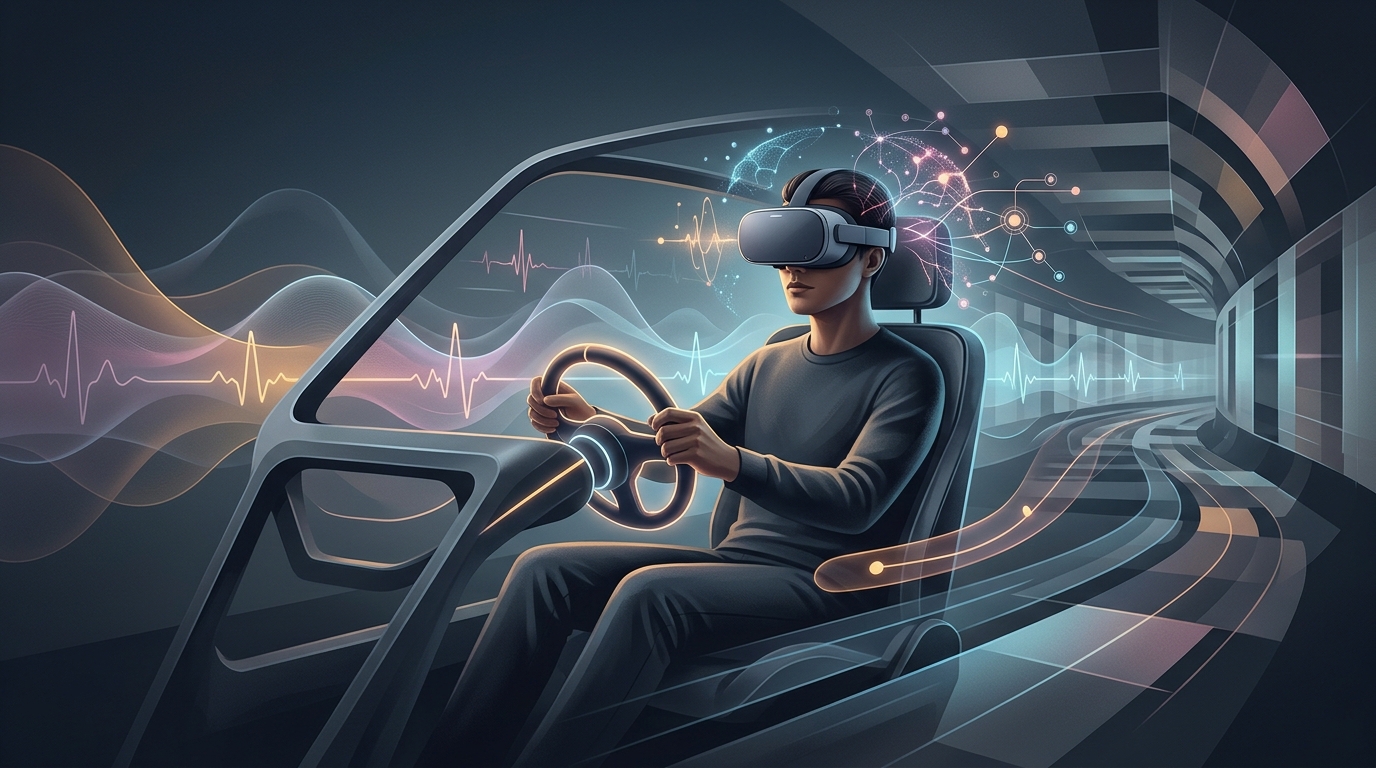
Cybersickness remains one of the most persistent obstacles to the widespread adoption of immersive virtual reality, producing symptoms such as nausea, dizziness, and eye strain that can strike users during even brief sessions. A new resource aims to change that: a multimodal dataset collected during an immersive VR driving simulation, designed specifically to study cybersickness in relation to stress and mental workload.
The dataset draws on sixty participants who completed a phase-based driving task inside a virtual reality environment. Every participant first worked through the same three initial driving phases, each one progressively more difficult than the last. After those shared phases came a final phase that differed from person to person. Depending on their assigned condition, participants faced a final phase engineered to elicit mental workload, stress, or a combination of both cognitive states, with twenty participants assigned to each of the three conditions.
What sets the resource apart is the breadth of measurement. Throughout the experiment, self-report questionnaires were administered directly in virtual reality at several time points, assessing cybersickness, mental workload, and stress-related symptoms. In parallel, physiological and behavioral data were recorded continuously using an instrumented VR headset and wearable sensors.
It includes electroencephalography, which tracks electrical activity in the brain; cardiovascular signals, which reflect the activity of the heart and circulatory system; respiration measurements; and head movement data.
To demonstrate that the data can support meaningful analysis, the researchers conducted representative analyses of both the subjective and objective measures. These validation analyses showed changes in cybersickness symptoms across the different driving phases and across the experimental conditions. In other words, the dataset already illustrates its potential to examine how sickness symptoms evolve as task difficulty increases and as the cognitive demands of the final phase differ between participants.
The work was carried out by a team spanning several Canadian institutions. Abhishek Tiwari and Marc-Antoine Moinnereau of the Institut national de la recherche scientifique Centre energie Materiaux Telecommunications in Varennes led the effort, working alongside Danielle Benesch of Thales – CortAIx Labs in Montreal, Nicole Bolt of the University of Saskatchewan, Gregory Kratzig of the University of Regina, Simon Pare of Public Safety Canada, and Tiago Henrique Falk, also of the Institut national de la recherche scientifique.
The dataset is intended as a foundation for neuroergonomics research, a field that studies the brain and body at work. By integrating self-reported symptoms with physiological and behavioral measurements, the resource supports future investigations into the relationships between cybersickness, stress, and mental workload.
For the broader VR research community, the value lies in the combination of design and instrumentation. The phase-based structure with progressively increasing difficulty creates a natural gradient against which symptom changes can be tracked, while the three-condition final phase isolates the effects of mental workload, stress, and their combination.
The dataset and its validation analyses are described in Frontiers in Neuroergonomics, in an article presenting the collection as a resource for studying cybersickness under stress and mental workload during immersive VR driving.
Subject of Research: A multimodal dataset for studying cybersickness in relation to stress and mental workload during immersive virtual reality driving
Article Title: A multimodal dataset for the study of cybersickness under stress and mental workload during immersive VR driving
Article References: Tiwari, A., Moinnereau, M.-A., Benesch, D., Bolt, N., Krätzig, G., Paré, S., & Falk, T. H. (2026). A multimodal dataset for the study of cybersickness under stress and mental workload during immersive VR driving. Frontiers in Neuroergonomics, 7, Article 1953568. https://doi.org/10.3389/fnrgo.2026.1953568
Image Credits: AI Generated
DOI: 10.3389/fnrgo.2026.1953568
Keywords: cybersickness, virtual reality, VR driving simulation, mental workload, stress, EEG, physiological signals, multimodal dataset, neuroergonomics, driving simulator, head movement, wearable sensors
News Source: Ophelia Keating. (November 4, 2026). VR Driving Simulator Dataset Captures Cybersickness Alongside Stress and Mental Workload. Scienmag.