Credit: Seung-Ki Min (POSTECH)
Climate change is occurring all over the globe as 1°C increase in Earth’s temperature has led to the rise in the sea level, melting of the Arctic ice, and unseasonable heat waves and heavy snow. To accurately predict the artificial climate changes set off by the increase in greenhouse gases, it is important to understand the effects of natural factors such as solar and volcanic activities. A recent study has shown how global precipitation decreases when volcanoes erupt in the tropics.
Professor Seung-Ki Min and Dr. Seungmok Paik of department of environmental engineering at POSTECH and researchers from the French National Centre for Scientific Research, Zurich Institute of Technology, and Edinburgh University have released new findings that the El Niño induced by volcanic eruptions plays a key role in the decrease in global precipitation. So far, studies have shown that volcanic activity reduces precipitation across the globe, but its specific mechanism had been unclear. These research results were recently published in Science Advances, a sister journal of Science.
For the two to three years following Mount Pinatubo’s volcanic eruption in 1991, the average global temperature fell by about 0.2 degrees. This is because the massive dust and greenhouse gases emitted by the eruption reflected the light from the sun and blocked its heat from reaching the Earth. Volcanic activities, along with these cooling effects, reduce the global terrestrial precipitation but its scale greatly varies depending on each climate model simulation. For the first time, the joint research team confirmed that the main factor for the drop in precipitation after these volcanic eruptions is the difference in El Niño’s response.
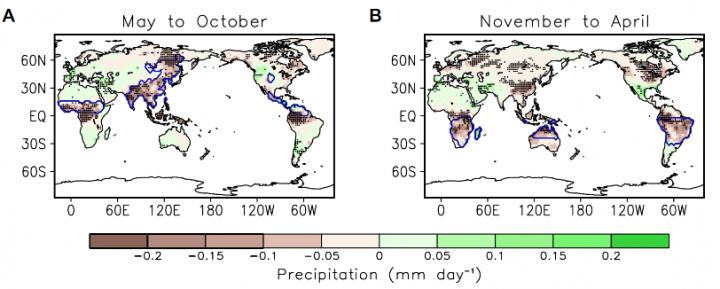
El Niño is a severe climate change that occurs every three to eight years, weakening trade winds in the equatorial Pacific Ocean and raising sea level temperatures in the East Pacific, causing extreme weather conditions across the globe including drought and heavy rains. Under El Niño’s influence, precipitation reduction occurs especially in the global monsoon regions, including Southeast Asia, India, South Africa, Australia and Latin America.
The team compared several climate model simulations and found that El Niño appeared in the year following a volcanic eruption in most models, with a significant drop in precipitation around the global monsoon region. In particular, the strength of El Niño was different for each simulation, and the stronger the El Niño, the more pronounced the reduction in precipitation occurred. The research team also found that the stronger the volcanic forcing and the greater the water temperature in the western Pacific Ocean, a stronger El Niño developed, which in turn intensified the reduction in precipitation.
These findings are expected to be used to identify the side effects of geoengineering techniques or to predict the climate of the later years. In particular, it suggests that if geoengineering techniques are used to reduce global warming by spraying sulfur dioxide – the main component of volcanic ash – in the lower stratosphere to imitate artificial volcanoes, they could produce unexpected side effect of changing the precipitation patterns across the globe.
Professor Seung-Ki Min stated, “If geoengineering techniques are applied to mimic volcanoes and block sunlight, drought and water shortages may increase significantly in the monsoon regions – home to two-thirds of the world’s population.”
###
This research was supported by the Mid-career Researcher Program of the National Research Foundation of Korea.
Media Contact
Jinyoung Huh
[email protected]
Original Source
http://www.
Related Journal Article
http://dx.