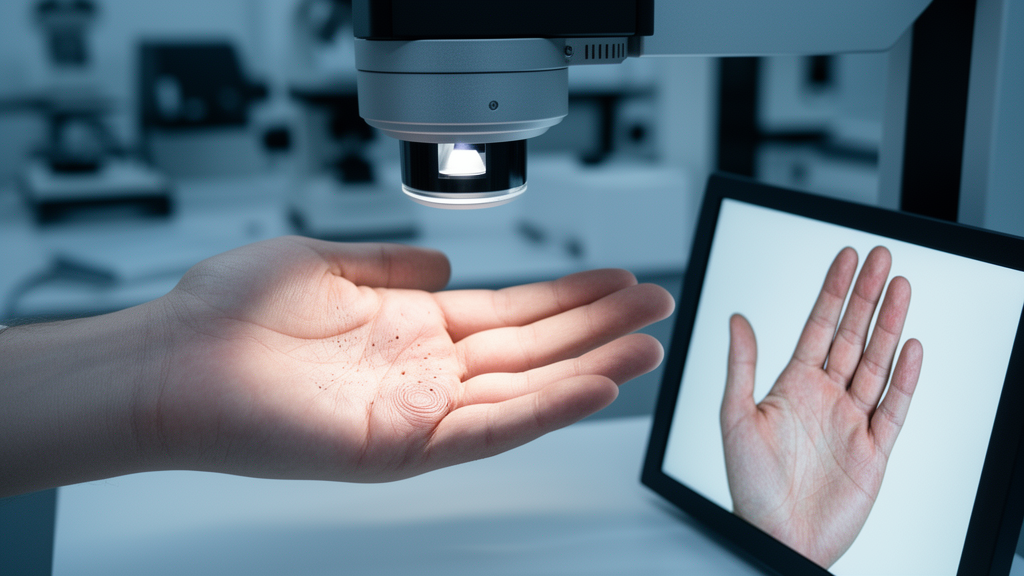
A computational pipeline combining CLAHE, Gabor filtering and a custom Vision Transformer outperformed five comparison methods for enhancing palmprint images, according to a study in Scientific Reports. The evaluation used 100 original grayscale palmprint images measuring 512 × 512 pixels. Across the tested set, the proposed method achieved an average mean squared error of 440.24, a peak signal-to-noise ratio of 22.01 dB, a structural similarity index of 0.8481 and a multiscale structural similarity index of 0.8211.
The researchers developed the pipeline to address image-capture conditions that can reduce the quality of palmprint data, including non-uniform illumination, low contrast and discontinuities in the print’s ridges. These variations can make palmprints harder to process for biometric identification. The study integrated image enhancement with deep feature representation rather than treating enhancement and feature extraction as separate tasks, with the aim of producing images that retain local contrast and texture while providing a more discriminative input to the feature-extraction stage.
Processing begins with Contrast Limited Adaptive Histogram Equalization, or CLAHE. In the proposed pipeline, this stage boosts local contrast while limiting noise amplification. Multi-orientation Gabor filtering is then applied to the CLAHE output, where it is used to enhance ridge and texture structures.
The filtered outputs are combined with a weighted superposition method to form the final enhanced image. According to the researchers, the fusion is designed to balance contrast fidelity with texture preservation, retaining information associated with the fine patterns visible in palmprints. A custom Vision Transformer performs the deep feature-extraction stage on the enhanced palmprints.
Its multi-head self-attention captures both fine-grained texture details and longer-range associations among pixel positions. These capabilities allow the model to represent the processed palmprint globally rather than relying only on the local responses emphasized by the enhancement stages. The proposed system was evaluated as an integrated CLAHE–Gabor–Vision Transformer pipeline against five benchmark enhancement methods: Fuzzy Enhancement, Gamma Correction, a Homomorphic Method, Multi-Scale Retinex with Color Restoration and a traditional baseline method.
The combined approach produced the strongest reported average results among the methods tested. Relative to the best-performing alternative, the proposed pipeline reduced average mean squared error by 78.6% and increased average peak signal-to-noise ratio by 38.2%. It also recorded average structural similarity and multiscale structural similarity values of 0.8481 and 0.8211, respectively.
These measurements were reported alongside the 440.24 mean squared error and 22.01 dB peak signal-to-noise ratio, providing the study’s principal quantitative assessment of image enhancement performance. The technique is aimed at making useful feature representations possible from images affected by uneven lighting, weak contrast or interrupted ridges, while the Gabor and transformer components respectively target visible ridge structure and broader relationships within the processed image. The result is a pipeline whose reported gains were observed against the specific comparison methods and dataset used in the study.
The evaluation was limited in scope to 100 original grayscale palmprint images at 512 × 512 pixels. The reported results therefore describe a small computational experiment and do not, by themselves, establish improved identification accuracy or performance in operational biometric systems. The article’s shared version is identified as peer-reviewed, accepted and citable research, with further edits possible before replacement by the final Version of Record.
Its central measured finding is that the integrated enhancement-and-feature-extraction pipeline outperformed all five tested alternatives on the study’s image-quality evaluation.
Subject of Research: Computational enhancement and deep feature extraction for palmprint biometrics
Article Title: A CLAHE–Gabor–vision transformer pipeline for palmprint image enhancement and deep feature extraction
Article References: Kaliaperumal, R., & Anandan, S. (2026). A CLAHE–Gabor–vision transformer pipeline for palmprint image enhancement and deep feature extraction. Scientific Reports. https://doi.org/10.1038/s41598-026-74200-4
Image Credits: AI Generated
DOI: 10.1038/s41598-026-74200-4
Keywords: palmprint recognition, palmprint enhancement, Vision Transformer, CLAHE, Gabor filtering, deep features, biometrics, image quality, computational imaging, self-attention, Gabor, vision
News Source: Denise Maddox. (October 26, 2026). Vision Transformer pipeline improves palmprint images in 100-image study. Scienmag.