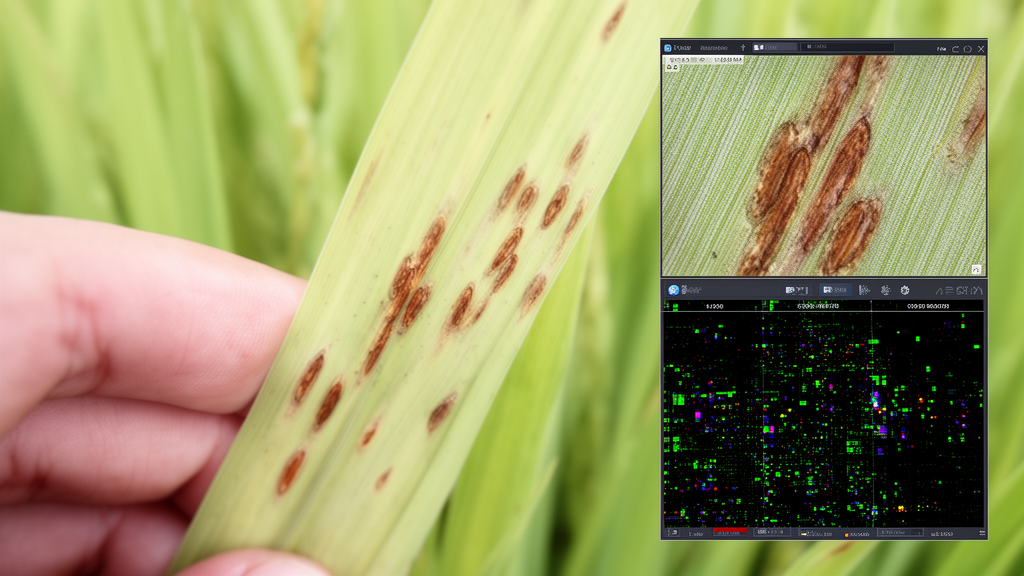
A deep-learning system that combines visual features from several levels of a convolutional neural network achieved about 93% accuracy in classifying rice blast disease as mild, moderate or severe, according to a study of 400 annotated leaf images. The model also included a regression output for estimating the proportion of leaf area affected by lesions, extending image analysis beyond simple disease detection. Its best validation accuracy was approximately 92%, and the reported area under the receiver operating characteristic curve was slightly above 0.88. The authors describe the results as evidence that multi-scale feature fusion can make automated severity assessment more consistent than single-scale convolutional models, while also identifying important limits on the evidence.
Rice blast is caused by the fungus Magnaporthe oryzae and can produce lesions on leaves, stems and panicles. The study focuses specifically on visible damage in leaf photographs, rather than predicting crop yield or the effectiveness of a treatment. Conventional assessment is generally performed by specialists and depends on visual judgment, making it time-consuming and vulnerable to differences among observers. The severity labels in this work were assigned from the estimated percentage of visible leaf area occupied by blast lesions: mild cases covered 0–10%, moderate cases covered more than 10% up to 30%, and severe cases exceeded 30%. Two agronomists independently examined lesion size, density, distribution, coalescence and the estimated affected area, then reached consensus when their initial judgments differed.
The images came from the public “Severity Based Rice Leaf Diseases Dataset” hosted on Kaggle. That repository contains 5,932 images covering bacterial blight, blast, brown spot and tungro, including 1,440 slides labeled for rice blast. The researchers selected 400 blast images after excluding duplicates and images described as extremely blurred, underexposed or highly occluded. The final collection comprised 120 mild, 150 moderate and 130 severe examples. Each image was converted to RGB and resized to 224 by 224 pixels. The repository does not provide the geographic origin or collection site of the photographs, so the study could not evaluate how well the dataset represents the diversity of rice varieties, growing environments and field conditions encountered elsewhere.
The proposed architecture begins with a convolutional neural network backbone organized into four hierarchical stages containing 64, 128, 256 and 512 filters. Two 3-by-3 convolution layers, each with batch normalization and a rectified linear activation, form the convolutional blocks. Feature maps are taken from the shallow, intermediate, deep and deepest stages, designated F1 through F4. Shallow maps retain edges, textures and fine lesion boundaries, whereas deeper maps contain more abstract information about large infected areas, lesion merging and the overall distribution of disease across a leaf. This hierarchy is central to the approach: an early infection may consist of small, scattered spots, while advanced disease can produce irregular, overlapping lesions covering much of the leaf.
Because the four feature maps have different spatial dimensions, the model resizes them to a common resolution through upsampling or downsampling. The aligned maps are then concatenated and passed through a 1-by-1 convolution, batch normalization and another rectified linear activation. This creates a consolidated representation of lesion size, shape, distribution and intensity without constructing a separate prediction at every feature level. Global average pooling converts the fused maps into a compact vector, which is supplied to two output heads. A softmax head assigns one of three severity classes, while a sigmoid regression head estimates infected leaf area within the range of zero to one. During development, the classification branch can be trained with categorical cross-entropy and the regression branch with mean squared error.
The model was trained for as many as 100 epochs with the Adam optimizer, an initial learning rate of 0.001 and a batch size of 32. The lowest-validation-loss checkpoint was retained, while early stopping with a patience of 15 epochs was used to limit unnecessary computation and reduce overfitting. At the best checkpoint, training accuracy was about 95% and validation accuracy about 92%, with losses of approximately 0.20 and 0.30, respectively. The study’s learning-rate experiment showed slower convergence at 0.0001, where loss remained around 1.0. Loss fell to about 0.4 at a learning rate of 0.005 and to roughly 0.2 at 0.01, although the authors note that very high rates can introduce instability. They therefore used 0.001 as a compromise between convergence and stability.
On the reported test-set confusion matrix, the system correctly classified 129 of 150 images, giving an overall accuracy of about 86%. It correctly identified 45 of 50 mild samples, 40 of 50 moderate samples and 44 of 50 severe samples. Most errors occurred among moderate cases, which were confused with mild or severe disease, consistent with the intermediate class having less sharply separated visual characteristics. Class-level results were stronger in other measures: the mild class had precision of 0.90, recall of 0.91 and an F1 score of about 0.905; the moderate class had precision of 0.88, recall of 0.85 and F1 of 0.865; and the severe class reached precision of 0.92, recall of 0.93 and F1 of 0.925. The text also summarizes the ROC curve as showing an AUC of roughly 0.85–0.90.
For infected-area regression, the predicted and actual percentages were plotted close to the ideal diagonal line, with deviations of about 5% reported around the principal relationship. For example, the model predicted 52–55% infected area for an actual value of 50%, and 75–85% for an actual value of 80%. These are reported performance results from the selected dataset, not evidence that the method will produce similarly precise estimates in every field setting. The framework was also compared with single-scale ResNet and MobileNet baselines, reported at about 88% and 86% accuracy, respectively, while the multi-scale model reached about 93%. The reported advantage therefore came from the fusion strategy as well as the convolutional backbone, and the authors did not interpret the difference as proof that a new crop-management intervention was clinically or agronomically effective.
An ablation study examined the contribution of each feature level under the same data partitions, preprocessing, augmentation, optimizer, learning rate, batch size and training schedule. The shallow F1 model achieved 84.50% accuracy, rising to 86.75% with intermediate F2 features and 88.25% with deep F3 features. Using only the deepest F4 stage produced 87.50%, which the authors attributed to the possibility that substantial spatial reduction can obscure small lesions. Combining F1 and F2 raised accuracy to 89.00%, and adding F3 increased it to 91.25%. Fusing all four maps produced the highest reported accuracy of 93.00% and an F1 score of 92.96%. Feature-importance analysis attributed about 20 units to F1, 30 to F2 and roughly 25 each to F3 and F4, suggesting that every scale contributed useful information. The authors also report repeated five-fold stratified cross-validation and paired statistical comparisons using Friedman and Wilcoxon tests with Holm–Bonferroni correction.
Several limitations prevent the reported accuracy from being interpreted as a field-ready performance estimate. The dataset is small relative to the full public repository and lacks documented geographic origins. The source images were also curated to exclude the poorest-quality examples, which may make conditions easier than those encountered in routine monitoring. Extreme illumination, heavy occlusion and complicated backgrounds could reduce robustness, while mixed infections or very early symptoms may not present clearly enough for image-based assessment. The model uses visible RGB information only and does not incorporate hyperspectral measurements, environmental variables or disease development over time. Multi-scale fusion also adds computational complexity, and the study did not test real-time operation on smartphones, drones or low-resource edge devices. Inter-rater agreement also could not be calculated because the original independent annotations were unavailable. The results therefore support further multi-location and field evaluation, alongside lighter fusion models, explainable lesion visualization and deployment on production systems.
Subject of Research: Evaluation of a multi-scale deep-learning framework for assessing rice blast severity from leaf images
Article Title: Multi scale feature fusion method for assessing the degree of damage caused by rice blast disease
Article References: Yu, Y., Liu, H., Wu, H., Gao, D., Yan, P., Yu, M., & Xu, Z. (2026). Multi scale feature fusion method for assessing the degree of damage caused by rice blast disease. Discover Artificial Intelligence, 6(1), Article 1171. https://doi.org/10.1007/s44163-026-02272-2
Image Credits: AI Generated
DOI: 10.1007/s44163-026-02272-2
Keywords: rice blast, deep learning, multi-scale feature fusion, plant disease, severity classification, leaf area regression, convolutional neural network, precision agriculture, image analysis, crop disease, Multi, scale
News Source: Alan Morgan. (October 26, 2026). Multi-scale AI model improves rice blast severity assessment. Scienmag.