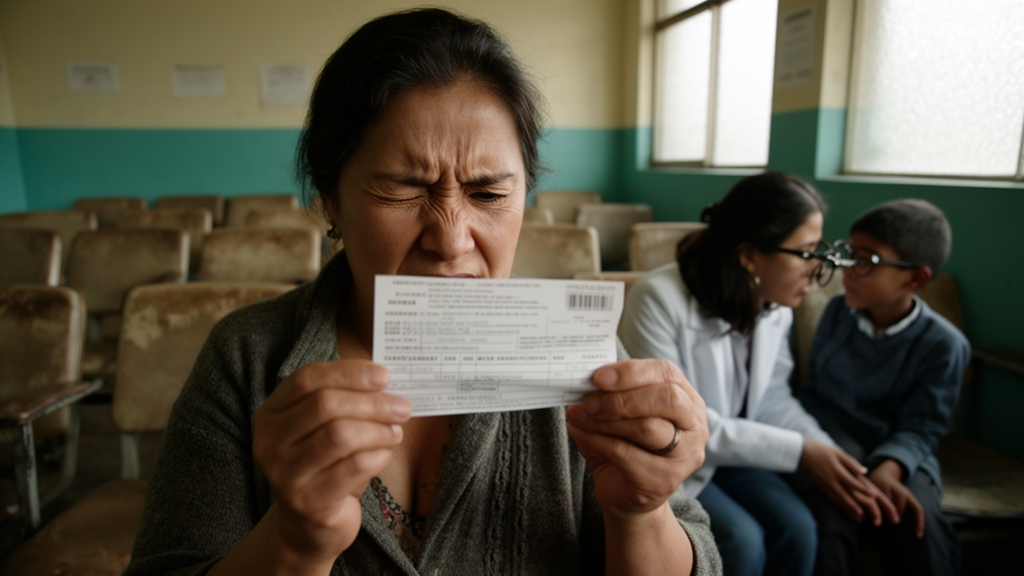
Visual impairment is one of the most common and most preventable forms of disability in the United States, and yet millions of Americans cannot obtain even basic eye care. A new scoping review published in Frontiers in Public Health by researchers at the College of William & Mary has systematically mapped the evidence on income-related and structural barriers to eye care access, and the picture it paints is stark. Despite the availability of effective screening, corrective lenses, and surgical procedures, people with lower household income consistently experience worse vision outcomes, less preventive care, and greater reliance on emergency services than their wealthier counterparts.
The review, conducted by Alexandra K. Lersten and Carrie B. Dolan, followed the Arksey and O’Malley methodological framework and the PRISMA-ScR reporting guidelines. The team searched PubMed, Scopus, CINAHL, and Google Scholar for studies published between 2001 and 2025, ultimately including 19 sources: 17 identified through database searches and two grey literature sources providing policy and health-system context. Because the search deliberately restricted keywords to article titles to keep the screening workload manageable and reproducible, the authors caution that the findings represent a mapping of a high-specificity evidence base rather than an exhaustive inventory of all relevant research.
The scale of the problem is documented across multiple national data sources. An analysis of the 2002–2008 National Health Interview Survey found persistent socioeconomic disparities in eye care accessibility and usage. In 2017, nine percent of people who reported needing glasses also said they could not afford them. Data from the National Health and Nutrition Examination Survey showed that households earning more than $75,000 had lower odds of visual impairment, and children in families below the federal poverty line were twice as likely to have visual impairment as children in families earning at least 200 percent of that threshold.
Financial barriers extend well beyond household income into the architecture of insurance coverage itself. In many states, Medicaid treats eye care as an auxiliary benefit rather than an essential health service. More than six million Medicaid enrollees live in states that lack comprehensive vision exam coverage, and more than 14 million live in states without coverage for eyeglasses. Even where coverage exists on paper, practical access can falter: one study found that obtaining an eye care appointment was more difficult for patients with Medicaid than for those with private insurance, a disparity the authors link to reimbursement levels and provider participation.
The health care safety net shows similar cracks. Federally qualified health centers, or FQHCs, are often the only accessible entry point to care for uninsured and low-income patients—nearly seven in ten FQHC patients have incomes at or below the federal poverty level—yet 69 percent of these centers do not provide on-site comprehensive eye exams. The consequences ripple outward. Research on emergency department visits suggests that lack of insurance coverage is associated with emergent eye-related cases, and that improving access to ophthalmologic care in uninsured communities could reduce the progression of untreated chronic eye disease into costly emergency visits.
Informational and geographic barriers compound the financial ones. A 2014 nationwide online poll of 2,044 U.S. adults found that 25 percent were unfamiliar with any eye conditions, 37.3 percent had never heard of diabetic retinopathy, and half did not know macular degeneration existed. Among patients with glaucoma, low health literacy has been linked to missed appointments and lower medication use. Geography matters too: an analysis of 2012 Medicare data found that rural cataract patients traveled significantly farther for ophthalmic care than their urban and suburban counterparts, reflecting an uneven distribution of providers that persists across the country.
The stakes of these barriers extend far beyond eyesight itself. Visual impairment has been associated with depression, lost productivity, injuries, and premature death, and vision loss and socioeconomic disadvantage are tightly intertwined—people with visual impairment are more than twice as likely to rely on Medicaid as those without it. Delayed care also means later detection of disease: observational studies report a higher prevalence of diabetic retinopathy among lower-income populations, a condition that is far more manageable when caught early through routine screening.
To organize this fragmented evidence, the researchers applied Kingdon’s Multiple Streams Framework, a policy science model that conceptualizes change as the alignment of three streams: problem recognition, available policy solutions, and political conditions. Coding the 19 included sources against these streams revealed a telling imbalance. Seventeen sources, or 89 percent, contributed evidence to the problem stream, 16, or 84 percent, to the policy stream, but only nine, or 47 percent, to the politics stream. The authors stress that this pattern reflects the characteristics of the peer-reviewed evidence base rather than an absence of political activity, since government and advocacy literature was not systematically searched.
The policy stream does contain promising approaches. Community-based vision screening, integrated eye care within community health centers, and teleophthalmology have all been associated with improved access or service utilization in specific populations. Yet the review finds these interventions are typically localized and resource-dependent, sustained by temporary funding or individual health systems rather than embedded in broader policy. A screening program for underserved adults, for example, identified high rates of visual problems requiring comprehensive treatment, but follow-up rates after referral remained consistently low—a breakdown in linkage to care that limits the real-world impact of well-intentioned programs.
The authors conclude that closing these gaps will likely require coordinated, system-level change: expanded adult vision coverage in Medicaid and other public insurance, greater standardization of benefits across states, stronger integration of vision screening into primary care, and sustained federal investment in community health centers. They point to Rwanda’s integration of eye care into a national community-based health insurance scheme as an illustrative, if not directly transferable, international model. Emerging tools such as artificial intelligence-based screening systems and teleophthalmology may also help expand capacity where providers are scarce, though questions of cost, connectivity, and patient acceptance remain. What the evidence makes clear is that recognizing the problem has never been the missing ingredient—aligning needs, solutions, and political will is the harder task ahead.
Subject of Research: Income-related and structural disparities in access to eye care in the United States
Article Title: Blinded by inequity: a scoping review of income-related and structural disparities in eye care in the United States
Article References: Lersten, A. K., & Dolan, C. B. (2026). Blinded by inequity: a scoping review of income-related and structural disparities in eye care in the United States. Frontiers in Public Health, 14, Article 1885854. https://doi.org/10.3389/fpubh.2026.1885854
Image Credits: AI Generated
DOI: 10.3389/fpubh.2026.1885854
Keywords: eye care, health disparities, vision impairment, Medicaid, healthcare access, scoping review, socioeconomic factors, teleophthalmology, community health centers, health policy, Kingdon Multiple Streams Framework, public health
News Source: Phoebe Ingram. (October 19, 2026). Vision Care in America Remains Out of Reach for Millions of Low-Income Patients, Review Finds. Scienmag.