• HOME
  • NEWS
  • EXPLORE
    • CAREER
      • Companies
      • Jobs
    • EVENTS
    • iGEM
      • News
      • Team
    • PHOTOS
    • VIDEO
    • WIKI
  • BLOG
  • COMMUNITY
    • FACEBOOK
    • INSTAGRAM
    • TWITTER
Sunday, May 10, 2026
BIOENGINEER.ORG
No Result
View All Result
  • Login
  • HOME
  • NEWS
  • EXPLORE
    • CAREER
      • Companies
      • Jobs
        • Lecturer
        • PhD Studentship
        • Postdoc
        • Research Assistant
    • EVENTS
    • iGEM
      • News
      • Team
    • PHOTOS
    • VIDEO
    • WIKI
  • BLOG
  • COMMUNITY
    • FACEBOOK
    • INSTAGRAM
    • TWITTER
  • HOME
  • NEWS
  • EXPLORE
    • CAREER
      • Companies
      • Jobs
        • Lecturer
        • PhD Studentship
        • Postdoc
        • Research Assistant
    • EVENTS
    • iGEM
      • News
      • Team
    • PHOTOS
    • VIDEO
    • WIKI
  • BLOG
  • COMMUNITY
    • FACEBOOK
    • INSTAGRAM
    • TWITTER
No Result
View All Result
Bioengineer.org
No Result
View All Result
Home NEWS Science News Chemistry

Virtues of modeling many faults: New method illuminates shape of Alaskan quake

Bioengineer by Bioengineer
March 22, 2021
in Chemistry
Reading Time: 2 mins read
0
IMAGE
Share on FacebookShare on TwitterShare on LinkedinShare on RedditShare on Telegram

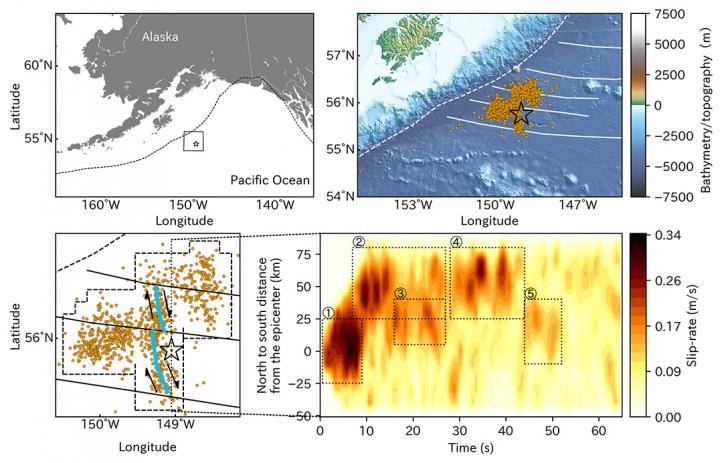
A University of Tsukuba research team find that the irregular behavior of the conjugate fault system responsible for the 2018 Gulf of Alaska earthquake was linked to pre-existing features of the ocean floor
IMAGE

Credit: University of Tsukuba

Tsukuba, Japan – An earthquake is generally viewed to be caused by a rupture along a fault that is transmitted outward from its point of origin in a uniform, predictable pattern. Of course, given the complexity of the environments where these ruptures typically occur, the reality is often much more complicated.

In a new study published in Scientific Reports, a research team led by the University of Tsukuba developed a new method to model the details of complex earthquake rupture processes affecting systems of multiple faults. They then applied this method to the magnitude 7.9 earthquake that struck the Gulf of Alaska near Kodiak Island on January 23, 2018.

As study co-author Professor Yuji Yagi explains, “Our method uses a flexible finite-fault inversion framework with improved smoothness constraints. This approach allows us to analyze seismic P waves and estimate the focal mechanisms and rupture evolution of geometrically complex earthquakes involving rupture of multiple fault segments.”

Based on the distribution of aftershocks within one week of the main shock of the Gulf of Alaska earthquake, this method was applied to represent slip along a horizontal plane at a depth of 33.6 km.

The main rupture stage of the earthquake, which lasted for 27 seconds, affected fault segments oriented both north-south and east-west.

“Our results confirm previous reports that this earthquake ruptured a conjugate fault system in a multi-shock sequence,” says study first author Shinji Yamashita. “Our model further suggests that this rupture tended to occur along weak zones in the sea floor: fracture zones that extend east-west, as well as plate-bending faults that run parallel to north-south-oriented magnetic lineaments.”

These features caused discontinuities in the fault geometry that led to irregular rupture behavior. “Our findings show that irregular rupture stagnation 20 kilometers north of the earthquake’s epicenter may have been promoted by a fault step across the seafloor fracture zone,” explains co-author Assistant Professor Ryo Okuwaki, “They also indicate a causal link between rupture evolution and pre-existing bathymetric features in the Gulf of Alaska.”

This method represents a promising step forward in modeling earthquake rupture processes in complex fault systems based only on seismic body waves, which may improve modeling of seismic wave propagation and mapping of complex fault networks in tectonically active areas.

###

The article, “Consecutive Ruptures on a Complex Conjugate Fault System During the 2018 Gulf of Alaska Earthquake,” was published in Scientific Reports at DOI: 10.1038/s41598-021-85522-w

Media Contact
Naoko Yamashina
[email protected]

Related Journal Article

http://dx.doi.org/10.1038/s41598-021-85522-w

Tags: Earth ScienceGeology/SoilGeophysics/GravityOceanographyPlate Tectonics
Share12Tweet8Share2ShareShareShare2

Related Posts

Miniature Sensor Uses Light to Detect Touch — Chemistry

Miniature Sensor Uses Light to Detect Touch

May 8, 2026
Iron Minerals Determine Whether Dissolved Organic Matter Fuels Microbes or Becomes Long-Term Carbon Storage — Chemistry

Iron Minerals Determine Whether Dissolved Organic Matter Fuels Microbes or Becomes Long-Term Carbon Storage

May 8, 2026

Kate Evans Appointed Associate Lab Director for Biological and Environmental Systems Science at ORNL

May 8, 2026

Advancing Multiscale Modeling and Overcoming Operational Challenges in Autothermal COâ‚‚-to-Methanol Reactors

May 8, 2026
Please login to join discussion

POPULAR NEWS

  • Research Indicates Potential Connection Between Prenatal Medication Exposure and Elevated Autism Risk

    840 shares
    Share 336 Tweet 210
  • New Study Reveals Plants Can Detect the Sound of Rain

    727 shares
    Share 290 Tweet 181
  • Scientists Investigate Possible Connection Between COVID-19 and Increased Lung Cancer Risk

    68 shares
    Share 27 Tweet 17
  • Salmonella Haem Blocks Macrophages, Boosts Infection

    61 shares
    Share 24 Tweet 15

About

We bring you the latest biotechnology news from best research centers and universities around the world. Check our website.

Follow us

Recent News

Evaluating Digoxin Use in Patients with Symptomatic Rheumatic Heart Disease

Evaluating the Effectiveness and Safety of Digitalis Glycosides in Treating Heart Failure

Urdu Fall Risk Questionnaire Adapted for Elderly

Subscribe to Blog via Email

Enter your email address to subscribe to this blog and receive notifications of new posts by email.

Join 82 other subscribers
  • Contact Us

Bioengineer.org © Copyright 2023 All Rights Reserved.

Welcome Back!

Login to your account below

Forgotten Password?

Retrieve your password

Please enter your username or email address to reset your password.

Log In
No Result
View All Result
  • Homepages
    • Home Page 1
    • Home Page 2
  • News
  • National
  • Business
  • Health
  • Lifestyle
  • Science

Bioengineer.org © Copyright 2023 All Rights Reserved.