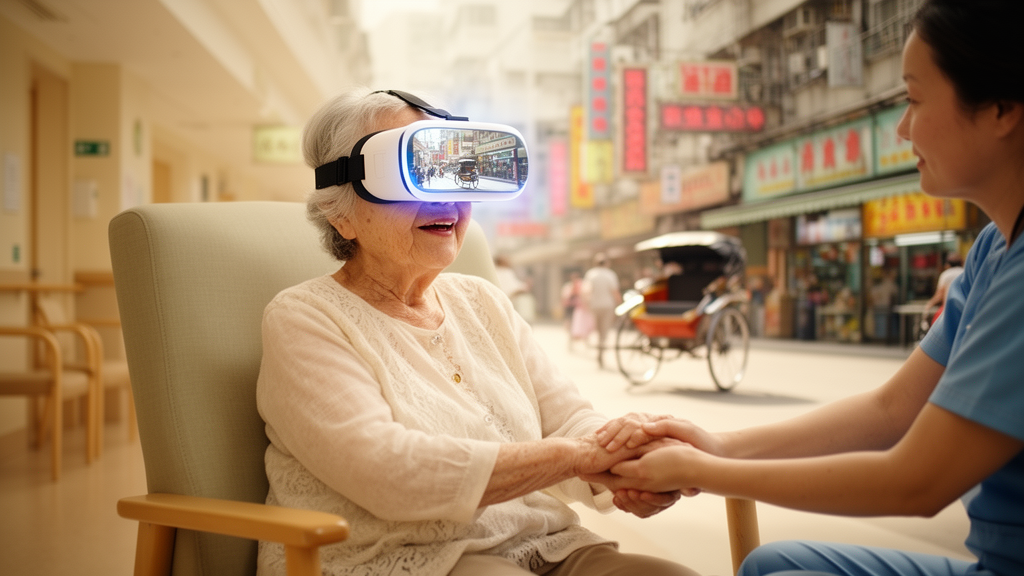
For older residents of Hong Kong, the city they remember is rapidly disappearing. Streets that once anchored daily life have been rebuilt, landmarks have been demolished, and the neighborhoods of childhood and early adulthood now exist mostly in fading photographs and fragile recollections. A new study published in Nature Cities suggests that this loss can be partly reversed, not by rebuilding the past in brick and concrete, but by reconstructing it in pixels and letting people walk through it once more. Researchers at City University of Hong Kong, working with colleagues at Hong Kong Baptist University, report that immersive virtual journeys through historical Hong Kong significantly improved memory recall, reduced stress, and strengthened feelings of social connectedness among older adults.
The study builds on CITY IN TIME, a publicly accessible digital platform commissioned by the Hong Kong Tourism Commission that reconstructs 44 iconic Hong Kong landmarks as they appeared between 1900 and 1970. The reconstructions were assembled from archival sources, including historical photographs, maps, and documentary records, and rendered as navigable three-dimensional environments built in the Unity game engine. Rather than offering static panoramas, the platform allows users to move through detailed streetscapes of a city that has largely vanished, encountering the shops, transport, and architecture of earlier eras at eye level and at walking pace.
The research team, led by Jingting Huang, Yifei Li, Richard William Allen, Jeffrey Shaw, and corresponding author Linyan Li, recruited older adults through community organizations and assigned participants to groups with differing levels of exposure to the virtual heritage environments. The experimental design was deliberately rigorous, capturing data before, during, and after the virtual experience. Physiological monitoring ran throughout each session, including electroencephalography to track brain activity, alongside measures of heart rate variability and electrodermal activity, both well-established indicators of stress and emotional arousal. Psychological assessments administered before and after the sessions measured memory recall, anxiety, mood, place attachment, and perceived social connection.
The results were consistent across both the biological and the self-reported data. Participants who experienced the historical environments showed enhanced memory recall, with the virtual streets acting as powerful cues for autobiographical memories. This effect aligns with a well-documented phenomenon in memory research known as the reminiscence bump, in which events from adolescence and early adulthood are recalled more vividly and frequently than experiences from other life periods. For many participants, the reconstructed landmarks fell squarely within that formative window, providing spatial scaffolding that helped them mentally time travel back to specific moments of their own lives.
The physiological traces told a parallel story. Electroencephalographic recordings revealed changes in relative power across frequency bands associated with relaxed, positive engagement, and the stress-linked measures of electrodermal activity indicated a calming effect during and after exposure. Trajectories of physiological and psychological responses were tracked across four assigned groups, and the between-group comparisons showed that the immersive heritage experience produced measurable benefits relative to control conditions. In practical terms, a session of walking through a digitally resurrected 1950s Hong Kong street functioned something like a relaxation intervention, lowering physiological stress markers while simultaneously lifting mood.
Semi-structured interviews conducted after the sessions added a qualitative dimension that the sensors could not capture. Participants described their experience of urban memory as multidimensional, encompassing both tangible places and intangible narratives. A reconstructed ferry pier was not merely a structure; it was the backdrop for stories of courtship, family outings, first jobs, and neighborhood friendships. Word frequency analysis of the interviews showed which digitally reconstructed landmarks resonated most strongly, and the perceptual patterns that emerged confirmed that the value of the virtual environments lay less in architectural fidelity alone and more in the personal and communal stories the places triggered.
The findings arrive at a moment when both of the forces at play are intensifying. Rapid urbanization worldwide continues to erase historic fabric, severing communities from the physical anchors of their collective memory. At the same time, populations are aging quickly, and social isolation and loneliness among older adults have been identified by major public health bodies as serious risks for mental and physical health, comparable in their impact to more traditional medical risk factors. Prior research has linked environmental factors, place attachment, and access to meaningful spaces with life satisfaction and lower rates of depressive symptoms in older populations, making the loss of familiar places a genuine well-being concern rather than a merely sentimental one.
Virtual reality has been explored before as a tool for older adults, including reminiscence therapy for people with cognitive impairment and nature-based virtual environments for stress reduction. What distinguishes the new work is its combination of a large, historically grounded, city-scale reconstruction with a multi-modal evaluation that spans brain activity, peripheral physiology, standardized psychometrics, and in-depth interviews. The authors also note that acceptance of immersive head-mounted displays among older adults, once considered a barrier, has been shown in earlier studies to be higher than commonly assumed when the technology is introduced carefully, and the technology acceptance and user experience ratings collected across the experimental groups in this study support that picture.
The researchers frame their results as evidence that urban heritage, even when the physical fabric is gone, can still safeguard collective memory and foster community well-being. Because the CITY IN TIME platform is publicly accessible and the approach is scalable, the authors argue that similar digital reconstructions could be created for other cities, offering a way to preserve layered histories while giving older residents an emotionally resonant resource for reminiscence, stress relief, and social interaction. The work also hints at broader applications, from intergenerational programs in which younger residents explore the same virtual streets alongside elders, to therapeutic settings where guided virtual heritage visits complement conventional care.
There are limits to what a single study can establish. The experimental data are not publicly available due to ethical restrictions, though de-identified or aggregated data may be requested from the corresponding author with a research proposal and data-use plan, and the participants were drawn from a specific urban population with specific memories of a specific city. The durability of the benefits beyond the immediate post-session period remains an open question, as does how the approach transfers to people whose formative years were spent elsewhere. Still, the convergence of physiological, psychological, and narrative evidence makes a compelling case that the past, once digitized with care, is not just an archive to be consulted but an environment to be inhabited, and that walking through it virtually can make the present measurably better for the people who remember it first.
Subject of Research: Immersive virtual heritage environments and well-being outcomes in older adults
Article Title: Revisiting the urban past virtually to enhance well-being for older adults
Article References: Huang, J., Li, Y., Allen, R. W., Shaw, J., & Li, L. (2026). Revisiting the urban past virtually to enhance well-being for older adults. Nature Cities. https://doi.org/10.1038/s44284-026-00523-y
Image Credits: AI Generated
DOI: 10.1038/s44284-026-00523-y
Keywords: virtual reality, urban heritage, older adults, collective memory, Hong Kong, well-being, reminiscence, stress reduction, social connectedness, digital reconstruction, Nature Cities, place attachment
News Source: Denise Maddox. (October 9, 2026). Virtual Time Travel Through Old Hong Kong Boosts Memory and Well-Being in Older Adults. Scienmag.