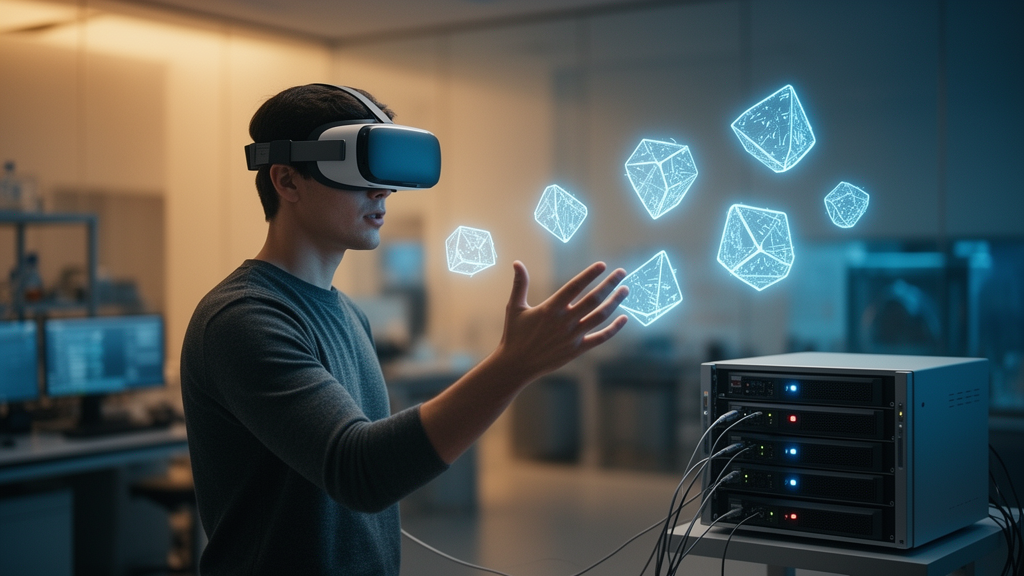
Researchers have built an adaptive learning system that fuses virtual reality with reinforcement learning into a single closed loop, allowing a computer tutor to sense a student’s cognitive state through a VR headset and adjust its teaching strategy in real time. The study, published in Discover Artificial Intelligence, reports that the system predicted knowledge mastery with 96.8 percent accuracy at the basic concept level and 85.6 percent at the most demanding comprehensive problem level, while keeping its decision latency between 278 and 282 milliseconds across all difficulty tiers — comfortably inside the 300 millisecond window the authors identify as the threshold beyond which learners begin to perceive lag.
The central problem the team set out to solve is what they describe as temporal decoupling. In most existing adaptive educational systems, the sensors that capture learner behavior and the algorithms that decide what to teach next operate as separate modules. A VR headset may record eye movements, gestures and spatial trajectories at millisecond resolution, but those signals often never reach the decision engine during the critical window in which they would be useful. The result is a tutor that reacts late, or not at all, to a student who is visibly struggling or coasting. The new framework closes that gap by formalizing a mathematical pathway from raw sensor streams to pedagogical action.
The system’s workflow runs through four phases: perception, construction, decision and feedback. In the perception phase, an integrated sensor array in the VR headset captures three streams of data simultaneously. An infrared eye tracker samples gaze position and fixation duration at 120 hertz, recording three-dimensional coordinates along with how long the student looks at each target. The motion controller’s inertial measurement unit logs acceleration and angular velocity for eight basic gesture types, and onboard positioning tracks the user’s location within a teaching space of roughly two cubic meters. All three streams pass through a unified timestamp alignment mechanism to eliminate offsets between devices.
Raw sensor data is noisy, so the pipeline applies three filtering techniques tuned to each modality. Sliding-window median filtering with a 150 millisecond window removes spurious fixation points caused by small head movements, Kalman filtering strips high-frequency noise from gesture signals using a state transition model with a Kalman gain term, and an exponentially weighted moving average with a weight of 0.35 smooths spatial coordinates. Once cleaned, the data is restructured into a directed acyclic graph in which nodes represent behavioral features — gaze duration, gesture type, interaction location — at discrete time steps, and edges connect events occurring within 200 milliseconds of one another. Features are then min-max normalized to the range from zero to one.
This graph feeds a lightweight graph convolutional network, or GCN, that encodes the heterogeneous behavioral data into a compact state vector. The architecture is deliberately economical: eye-tracking, gesture and spatial data enter with 4, 16 and 3 dimensions respectively, expand to 58 dimensions during graph structuring, and are compressed to just 4 output dimensions after two graph convolutional layers of 64 and 4 units. The layers use a separable convolution structure that splits spatial and channel-wise operations, reducing computational cost while preserving temporal dependencies between modalities. LeakyReLU activations introduce nonlinearity, Xavier initialization guards against vanishing gradients, and sparse matrix multiplication keeps the encoding fast enough for real-time use.
The encoded state then drives what the authors call a dynamic cognitive load-perceived reward function, the conceptual heart of the system. A temporal convolutional network with causal convolutions, a kernel size of three and dilation rates doubling up to eight, processes the sequence of state vectors to predict the probability that the student has mastered the current knowledge. That probability is compared against two thresholds, set at 0.3 and 0.7 through grid search on pilot data. A predicted mastery probability below 0.3 signals high cognitive load, prompting the system to increase the reward for switching scenes; a value above 0.7 signals low load, increasing the reward for raising content difficulty. The final reward blends the change in mastery probability, weighted at 0.7, with a load-adjusted intervention term weighted at 0.3, producing a continuous feedback signal for the learning algorithm.
Strategy optimization is handled by the Twin Delayed Deep Deterministic Policy Gradient algorithm, known as TD3. Two independent critic networks, each with fully connected layers of 256, 128 and 64 neurons, evaluate candidate teaching actions, and the algorithm takes the minimum of their two Q-value estimates. This minimum-selection mechanism suppresses the overestimation bias that plagues single-critic methods, a problem the authors note is especially severe in education, where rewards are sparse and feedback often arrives only after task completion. A delayed update scheme refreshes the policy network every two time steps, and Q-values are constrained to the range from minus 5.0 to 5.0 for stability. The policy network’s output, bounded by a tanh function, is linearly transformed into two concrete teaching parameters: a content difficulty coefficient limited to between 0.1 and 0.9, and a scene switching frequency between 5 and 30 seconds.
The experimental evaluation involved 200 undergraduate students from a single institution learning physics mechanics concepts in a three-dimensional VR environment built on the Oculus Quest 3 headset and the Unity 2022.3 engine, with five difficulty levels spanning basic concepts to comprehensive problems. Against a rule-based baseline that triggered content changes at fixed mastery thresholds of 0.6 and 0.8, the VR-RL system showed clear advantages. Prediction accuracy differences were statistically significant across all difficulty levels, with paired t-tests yielding p-values below 0.01 and effect sizes between 1.85 and 2.37. On latency, the gap was starker: the traditional system slowed from 385 milliseconds at basic level to 510 at comprehensive level, while the new system held at 278 to 282 milliseconds, and rose only from 268 to 293 milliseconds as concurrent user load climbed from 1 to 200. Engagement measures also favored the new system, with gaze fixation durations reaching 45.2 seconds at medium complexity — 8.8 seconds longer than the baseline — and gesture interaction frequency of 27.2 actions per minute, and gaze duration correlated positively with knowledge mastery at r equals 0.83.
Ablation experiments underscored why each component matters. Swapping the lightweight GCN for a two-layer multilayer perceptron dropped comprehensive-level prediction accuracy to 76.4 percent and pushed latency to 387 milliseconds. Replacing TD3 with the Soft Actor-Critic algorithm produced unstable Q-values oscillating between minus 5.2 and 4.6 and decision delays of 345 milliseconds. Substituting a static reward function for the dynamic one cut accuracy to 80.1 percent and raised latency to 312 milliseconds, confirming that real-time cognitive load perception is essential to the system’s responsiveness. Boundary-condition tests near the 0.3 threshold showed the system recovering from sharp attention drops in an average of 3.84 seconds, 4.20 seconds faster than the baseline, and making finer-grained strategy adjustments near the 0.7 threshold.
The authors are candid about the study’s limits. The dataset of 200 undergraduates from one institution, chosen to keep cognitive baselines consistent, lacks the demographic diversity needed for broad population inference, and publicly available datasets combining eye-tracking, gesture, spatial trajectory and reinforcement learning feedback remain scarce, blocking cross-dataset validation. The team suggests that the modular architecture — with its computationally parsimonious GCN and policy network — could be distilled onto cheaper standalone headsets for resource-constrained classrooms, and they flag interdisciplinary knowledge integration and multi-user support as open challenges. For now, the work stands as a demonstration that immersive sensing and adaptive decision-making can be wired into one coherent loop fast enough to keep pace with a learner’s mind.
Subject of Research: A VR and reinforcement learning collaborative model for real-time adaptive educational systems
Article Title: Synergistic mechanism of virtual reality and reinforcement learning in educational adaptive learning systems
Article References: Fu, S., Zhao, Q., Tao, Q., Liu, H., Wang, Q., & Liu, D. (2026). Synergistic mechanism of virtual reality and reinforcement learning in educational adaptive learning systems. Discover Artificial Intelligence, 6(1), Article 961. https://doi.org/10.1007/s44163-026-02091-5
Image Credits: AI Generated
DOI: 10.1007/s44163-026-02091-5
Keywords: virtual reality, reinforcement learning, adaptive learning, TD3 algorithm, graph convolutional network, cognitive load, knowledge mastery prediction, eye tracking, multimodal data fusion, educational technology, response latency, closed-loop system
News Source: Denise Maddox. (October 28, 2026). Virtual Reality Meets Reinforcement Learning in a Closed-Loop Adaptive Tutor That Answers in Under 300 Milliseconds. Scienmag.