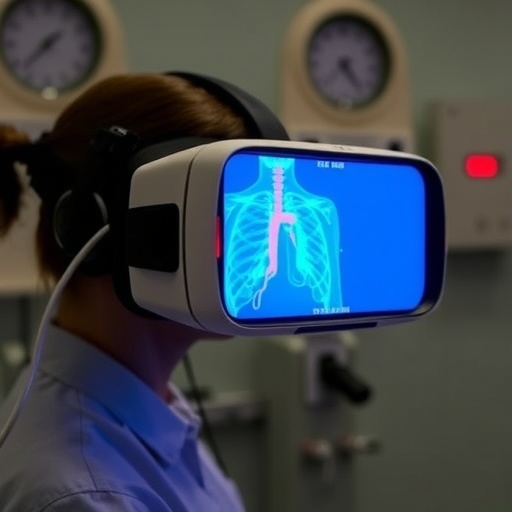
Patients undergoing coronary angiography often experience anxiety both before and during the procedure, often treated by the administration of anti-anxiety medications. A new analysis being presented at the American College of Cardiology (ACC) Middle East 2025 Together with 16th Emirates Cardiac Society Conference found virtual reality (VR) effectively reduced anxiety during the procedure and had more stable vital signs than patients receiving standard care.
“Virtual reality offers an innovative solution to manage and reduce the anxiety of patients undergoing an interventional cardiovascular procedure, like coronary angiography, that they are typically awake during,” said Yousef Radwan Alnomani, a clinical researcher at Benha University in Benha, Egypt, and the study’s lead author.
Coronary angiography is part of a group of cardiac tests known as cardiac catheterization, which utilizes catheters to determine blockages and/or place stents in the vessels of the heart. Coronary angiography uses X-rays during the procedure to see if the blood vessel is narrowed or blocked during the diagnosis of coronary artery disease. In coronary angiography, the standard of care is to provide anti-anxiety medications to the patient before and during the procedure.
Virtual reality is a computer simulation that enables a person to interact with computer-generated 3-D visuals or other sensory environments.
Researchers analyzed data from five randomized controlled trials comprising 451 patients comparing VR to standard of care in patients undergoing coronary angiography. Some of the VR scenarios used included nature scenes like waterfalls, mountains and valleys, designed to induce a state of relaxation that may reduce anxiety and stabilize vital signs in these patients, Alnomani said. VR during coronary angiography was found to be superior to the standard of care in reducing anxiety and was associated with significantly lower changes in heart rate and blood pressure. While VR before coronary angiography did reduce anxiety, it did not show efficacy.
“Immersing patients in a 3D simulation offers better relaxation than just watching a similar video on a screen,” Alnomani said.
Limitations of the study include its retrospective nature. Larger, randomized controlled trials are needed in the future to determine the broad use of VR in improving care of patients undergoing coronary angiography and other cardiovascular interventions.
For embargoed copies of abstracts or media registration for the conference, contact Katie Glenn at [email protected].
The American College of Cardiology (ACC) is a global leader dedicated to transforming cardiovascular care and improving heart health for all. For more than 75 years, the ACC has empowered a community of over 60,000 cardiovascular professionals across more than 140 countries with cutting-edge education and advocacy, rigorous professional credentials, and trusted clinical guidance. From its world-class JACC Journals and NCDR registries to its Accreditation Services, global network of Chapters and Sections, and CardioSmart patient initiatives, the College is committed to creating a world where science, knowledge and innovation optimize patient care and outcomes. Learn more at www.ACC.org or connect on social media at @ACCinTouch.
###
Media Contact
Katie Glenn
American College of Cardiology
Office: 202-375-6472
Meeting
ACC Middle East 2025 Together with 16th Emirates Cardiac Society Conference
Keywords
/Applied sciences and engineering/Computer science/User interfaces/Virtual reality
/Applied sciences and engineering/Computer science/Artificial intelligence
/Health and medicine/Medical specialties/Cardiology
/Health and medicine/Health care/Health care delivery
/Health and medicine/Health care/Medical products
/Health and medicine/Health care/Personalized medicine
/Health and medicine/Medical specialties/Surgery
/Research methods
bu içeriği en az 2000 kelime olacak şekilde ve alt başlıklar ve madde içermiyecek şekilde ünlü bir science magazine için İngilizce olarak yeniden yaz. Teknik açıklamalar içersin ve viral olacak şekilde İngilizce yaz. Haber dışında başka bir şey içermesin. Haber içerisinde en az 12 paragraf ve her bir paragrafta da en az 50 kelime olsun. Cevapta sadece haber olsun. Ayrıca haberi yazdıktan sonra içerikten yararlanarak aşağıdaki başlıkların bilgisi var ise haberin altında doldur. Eğer yoksa bilgisi ilgili kısmı yazma.:
Subject of Research:
Article Title:
News Publication Date:
Web References:
References:
Image Credits:
Keywords