Credit: Brandon Jutras for Virginia Tech
With a $661,216 grant from the Steven & Alexandra Cohen Foundation, Brandon Jutras, an assistant professor of biochemistry in the Virginia Tech College of Agriculture and Life Sciences, will study Lyme arthritis, including the cellular component that contributes to it.
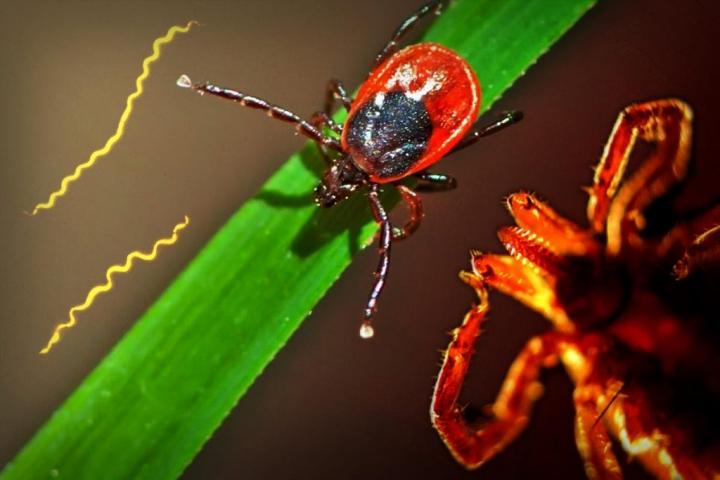
Lyme disease is the most reported vector-borne disease in the country. Over the past 20 years the United States has experienced a dramatic increase in both the number of reported cases and the geographic distribution of the disease. In Virginia, the disease is transmitted by blacklegged ticks, which are infected with the Lyme disease-causing bacterium Borrelia burgdorferi.
Symptoms can begin with the classic “bull’s-eye” rash and/or flu-like symptoms, though some patients exhibit few if any initial warning signs. If not promptly treated, the infection can quickly worsen, spreading to other tissues and giving rise to neuromuscular and cardiac problems. In the United States, Lyme arthritis — a debilitating and extremely painful condition– is the most common late-stage symptom of Lyme disease.
“As Borrelia burgdorferi — the bacterium that causes Lyme disease — is transmitted from a tick to a human, it is growing and dividing. And as it’s growing and dividing, it’s shedding a cellular component called peptidoglycan. This cell-wall component can persist in a patient after antibiotic treatment and is capable of causing arthritis,” said Jutras, who is also an affiliated faculty member of the Fralin Life Sciences Institute and the molecular and cellular biology program.
Jutras and his colleagues at Virginia Tech are using a recent study as a stepping stone. In 2019, they discovered that when Borrelia burgdorferi invades and grows within the body, it sheds peptidoglycan into the extracellular environment. Once shed, the peptidoglycan begins to congregate in the synovial fluid that surrounds our joints, especially the knee in some patients.
Once an infection is established, the human body sends out an inflammatory response to combat Lyme disease. Some patients are able to get rid of the infection naturally, but most require exhaustive antibiotic therapy. The problem is, even when there are no obvious signs of an infection, the inflammation continues. With the inappropriate inflammation comes intense pain, stiffness, and other signs of Lyme arthritis. Exactly how and why the body responds in this way has puzzled researchers, but Jutras believes that the peptidoglycan’s unique chemistry may hold the key.
“All bacteria have peptidoglycan. But, as it turns out, Borrelia burgdorferi peptidoglycan has unique chemical features that distinguish it from most all other bacteria. We think that those molecular differences that occur in the peptidoglycan of Borrelia burgdorferi are important in causing the sustained Lyme arthritis response,” said Jutras.
To determine what pathways are in play, and how and why the inflammation occurs, Jutras will be using single-cell RNA sequencing. Researchers will expose both mice and healthy human cells to peptidoglycan, then they will use single-cell RNA sequencing to observe how every single immunological cell responds.
“If we are able to understand how we react to B. burgdorferi peptidoglycan, and why it is capable of residing in humans for extended periods, we should be able to design or modify therapies to intervene, thus curing patients of long-term symptoms,” said Jutras.
The Jutras lab has also enlisted the help of co-PIs Coy Allen and Rich Helm. Allen, an associate professor of inflammatory disease in the Virginia-Maryland College of Veterinary Medicine’s Department of Biomedical Sciences and Pathobiology, will assist in immunological studies. Helm, an associate professor of biochemistry in the College of Agriculture and Life Sciences, will analyze and perform quality control of peptidoglycan preparations using mass spectrometry.
The grant was awarded through the Steven & Alexandra Cohen Foundation, the largest private funder of Lyme and tick-borne disease research in the United States. Launched in 2015, the Cohen Lyme & Tickborne Disease Initiative underwrites groundbreaking studies in prevention, diagnostics, and treatment.
“This foundation acts as a catalyst for Lyme and other tick-borne disease research. There are so many important areas of research in the Lyme disease field and it is these types of efforts that will move the needle forward. It’s a phenomenal service and initiative. We are very fortunate to partner with them and to hopefully get answers to some critical questions in the field,” said Jutras.
###
Media Contact
Zeke Barlow
@vtnews
540-231-5417
Original Source
https:/