Credit: ©Science China Press
How is the universe formed? What’s the mechanism of the nucleosynthesis of lighter nuclei to heavier nuclei in the Universe? Where is the limit of the nuclear landscape? These problems have always been hot topics in nuclear astrophysics in which nuclear reactions play an important role. Moreover, much attention has been paid on solving these problems.
To understand the path of nucleosynthesis in the Universe, traditionally, researchers require to solve a set of time-dependent differential equations called nuclear reaction network calculation, which need expensive computer equipment and spend a lot of time, even is prohibitive, and obtain the abundance of element involved in nucleosynthesis.
The REACLIB database, which is continuously updated and snapshotted regularly by the Joint Institute for Nuclear Astrophysics (JINA) Collaboration, is usually used in nuclear reaction network calculation. It contains eight thousand nuclei and eighty thousand reactions, where each reaction includes the information of the type of reaction, parameters needed for calculating reaction rate and Q value, etc.
In recent years, complex network science, as a new interdisciplinary field, has been applied in reactions involved in physics, chemistry and biology to explore their statistical characteristics of the whole reaction system which is challenging. Its basic ideas origin from graph theory, which regard reaction individuals in a real system as node and relationship between two individuals as edge, by doing so the real system is mapped to a network.
Chinese group guided by Yugang Ma combined the REACLIB database with the complex network theory aiming to obtain the topological characteristics of all thermonuclear reactions in the database. The main concept was to identify real interacting nuclide as nodes and determine the relationships between the two nuclides as edges. Using the substrate-product method, a directed, multi-layer nuclear reaction network was formed, which contained four layers, n-, p-, h- and r-, according to the types of reactions involved in neutrons, proton, 4He and the remaining atomic particles, respectively.
For example, each nuclide in n-layer, called `node’ X in terms of network concept, the reaction n + Y -> X was considered as ‘in-coming’ (corresponding to in-degree), the reaction X + n -> Y was regarded as ‘out-going’ (corresponding to out-degree) and the number of all reactions involved in this node X was called degree that equal to in-degree plus out-degree.
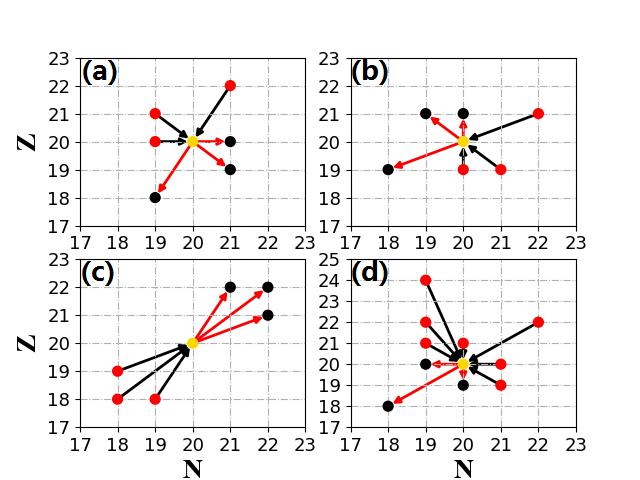
In order to understand this more clearly, figure 1 shows an example of the topological structures of 40Ca nucleus denoted by gold color in the four-layer nuclear reaction network. Where the red arrow and the black arrow represent the consumption and the production of 40Ca, respectively.
In an article published in Scientific Reports (2016) coauthored with Yugang Ma, scholars at Shanghai Institute of Applied Physics, Chinese Academy of Sciences and School of Information Science and Technology, East China Normal University, indicated that “the degree difference and node overlapping coefficient are able to identify the majority of stable nuclides”.
Recently, four scholars, guided by Yugang Ma, likewise took advantage of the directed, un-weighted, multi-layer nuclear reaction networks in the study, which is published in the Science China Physics, Mechanics & Astronomy, and revealed that nuclear reaction networks for nucleosynthesis calculations are amenable to many topological properties that have not yet been explored in the theoretical and experimental studies in nucleosynthesis.
Research aimed at finding out the most frequent reaction patterns of interconnections occurring in different nodes, which called ‘motif’ structure, and calculating the correlation of each two layers.
“All motif structures, regardless of the layer in which they are found, fade away or change shape as the number of protons reaches at or near 82.” the researchers wrote in an article titled “Network structure of thermonuclear reactions in nuclear landscape”.
“The degree values (i.e. numbers of reactions), for three layers of n-, p-, and h-, have a significant correlation with one another, and their topological structures exhibit a similar regularity. However, the r-layer has a more complex topological structure compared to the other layers.” they explained.
“This work provides a novel approach to investigating the nuclear reaction network that prevails in the astrophysical context.” wrote the four researchers.
“In the future work, we will focus on improving mapping methods, incorporating the dynamics on the network and a more in-depth analysis of each layer.” wrote the four researchers.
###
This research was funded by the National Natural Science Foundation of China (Nos. 11890714, 11421505, 11875133 and 11075057) and the National Key Research and Development Program of China (No. 2018YFB2101302).
See the article:
H. L. Liu, D. D. Han, Y. G. Ma and L. Zhu, “Network structure of thermonuclear reactions in nuclear landscape,” Sci. China-Phys. Mech. Astron. 63, 112062 (2020). doi: 10.1007/s11433-020-1552-2
http://engine.
Media Contact
Yugang Ma
[email protected]
Related Journal Article
http://dx.