• HOME
  • NEWS
  • EXPLORE
    • CAREER
      • Companies
      • Jobs
    • EVENTS
    • iGEM
      • News
      • Team
    • PHOTOS
    • VIDEO
    • WIKI
  • BLOG
  • COMMUNITY
    • FACEBOOK
    • INSTAGRAM
    • TWITTER
Sunday, May 10, 2026
BIOENGINEER.ORG
No Result
View All Result
  • Login
  • HOME
  • NEWS
  • EXPLORE
    • CAREER
      • Companies
      • Jobs
        • Lecturer
        • PhD Studentship
        • Postdoc
        • Research Assistant
    • EVENTS
    • iGEM
      • News
      • Team
    • PHOTOS
    • VIDEO
    • WIKI
  • BLOG
  • COMMUNITY
    • FACEBOOK
    • INSTAGRAM
    • TWITTER
  • HOME
  • NEWS
  • EXPLORE
    • CAREER
      • Companies
      • Jobs
        • Lecturer
        • PhD Studentship
        • Postdoc
        • Research Assistant
    • EVENTS
    • iGEM
      • News
      • Team
    • PHOTOS
    • VIDEO
    • WIKI
  • BLOG
  • COMMUNITY
    • FACEBOOK
    • INSTAGRAM
    • TWITTER
No Result
View All Result
Bioengineer.org
No Result
View All Result
Home NEWS Science News Chemistry

View of the Earth in front of the Sun

Bioengineer by Bioengineer
June 18, 2019
in Chemistry
Reading Time: 3 mins read
0
IMAGE
Share on FacebookShare on TwitterShare on LinkedinShare on RedditShare on Telegram

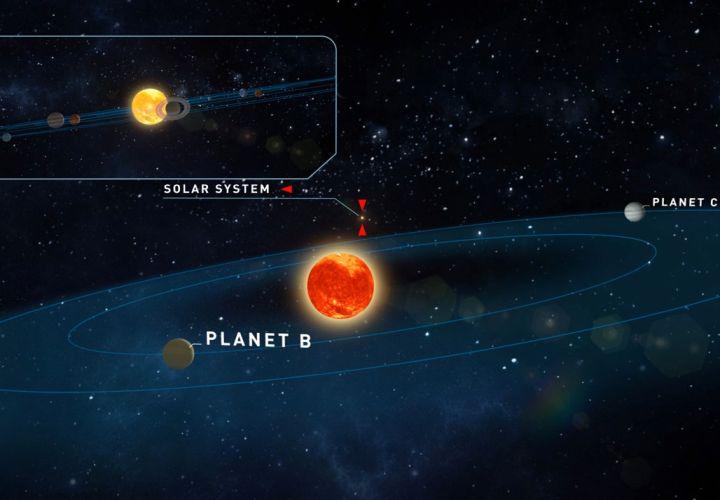
International research team discovers two new Earth-like planets near Teegarden’s star
IMAGE

Credit: University of Göttingen, Institute for Astrophysics

An international research team led by the University of Göttingen has discovered two new Earth-like planets near one of our closest neighboring stars. “Teegarden’s star” is only about 12.5 light years away from Earth and is one of the smallest known stars. It is only about 2,700 °C warm and about ten times lighter than the Sun. Although it is so close to us, the star wasn’t discovered until 2003. The scientists observed the star for about three years. The results were published in the journal Astronomy and Astrophysics.

Their data clearly show the existence of two planets. “The two planets resemble the inner planets of our solar system,” explains lead author Mathias Zechmeister of the Institute for Astrophysics at the University of Göttingen. “They are only slightly heavier than Earth and are located in the so-called habitable zone, where water can be present in liquid form.”

The astronomers suspect that the two planets could be part of a larger system. “Many stars are apparently surrounded by systems with several planets,” explains co-author Professor Stefan Dreizler of the University of Göttingen. Teegarden’s star is the smallest star where researchers have so far been able to measure the weight of a planet directly. “This is a great success for the Carmenes project, which was specifically designed to search for planets around the lightest stars,” says Professor Ansgar Reiners of the University of Göttingen, one of the scientific directors of the project.

Although planetary systems around similar stars are known, they have always been detected using the “transit method” – the planets have to pass visibly in front of the star and darken it for a moment, which only happens in a very small fraction of all planetary systems. Such transits have not yet been found for the new planets. But the system is located at a special place in the sky: from Teegarden’s star you can see the planets of the solar system passing in front of the Sun.

“An inhabitant of the new planets would therefore have the opportunity to view the Earth using the transit method,” says Reiners. The new planets are the tenth and eleventh discovered by the team.

###

Carmenes is carried out by the universities of Göttingen, Hamburg, Heidelberg, and Madrid, the Max-Planck-Institut für Astronomie Heidelberg, Institutes Consejo Superior de Investigaciones Científicas in Barcelona, Granada, and Madrid, Thüringer Landessternwarte, Instituto de Astrofísica de Canarias, and Calar-Alto Observatory.

Further information can be found at https://carmenes.caha.es.

Original publication: Mathias Zechmeister et al. The CARMENES search for exoplanets around M dwarfs – Two temperate Earth-mass planet candidates around Teegarden’s Star. Astronomy & Astrophysics 2019. DOI: 10.1051/0004-6361/201935460

Contact:

University of Göttingen

Institute for Astrophysics:

Dr Mathias Zechmeister

Tel: +49 (0)551 39-9988

Email: [email protected]

Internet: http://www.astro.physik.uni-goettingen.de/~zechmeister/

Professor Ansgar Reiners

Tel: +49 (0)551 39-13825

Email: [email protected]

Internet: http://www.uni-goettingen.de/de/homepage/574854.html

Professor Stefan Dreizler

Tel: +49 (0)551 39-5041

Email: [email protected]

Internet: http://www.uni-goettingen.de/de/216891.html

Media Contact
Melissa Sollich
[email protected]

Original Source

http://www.uni-goettingen.de/en/3240.html?id=5496

Related Journal Article

http://dx.doi.org/10.1051/0004-6361/201935460

Tags: AstronomyAstrophysicsPlanets/MoonsSpace/Planetary ScienceStars/The Sun
Share12Tweet8Share2ShareShareShare2

Related Posts

Miniature Sensor Uses Light to Detect Touch — Chemistry

Miniature Sensor Uses Light to Detect Touch

May 8, 2026
Iron Minerals Determine Whether Dissolved Organic Matter Fuels Microbes or Becomes Long-Term Carbon Storage — Chemistry

Iron Minerals Determine Whether Dissolved Organic Matter Fuels Microbes or Becomes Long-Term Carbon Storage

May 8, 2026

Kate Evans Appointed Associate Lab Director for Biological and Environmental Systems Science at ORNL

May 8, 2026

Advancing Multiscale Modeling and Overcoming Operational Challenges in Autothermal CO₂-to-Methanol Reactors

May 8, 2026
Please login to join discussion

POPULAR NEWS

  • Research Indicates Potential Connection Between Prenatal Medication Exposure and Elevated Autism Risk

    840 shares
    Share 336 Tweet 210
  • New Study Reveals Plants Can Detect the Sound of Rain

    727 shares
    Share 290 Tweet 181
  • Scientists Investigate Possible Connection Between COVID-19 and Increased Lung Cancer Risk

    68 shares
    Share 27 Tweet 17
  • Salmonella Haem Blocks Macrophages, Boosts Infection

    61 shares
    Share 24 Tweet 15

About

We bring you the latest biotechnology news from best research centers and universities around the world. Check our website.

Follow us

Recent News

Evaluating Digoxin Use in Patients with Symptomatic Rheumatic Heart Disease

Evaluating the Effectiveness and Safety of Digitalis Glycosides in Treating Heart Failure

Urdu Fall Risk Questionnaire Adapted for Elderly

Subscribe to Blog via Email

Enter your email address to subscribe to this blog and receive notifications of new posts by email.

Join 82 other subscribers
  • Contact Us

Bioengineer.org © Copyright 2023 All Rights Reserved.

Welcome Back!

Login to your account below

Forgotten Password?

Retrieve your password

Please enter your username or email address to reset your password.

Log In
No Result
View All Result
  • Homepages
    • Home Page 1
    • Home Page 2
  • News
  • National
  • Business
  • Health
  • Lifestyle
  • Science

Bioengineer.org © Copyright 2023 All Rights Reserved.