• HOME
  • NEWS
  • EXPLORE
    • CAREER
      • Companies
      • Jobs
    • EVENTS
    • iGEM
      • News
      • Team
    • PHOTOS
    • VIDEO
    • WIKI
  • BLOG
  • COMMUNITY
    • FACEBOOK
    • INSTAGRAM
    • TWITTER
Thursday, January 15, 2026
BIOENGINEER.ORG
No Result
View All Result
  • Login
  • HOME
  • NEWS
  • EXPLORE
    • CAREER
      • Companies
      • Jobs
        • Lecturer
        • PhD Studentship
        • Postdoc
        • Research Assistant
    • EVENTS
    • iGEM
      • News
      • Team
    • PHOTOS
    • VIDEO
    • WIKI
  • BLOG
  • COMMUNITY
    • FACEBOOK
    • INSTAGRAM
    • TWITTER
  • HOME
  • NEWS
  • EXPLORE
    • CAREER
      • Companies
      • Jobs
        • Lecturer
        • PhD Studentship
        • Postdoc
        • Research Assistant
    • EVENTS
    • iGEM
      • News
      • Team
    • PHOTOS
    • VIDEO
    • WIKI
  • BLOG
  • COMMUNITY
    • FACEBOOK
    • INSTAGRAM
    • TWITTER
No Result
View All Result
Bioengineer.org
No Result
View All Result
Home NEWS Science News

Versatile LED irradiation system — From disinfection to medical treatments

Bioengineer by Bioengineer
June 30, 2020
in Science News
Reading Time: 2 mins read
0
IMAGE
Share on FacebookShare on TwitterShare on LinkedinShare on RedditShare on Telegram

IMAGE

Credit: FBH/P. Immerz

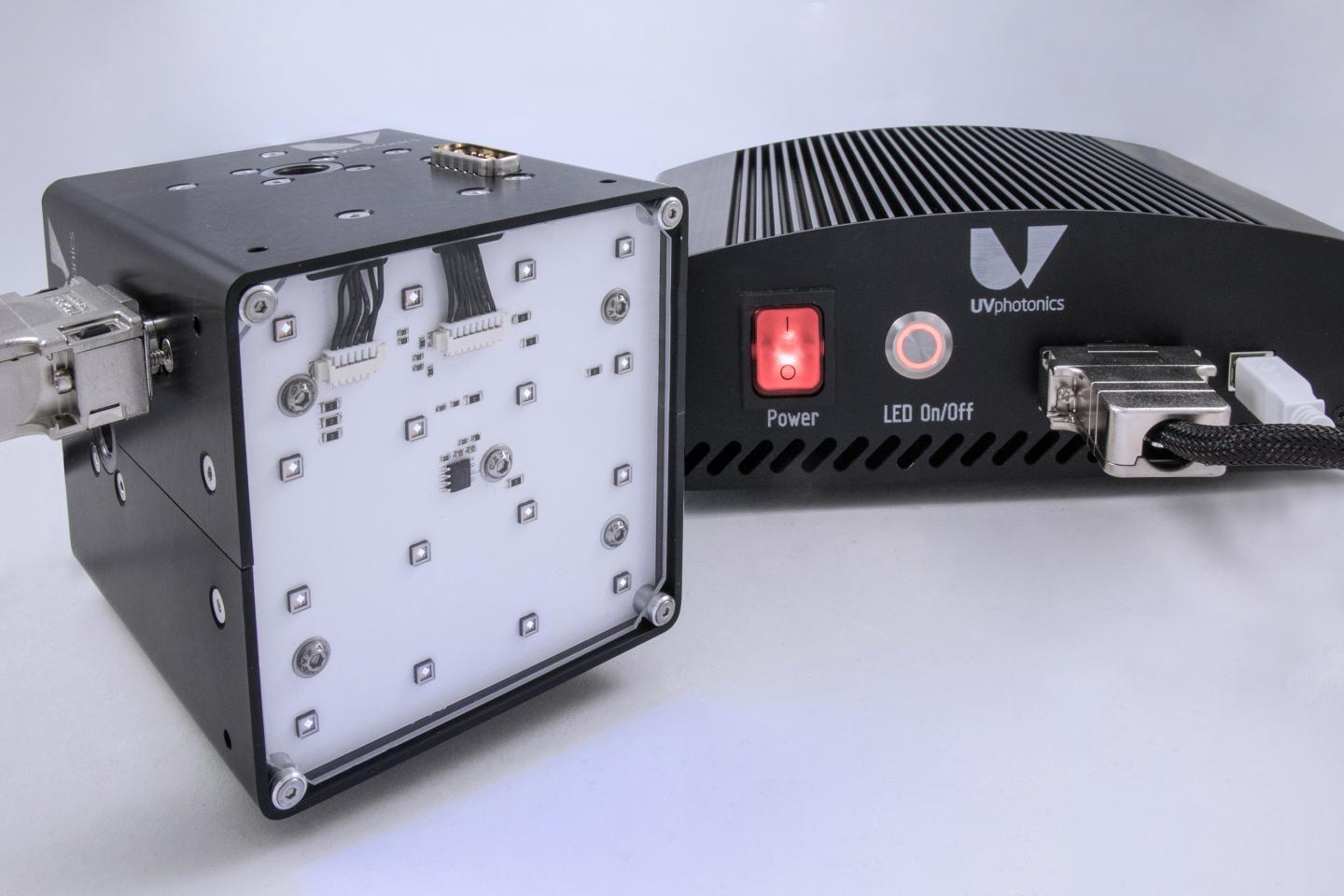
For disinfection purposes, the compact system can be equipped with UV LEDs to eliminate germs on critical surfaces such as mobile phones. It can also be assembled with LEDs providing the optimum emission spectrum for polymer curing and medical treatments – even multiple wavelengths are possible.

Berlin-based Ferdinand-Braun-Institut (FBH) and its spin-off UVphotonics NT GmbH have designed and developed a versatile turnkey irradiation system for surface treatment. Since the compact, modular system can be flexibly equipped with both in-house developed UV LEDs as well as with commercially available UV, visible and infrared LEDs it can be flexibly adjusted to the targeted emission spectrum.

For disinfection purposes it can be equipped with in-house developed LEDs emitting at 265 nm to eliminate germs on surfaces – this includes personal items like mobile phones and reusable masks as well as menu cards in restaurants. The system can also be used in the professional sector, for example in healthcare clinics and laboratories. It is equipped with an illumination module comprising 16 UV LEDs distributed over an area of 80 mm x 80 mm. The LEDs provide an intensity >5 mW/square centimeter. Therefore, the irradiation system achieves the minimum UV dose of 500 mJ/square centimeter recommended by the Centers for Disease Control and Prevention (US Department of Health) in less than two minutes. An integrated timer ensures the correct dosage.

Flexible und expandable plug & play solution

The module can control up to four different wavelengths separately, which can be an enormous advantage in applications such as medical treatments and curing. To cover larger areas, the modular segments can be mechanically interconnected wire-free and therefore the system is flexibly expandable into 1-dimensional as well as 2-dimensional arrays. Also, individually shaped arrays are possible, which can be integrated into a large number of disinfection systems. The overall system is a plug and play solution. It can be computer-controlled or operated as a stand-alone solution with constant power. Even programming a timing pattern is possible.

###

Media Contact
Gisela Gurr
[email protected]

Original Source

https://www.fbh-berlin.de/en/press/press-releases/detail/versatile-led-irradiation-system-from-disinfection-to-medical-treatments

Tags: Chemistry/Physics/Materials SciencesElectrical Engineering/ElectronicsMaterialsOpticsResearch/DevelopmentTechnology TransferTechnology/Engineering/Computer Science
Share12Tweet8Share2ShareShareShare2

Related Posts

Genetic Links and Mechanisms in Gestational, Type 2 Diabetes

January 15, 2026
blank

How Maternal BMI and Depression Shape Newborn Brains

January 15, 2026

Unlocking Soybean Root Traits: A Genome Study

January 15, 2026

Exploring Quinoxalinyl and Quinolinyl Compounds as ALK5 Inhibitors

January 15, 2026
Please login to join discussion

POPULAR NEWS

  • Enhancing Spiritual Care Education in Nursing Programs

    155 shares
    Share 62 Tweet 39
  • PTSD, Depression, Anxiety in Childhood Cancer Survivors, Parents

    147 shares
    Share 59 Tweet 37
  • Robotic Ureteral Reconstruction: A Novel Approach

    76 shares
    Share 30 Tweet 19
  • Study Reveals Lipid Accumulation in ME/CFS Cells

    53 shares
    Share 21 Tweet 13

About

We bring you the latest biotechnology news from best research centers and universities around the world. Check our website.

Follow us

Recent News

Genetic Links and Mechanisms in Gestational, Type 2 Diabetes

How Maternal BMI and Depression Shape Newborn Brains

Unlocking Soybean Root Traits: A Genome Study

Subscribe to Blog via Email

Enter your email address to subscribe to this blog and receive notifications of new posts by email.

Join 71 other subscribers
  • Contact Us

Bioengineer.org © Copyright 2023 All Rights Reserved.

Welcome Back!

Login to your account below

Forgotten Password?

Retrieve your password

Please enter your username or email address to reset your password.

Log In
No Result
View All Result
  • Homepages
    • Home Page 1
    • Home Page 2
  • News
  • National
  • Business
  • Health
  • Lifestyle
  • Science

Bioengineer.org © Copyright 2023 All Rights Reserved.