Along a six-kilometre strip of sand in southern Tuscany, botanists have completed the first comprehensive inventory of the vascular flora of the isthmus of Feniglia, a Nature Reserve that connects the Italian Peninsula to the promontory of Monte Argentario. The survey, published in the journal Italian Botanist, documents 502 specific and subspecific taxa of vascular plants across 80 families and 279 genera, offering a century-spanning portrait of one of the Mediterranean’s most unusual coastal landscapes. The result is remarkable not only for its scale but for what it reveals about resilience: despite intensive grazing, deforestation, large-scale reforestation and heavy summer tourism, the isthmus still shelters rare species, Italian endemics and plants pushing the limits of their geographical distribution.
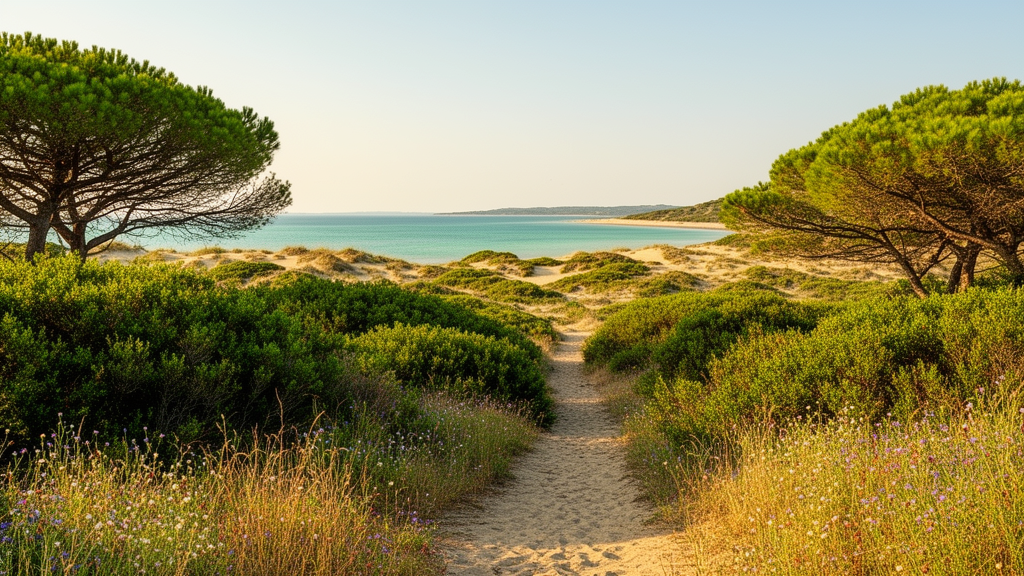
The geography of Feniglia is what makes it botanically exceptional. The dune system stretches roughly six kilometres long and one kilometre wide, covering about 4.92 square kilometres and rising no more than 14 metres above sea level. Together with another sandy strip, it encloses the Orbetello lagoon, cutting it off from the open Mediterranean Sea. According to the researchers, coastal dunes that lie in direct contact with coastal lagoons are genuinely rare in the Mediterranean Basin, where only about 54 main coastal lagoons exist and lagoon shores are typically dominated by shrubs or herbs rather than forest. Feniglia, by contrast, packs pine forest, dune and lagoon macrohabitats into a single narrow isthmus, a configuration that has earned it recognition as a protected biotope and as a distinctive biotope of the Mediterranean macchia.
The isthmus itself is a young landform, built during the late Quaternary period as carbonate-rich sands eroded from Monte Argentario were transported by sea waves and strong southwesterly winds. Its creation converted what was once an island of the Tuscan Archipelago into a promontory, and it now functions as an ecological corridor linking the peninsula to this former island, a connection of considerable biogeographical significance given the endemic animals and plants of Argentario. The sands that built the dune, however, nearly destroyed the lagoon when human mismanagement set them in motion again.
In the early 1800s, the municipality of Orbetello sold the dune to private owners who exploited it intensively for grazing and logging. Deforestation allowed sand to pour into the Orbetello lagoon, creating shallow marshes, harming fishing and increasing the risk of malaria. Authorities responded by building canals to improve water circulation, and reforestation plans were drafted around 1900, though landowners’ opposition delayed them until a 1910 law designated all of Feniglia as public land. In 1911, a consolidation and reforestation project began, mainly planting maritime pine and stone pine to stop the lagoon from silting up, alongside Mediterranean dune species such as Calamagrostis arenaria subsp. arundinacea, Cakile maritima, Juniperus macrocarpa, Euphorbia paralias and Medicago marina. The works covered about 360 hectares until 1925, and the forest eventually expanded to roughly 460 hectares. The researchers note this is likely the oldest ecological rehabilitation operation in Europe, and the new inventory was undertaken more than a century after it began.
Compiling the checklist demanded substantial detective work. The team retrieved all past botanical research conducted entirely or partly in the study area, from nineteenth-century surveys to studies carried out shortly after reforestation began and others conducted 70 to 80 years later, and complemented this data mining with fresh field surveys in 2023. Species recorded before the reforestation were excluded from the analyses, as were erroneous reports identified in theses, and planted species were counted only if they had naturalised. Collected specimens are preserved in the herbaria of Siena and Viterbo, and identifications followed standard Italian and European floras, with nomenclature aligned to the most recent checklists of the Italian flora. Each taxon was assigned a life form, a chorological type and ecological indicator values, and classified into preferential macrohabitats of forest, dune or lagoon to allow separate analyses.
The resulting inventory shows a flora dominated by three families: Poaceae with 72 taxa, Asteraceae with 54 and Fabaceae with 52, a pattern broadly consistent with the Italian flora as a whole, though with the first two families reversed. The high number of grasses reflects the presence of xerophilous, discontinuous small grasslands, including a priority habitat under the EU Habitats Directive that occurs as a mosaic in the pine forest understorey. The abundance of Amaranthaceae, with genera tied to coastal salt marshes, and Cyperaceae, linked to wet habitats, mirrors the isthmus’s brackish lagoon and freshwater wetlands. The genus Trifolium stands out with 16 taxa, likely favoured by sandy, silica-rich soils and numerous dry grasslands, while the natural presence of numerous Quercus species in such a limited area is noteworthy enough that the authors suggest it merits a dedicated study. Vascular cryptogams, by contrast, are represented by only two species, a scarcity the researchers attribute to limited summer water availability and the absence of rocky substrates.
A species-area analysis revealed that the observed flora is far richer than expected for an area of this size. The 502 recorded taxa exceed the predicted value of 377 by more than 33 percent, with native species exceeding expectations by 27.35 percent and alien species by 42.11 percent. The life-form spectrum is dominated by therophytes, short-lived plants that complete their cycle quickly and thrive on well-drained, nutrient-poor soils, followed by hemicryptophytes and phanerophytes. The ratio of hemicryptophytes to therophytes, at 0.54, reflects a Mediterranean-type bioclimate consistent with values reported for nearby protected areas. The chorological spectrum tells the same climatic story: Mediterranean species lead with 157 taxa, followed by Euromediterranean and Eurasiatic elements, confirming the picture painted by the biological forms and matching findings from other Tuscan coastal areas such as Monte Argentario, Diaccia Botrona and Lake Burano.
The conservation headline figures are striking. The inventory includes 15 species of the Tuscan Attention List and 3 species of the Italian Red List, alongside 3 Italian endemics: Ornithogalum exscapum, found in the pine forest; Limonium multiforme, endemic to the Tuscan coast from Livorno to the Ansedonia promontory; and Linaria purpurea, widespread in central and southern Italy. Sixteen species are considered rare in Tuscany, including Atriplex littoralis, whose Feniglia lagoon populations are the only recent and certain ones in the region and represent the southern limit of the species in Italy. Juncus sorrentinoi, known nationally only from Sardinia and Tuscany, is recorded here as only the second site for the region. Maresia nana, a psammophilous dune specialist, appears to survive in Tuscany at Feniglia alone. Staphisagria macrosperma, collected in the region over a century ago, persists in locally abundant populations near the reserve entrance on the Ansedonia side. Four species reach their northern distribution limit at Feniglia, and three species were found to be new for the province of Grosseto.
Alien species, often the bellwether of ecological degradation, are surprisingly scarce. The team found 26 alien species at the Italian level, of which 15 are invasive, 9 naturalised and 2 casual, a relatively low presence the researchers interpret as an excellent indicator of naturalness, especially since most occur with very limited populations. Of the numerous non-native species trialled during the historic reforestation experiments, including radiata pine, Monterey cypress and black locust, very few have naturalised and the majority are no longer present. Two discoveries stand out: Monterey cypress is reported as new to Tuscany, while white elm is new to the province of Grosseto. The lagoon environment, with its harsh salinity, anaerobic muddy substrate and fluctuating water levels, hosts no alien species at all and acts as a protective barrier for the isthmus. The authors also weigh in on the stone pine itself, noting that although some consider it alien in Italy, its Mediterranean origins and the persistence of dune species in its understorey mean not all authors agree on its alien status.
The study’s conclusions carry a message that extends well beyond one Tuscan dune. Feniglia has transitioned from shrubland to pasture to dune to forest over the past two centuries, yet it still supports species of particular conservation interest, many of them rare or at their geographical limits, and its low alien load signals genuine naturalness. The researchers argue that the multiple layers of protection now covering the area, as a State Nature Reserve, a Special Protection Area and part of Special Areas of Conservation, have been decisive in preserving its plant diversity despite the environmental upheavals of the last century and the tourist pressure of each summer. As a benchmark for future research in botany and related fields, the inventory demonstrates that floristic surveys, though time-demanding and increasingly neglected, remain the foundation for understanding and conserving natural heritage, and that well-designed protection can allow even a heavily modified landscape to recover its botanical soul.
Subject of Research: Floristic inventory of the vascular flora of the isthmus of Feniglia Nature Reserve in southern Tuscany, Italy
Article Title: Vascular flora of the isthmus of Feniglia (southern Tuscany, Italy)
Article References: Fiaschi, T., Bonari, G., Frignani, F., Gizzi, G., Landi, M., Magrini, S., Quilghini, G., Pafumi, E., Scoppola, A., & Angiolini, C. (2024). Vascular flora of the isthmus of Feniglia (southern Tuscany, Italy). Italian Botanist, 17, 77-101. https://doi.org/10.3897/italianbotanist.17.122982
Image Credits: AI Generated
DOI: 10.3897/italianbotanist.17.122982
Keywords: Feniglia, Tuscany, Italy, vascular flora, Mediterranean, coastal dunes, biodiversity, conservation, alien species, pine forest, Orbetello lagoon, endemic plants
News Source: Margaret Porter. (October 18, 2026). Vascular flora of the isthmus of Feniglia (southern Tuscany, Italy). Scienmag.