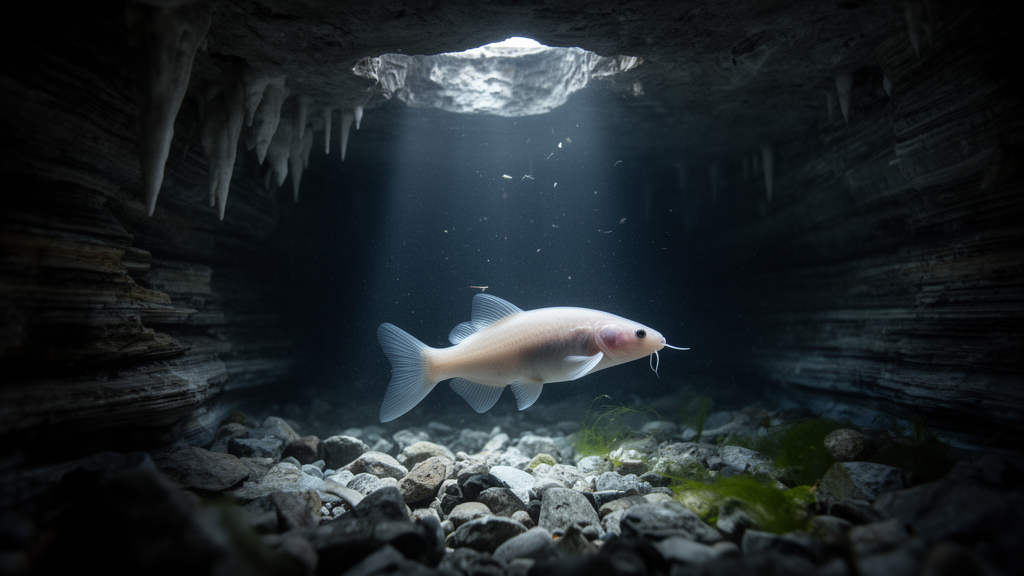
Deep beneath the limestone hills of northeastern Mexico, blind fish swim through pools that have never seen a ray of sunlight. What these fish eat, and how much food actually reaches their underground world, has long puzzled biologists. Now, a new study published in the journal Subterranean Biology has used chemical fingerprints locked into the muscle tissue of the blind Mexican tetra, Astyanax mexicanus, to reveal that the geometry of each cave, its depth, the distance from the entrance to the fish pools, and its position relative to the water table, directly shapes the food web that sustains life in perpetual darkness.
The research team analyzed seven cave populations of Astyanax mexicanus across two karst regions in the Mexican states of San Luis Potosí and Tamaulipas: the Sierra de El Abra and the Sierra de Guatemala. These two mountain systems host at least 30 known cavefish populations and represent distinct evolutionary lineages that arose independently from surface ancestors. By measuring the ratios of two stable isotopes, carbon-13 and nitrogen-15, in the muscle tissue of 47 fish collected during the dry season of 2017, the researchers reconstructed the trophic ecology of each population and compared it between regions, caves, and geological settings.
Stable isotope analysis works like a biological passport. The carbon isotope ratio, written as δ13C, reflects the diversity of primary productivity at the base of the food web, essentially telling researchers what kinds of carbon sources feed the ecosystem. The nitrogen isotope ratio, δ15N, increases predictably with each step up the food chain, so it reveals the trophic level of an organism. In caves, where photosynthesis is impossible and organic matter must be transported from the surface or produced by chemoautotrophic bacteria, these isotope signals become powerful tools for understanding how energy flows through an ecosystem that most people never see.
The results showed significant differences in both isotope signals among the seven cave populations. Within the Sierra de El Abra, Montecillos cave had the highest δ15N value at 10.9 parts per thousand, while Yerbaniz had the lowest at 9.2 parts per thousand. In the Sierra de Guatemala, Molino cave registered the lowest nitrogen signal at 8.6 parts per thousand. When the researchers compared the two regions directly, they found that populations from the Sierra de El Abra occupied a broader trophic niche area with lower trophic redundancy, meaning individuals within those populations were feeding on a wider variety of resources and competing less intensely for the same food items.
This regional difference is striking. The Sierra de El Abra system showed a total niche area of 3.27 compared to just 1.41 in the Sierra de Guatemala, along with higher values for mean distance to centroid and mean distance to nearest neighbor, all indicators of greater trophic diversity and less clustering around similar diets. The researchers suggest this could be linked to the geological history of the two systems, which have followed different evolutionary paths and may support different structures of trophic networks. Palma Seca cave in the Sierra de El Abra had the widest niche amplitude of any population at 7.06, while Vásquez cave in the Sierra de Guatemala had the narrowest at just 0.42.
To connect these isotope patterns to cave structure, the team developed a new metric called the Nutrient Input Index, or NI. This index compares the distance from the cave entrance to the first fish pool against the cave’s depth relative to the local groundwater level. A value greater than one indicates that the pool is closer to the entrance and receives more allochthonous material, organic matter transported from the surface. A value less than one means the pool is deeper and more isolated, where autochthonous sources, those generated within the cave itself, dominate. The researchers calculated NI values using topographic cave maps, published depth data, and measurements of the local phreatic mantle.
The relationship between the NI index and the isotope signals revealed something important. For carbon, the researchers found a significant negative relationship: as the NI index increased, meaning pools were closer to the surface and receiving more plant-derived material, the δ13C values became more depleted. This makes sense chemically, because surface plant material typically carries δ13C values between -35 and -25 parts per thousand, consistent with the range observed in the cavefish. Even in Vásquez cave, which reaches a depth of 270 meters, the fish showed carbon signals consistent with surface plant material, suggesting that decomposing organic matter still reaches even the deepest pools, either directly in the fish diet or through the prey they consume.
For nitrogen, the trend was positive but not statistically significant, hinting that caves with shallower pools and shorter distances from the entrance may support more complex trophic networks with additional trophic levels. The researchers propose that the influx of allochthonous material, driven by water currents, rainwater percolation, and animal access, significantly influences the trophic ecology within each cave. Caves with positive NI values, such as Montecillos and Palma Seca in the Sierra de El Abra and Molino and Caballo Moro in the Sierra de Guatemala, receive more surface-derived nutrients and may support richer food webs.
The findings carry broader implications for understanding how extreme environments shape evolution. Cavefish populations of Astyanax mexicanus have evolved at least three times independently from surface ancestors, losing their eyes and pigmentation while developing remarkable starvation tolerance and altered metabolism. The new study suggests that the selective pressures driving these adaptations may differ from cave to cave, depending on how much food reaches each population. In deeper caves with negative NI values, such as Escondido, Yerbaniz, and Vásquez, fish may face more intense competition for scarcer resources, potentially driving stronger selection for efficient foraging and energy conservation.
The researchers acknowledge limitations in their approach. The isotope signals of a consumer alone cannot fully reconstruct a trophic position without an appropriate isotopic baseline from primary producers and prey. Seasonality could also affect the results, as previous studies have reported variation in cavefish feeding across the year. Future studies should examine the entire trophic network, incorporate stomach content analysis, and measure resource inputs directly. Still, the Nutrient Input Index represents a pioneering tool for indirectly describing the trophic ecology of cave systems based on geomorphology alone, offering a promising approach to infer the intensity of selective pressures on cave-dwelling organisms across the world’s karst landscapes.
Subject of Research: Stable isotope analysis of blind Mexican tetra cave populations reveals trophic ecology differences linked to cave geomorphology
Article Title: Isotopic variability of δ 13 C and δ 15 N signals in cave systems: insights from the blind tetra Astyanax mexicanus
Article References: Hernández-Lozano, J., Córdova-Tapia, F., Miranda-Gamboa, R., Vázquez-Cruz, M. D. L., Garita-Alvarado, C., Mercado-Silva, N., & Ornelas-García, C. P. (2025). Isotopic variability of δ13C and δ15N signals in cave systems: insights from the blind tetra Astyanax mexicanus. Subterranean Biology, 51, 31-47. https://doi.org/10.3897/subtbiol.51.140856
Image Credits: AI Generated
DOI: 10.3897/subtbiol.51.140856
Keywords: cavefish, stable isotopes, Astyanax mexicanus, trophic ecology, karst caves, Sierra de El Abra, Sierra de Guatemala, nutrient input, blind tetra, subterranean ecosystems, Mexico, Isotopic
News Source: Gavin Prescott. (October 18, 2026). Cavefish isotope fingerprints reveal how cave geometry shapes food webs in the dark. Scienmag.