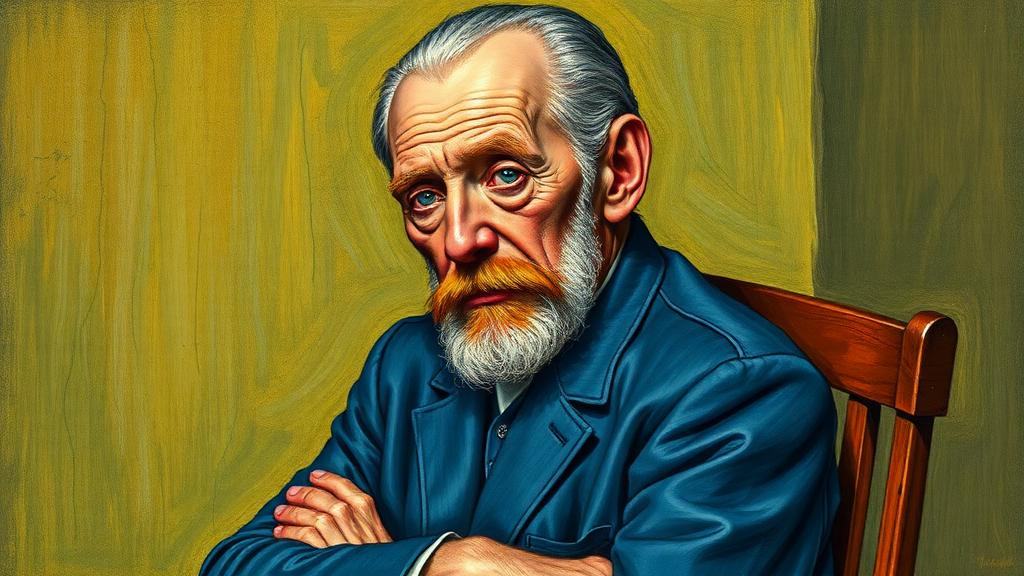
In May 1890, inside the asylum of Saint-Paul-de-Mausole in Saint-Rémy-de-Provence, Vincent van Gogh painted an old man bent forward on a chair beside a stove, his fists pressed into his eyes. The canvas, known as Sorrowing Old Man (At Eternity’s Gate), is now held at the Kröller-Müller Museum in Otterlo, and it is one of the most widely reproduced images of old age in distress. For clinicians who care for older people, the temptation to read it as a case study is almost irresistible: a solitary figure, withdrawn, hunched, apparently abandoned. A new essay published in European Geriatric Medicine by Murat Pehlivan and Burcu Balam Doğu of Hacettepe University argues that this reading collapses under the historical evidence, and that its collapse carries a practical lesson for geriatric medicine about the dangers of judging social circumstances by appearance alone.
The authors, writing in the journal’s Geriatric Medical Classics series, chose the painting precisely because it invites a clinical misreading. The figure seems to embody what geriatricians call social frailty, a state in which older adults lose social contact, roles and resources, and which research has shown to predict incident disability. Yet the documented history of the picture shows that it is not a portrait of one man’s condition at all. It is a figure type, reworked across a decade, drawn from multiple models and literary sources, and animated by religious and poetic intentions that have nothing to do with the clinical categories a modern viewer brings to it. The failure of the clinical reading, the authors argue, is instructive in itself.
The canvas reworks Van Gogh’s own lithograph of November 1882, one of several earlier works he took up again in 1890 while recovering at the asylum, after spending the winter copying other artists’ prints. The pose itself predates that print: the artist first drew it in 1881 with a different model. In The Hague he returned to the composition with two sitters, one of them Adrianus Jacobus Zuyderland, a veteran living in the Dutch Reformed Old Men’s and Women’s Home. Art historians have linked the attitude to Charles Dickens’s illustrated Christmas books and to English prints of aged pensioners, probably including Hubert von Herkomer’s The Last Muster. In 1883 Van Gogh also used the same pose for young women. With the face hidden by the man’s fists, what the painting shows is a figure type rather than a record of Zuyderland’s state of mind.
Van Gogh’s own account of the work confirms how far it sits from clinical observation. Sending his brother Theo the first proof of the lithograph, he described the unutterably moving quality of an old man sitting quietly by his hearth as evidence of something on high. Weeks later he named the poem he had in mind: Thomas Moore’s Oft, in the stilly night, whose speaker, having outlived his friends, feels like one who treads alone in some banquet-hall deserted. Consolation and bereavement are both present in the artist’s own framing. The 1890 canvas, executed in the heavy brushwork of his late style, also carries the painter’s own feeling. As the gerontologists Heta Kauppinen and Patricia McKee argued in an earlier study cited by the authors, painters are not illustrators of gerontological theory, and treating them as such distorts both the art and the science.
Even the identity of the model undermines the solitary reading. Zuyderland was a paid and regular sitter who appears in dozens of Hague drawings wearing a top hat and long coat, smoking a pipe, reading or saying grace. Van Gogh praised his old, lively face. Zuyderland, then 72, lived to 87. A clinician shown only the 1890 painting would judge the man lonely and withdrawn; a clinician shown Zuyderland in his top hat would judge him robust. Neither judgement would constitute evidence, and the painting itself cannot settle the question. No window indicates whether it is day or night. The heavy boots are as consistent with a recent return from outdoors as with remaining indoors. Nothing in the image establishes whether anyone visits or speaks to the sitter, whether he goes out, or whether his distress, if any, reflects grief, poverty, illness or prayer.
This is where the essay turns from art history to measurement. Makizako and colleagues, in a widely cited 2015 study, showed that social frailty predicts incident disability in community-dwelling older adults, and they operationalised the construct with five questions: going out less often than a year earlier, rarely visiting friends, feeling unhelpful to family or friends, living alone, and not talking with anyone every day. None of these items can be inferred from posture or facial expression. Each must be asked, and several are informative only when repeated over time. A single image, like a single glance in a clinic, cannot supply them.
The five questions also point in different clinical directions, the authors note. Living alone and the absence of daily conversation describe the structure of a person’s social network, and they call for attention to contact, support and services. Going out less often and feeling unhelpful to others, by contrast, describe withdrawal and the loss of social roles, and they call for attention to participation and purpose. The painting cannot distinguish between these dimensions, and neither can a clinician who does not ask. The answers must also be read alongside the rest of the assessment, because withdrawal may reflect depression, cognitive decline, hearing loss or reduced mobility as much as a shrinking network, and each of those conditions can in turn deepen isolation. A patient who cannot hear the telephone may appear to have contact while being effectively cut off from it.
The essay situates the problem within comprehensive geriatric assessment, the structured multidimensional evaluation that measures gait, grip strength, cognition and nutrition with validated instruments. The social domain, by contrast, is often judged by impression, and the Van Gogh case demonstrates exactly why that impression is unreliable. Writing previously in the same journal, Sai Shreya and Harshil Sai drew on Rembrandt’s portrayals of ageing to argue that geriatric practice must hold a diagnostic and a human gaze together. Pehlivan and Doğu push the argument further: for social frailty even that dual gaze is insufficient, because the facts that matter are visible to neither gaze. Informants can mislead in the same way as appearances. A relative who brings the patient to clinic may be the only regular contact, and being accompanied on the day of the appointment says nothing about the rest of the week.
Moore’s poem also suggests when the relevant facts change. Its speaker is not neglected but bereaved, the last survivor of his circle, and this points to a pattern that clinicians can anticipate. In late life, a social network often contracts at identifiable transitions rather than gradually: the death of a spouse or friend, a move of home, entry to long-term care, or discharge from hospital. A single drawing of Zuyderland, like a single clinic visit, can support conclusions that the person’s circumstances do not warrant. The remedy the authors propose is correspondingly practical rather than philosophical. The five screening questions take little time and belong in the social history of every comprehensive geriatric assessment, including the assessment made before hospital discharge, where the risk of an abrupt contraction of support is highest.
A positive answer, the authors stress, should prompt further enquiry rather than a label: whether the person feels lonely, whether the change is recent, and what exactly has been lost. The answers should be recorded in structured form and reviewed at subsequent visits and at each of the recognised transitions, so that change over time, rather than a single observation, becomes the object of assessment. The lesson of the painting, then, is not that Van Gogh painted social frailty, but that he painted something clinicians are predisposed to read as social frailty, and that this predisposition is itself a source of error. In an era when loneliness is increasingly treated as a medical risk factor, the essay is a reminder that the most important information about an older person’s social world is not on display in their posture or their face. It has to be asked for, recorded, and asked for again.
Subject of Research: Social frailty assessment in older adults and the limits of clinical observation, illustrated through Van Gogh's painting
Article Title: Through Van Gogh's eyes: social frailty and the limits of clinical seeing
Article References: Pehlivan, M., & Doğu, B. B. (2026). Through Van Gogh's eyes: social frailty and the limits of clinical seeing. European Geriatric Medicine. https://doi.org/10.1007/s41999-026-01625-5
Image Credits: AI Generated
DOI: 10.1007/s41999-026-01625-5
Keywords: social frailty, Van Gogh, loneliness, comprehensive geriatric assessment, older adults, geriatric medicine, medical humanities, art history, ageing, disability risk, social networks, clinical observation
News Source: Beatrice Stafford. (October 12, 2026). Van Gogh’s Sorrowing Old Man Reveals Why Clinicians Misjudge Loneliness in Older Patients. Scienmag.