Van Andel Institute’s Nick Burton, Ph.D., has earned a five-year, nearly $2.9 million New Innovator Award from the National Institutes of Health Common Fund to find new ways to fix or prevent insulin resistance, a key driver of Type 2 diabetes.
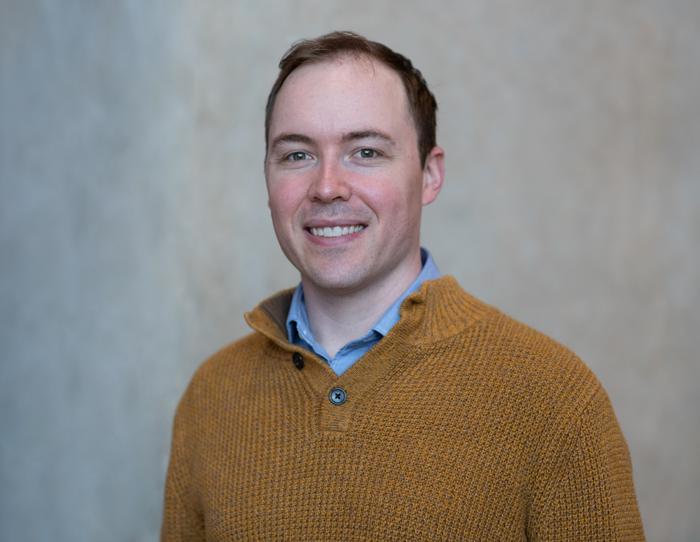
Credit: Courtesy of Van Andel Institute
Van Andel Institute’s Nick Burton, Ph.D., has earned a five-year, nearly $2.9 million New Innovator Award from the National Institutes of Health Common Fund to find new ways to fix or prevent insulin resistance, a key driver of Type 2 diabetes.
Although manageable with treatment, there currently is no way to repair the underlying mechanisms that cause the disease. Furthermore, it remains unclear why some people are more prone to Type 2 diabetes while others are resistant. To find a solution, Burton and his team are turning to nature — namely, pinpointing bacteria that influence insulin production and signaling.
“The New Innovator Award will allow us to establish a protocol for identifying new species of bacteria that regulate insulin signaling and the mechanisms they use to do so. Insights from this work will help us understand why some people who eat similar diets are more susceptible to diabetes than others,” Burton said. “In the future, we hope this approach will lead to new therapeutic strategies for Type 2 diabetes.”
One in 10 people in the U.S. — more than 35 million people — have Type 2 diabetes. Another 96 million, or 38%, of people aged 18 and older have higher-than-normal blood sugar levels that put them at risk of developing the disease.
At the root of Type 2 diabetes is insulin resistance, which occurs when cells no longer respond to the hormone tasked with managing blood sugar. The resulting sustained increase in blood sugar can impede healthy function and contribute to ulcers, tough-to-treat infections, kidney problems, and tissue and nerve damage, among other symptoms.
The New Innovator Award will enable Burton and his team to deploy the first-ever, large-scale screen for bacteria that modify insulin signaling. Analysis of initial samples gathered from a small-scale, proof-of-concept pilot conducted over the past year is ongoing, but the preliminary results are promising, Burton says.
“Growing evidence suggests bacteria that reside in the human gut help the body govern insulin levels,” he said. “We believe other bacteria species also are capable of impacting insulin. We hope to find novel bacteria, which would open a new realm of research with game-changing implications for health.”
The New Innovator Award was established in 2007 as part of the NIH Common Fund’s Director’s Awards and supports “unusually innovative research from early career investigators,” according to NIH.
Burton joined Van Andel Institute in 2021 as an assistant professor in the Department of Epigenetics. Prior to arriving in Grand Rapids, he was an independent Next Generation Fellow at the Centre for Trophoblast Research at University of Cambridge in the U.K.
Research reported in this publication was supported by the NIH Common Fund and administered by the National Institute of Diabetes and Digestive and Kidney Diseases of the National Institutes of Health under award no. DP2DK139569 (Burton). The content is solely the responsibility of the authors and does not necessarily represent the official views of the National Institutes of Health.
###
ABOUT VAN ANDEL INSTITUTE
Van Andel Institute (VAI) is committed to improving the health and enhancing the lives of current and future generations through cutting-edge biomedical research and innovative educational offerings. Established in Grand Rapids, Michigan, in 1996 by the Van Andel family, VAI is now home to more than 500 scientists, educators and support staff, who work with a growing number of national and international collaborators to foster discovery. The Institute’s scientists study the origins of cancer, Parkinson’s and other diseases and translate their findings into breakthrough prevention and treatment strategies. Our educators develop inquiry-based approaches for K-12 education to help students and teachers prepare the next generation of problem-solvers, while our Graduate School offers a rigorous, research-intensive Ph.D. program in molecular and cellular biology. Learn more at vai.org.