

• HOME
  • NEWS
  • EXPLORE
    • CAREER
      • Companies
      • Jobs
    • EVENTS
    • iGEM
      • News
      • Team
    • PHOTOS
    • VIDEO
    • WIKI
  • BLOG
  • COMMUNITY
    • FACEBOOK
    • INSTAGRAM
    • TWITTER
Thursday, May 21, 2026
BIOENGINEER.ORG
No Result
View All Result
  • Login
  • HOME
  • NEWS
  • EXPLORE
    • CAREER
      • Companies
      • Jobs
        • Lecturer
        • PhD Studentship
        • Postdoc
        • Research Assistant
    • EVENTS
    • iGEM
      • News
      • Team
    • PHOTOS
    • VIDEO
    • WIKI
  • BLOG
  • COMMUNITY
    • FACEBOOK
    • INSTAGRAM
    • TWITTER
  • HOME
  • NEWS
  • EXPLORE
    • CAREER
      • Companies
      • Jobs
        • Lecturer
        • PhD Studentship
        • Postdoc
        • Research Assistant
    • EVENTS
    • iGEM
      • News
      • Team
    • PHOTOS
    • VIDEO
    • WIKI
  • BLOG
  • COMMUNITY
    • FACEBOOK
    • INSTAGRAM
    • TWITTER
No Result
View All Result
Bioengineer.org
No Result
View All Result
Home NEWS Science News Chemistry

Vacuum in optical cavity can change material’s magnetic state without laser excitation

Bioengineer by Bioengineer
November 3, 2023
in Chemistry
Reading Time: 3 mins read
0
α-RuCl3 inside an optical cavity
Share on FacebookShare on TwitterShare on LinkedinShare on RedditShare on Telegram

Researchers in Germany and the USA have produced the first theoretical demonstration that the magnetic state of an atomically thin material, α-RuCl3, can be controlled solely by placing it into an optical cavity. Crucially, the cavity vacuum fluctuations alone are sufficient to change the material’s magnetic order from a zigzag antiferromagnet into a ferromagnet. The team’s work has been published in npj Computational Materials.
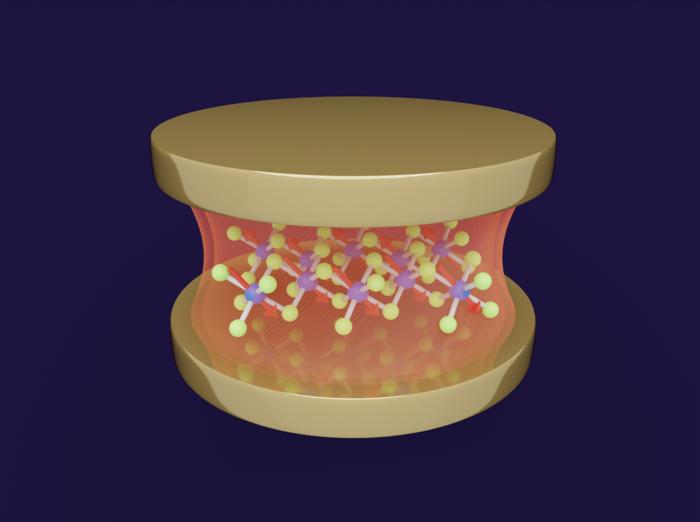
α-RuCl3 inside an optical cavity

Credit: J. Harms, MPSD

Researchers in Germany and the USA have produced the first theoretical demonstration that the magnetic state of an atomically thin material, α-RuCl3, can be controlled solely by placing it into an optical cavity. Crucially, the cavity vacuum fluctuations alone are sufficient to change the material’s magnetic order from a zigzag antiferromagnet into a ferromagnet. The team’s work has been published in npj Computational Materials.

A recent theme in material physics research has been the use of intense laser light to modify the properties of magnetic materials. By carefully engineering the laser light’s properties, researchers have been able to drastically modify the electrical conductivity and optical properties of different materials. However, this requires continuous stimulation by high-intensity lasers and is associated with some practical problems, mainly that it is difficult to stop the material from heating up. Researchers are therefore looking for ways to gain similar control over materials using light, but without employing intense lasers.

Now theoreticians at the Max Planck Institute for the Structure and Dynamics of Matter (MPSD) in Hamburg, Germany, Stanford University and the University of Pennsylvania (both in the USA) have come up with a fundamentally different approach to change a real material’s magnetic properties in a cavity  – without the use of any laser light. Their collaboration shows that the cavity alone is enough to turn the zigzag antiferromagnet α-RuCl3 into a ferromagnet.

Crucially, the team demonstrates that even in an apparently dark cavity, α-RuCl3 senses modifications of the electromagnetic environment and changes its magnetic state accordingly. This is a purely quantum mechanical effect, arising from the fact that within quantum theory the empty cavity (technically called the vacuum state) is never really empty. Instead, the light field fluctuates so that light particles pop in and out of existence which, in turn, affects the properties of the material.

“The optical cavity confines the electromagnetic field to a very small volume, thereby enhancing the effective coupling between the light and the material,” explains lead author Emil Viñas Boström, a postdoctoral researcher in the MPSD Theory Group. “Our results show that carefully engineering the vacuum fluctuations of the cavity electric field can lead to drastic changes in a material’s magnetic properties.” As no light excitation is needed, the approach in principle circumvents the problems associated with continuous laser driving.

This is the first work demonstrating such cavity control over magnetism in a real material, and follows previous investigations into cavity control of ferroelectric and superconducting materials. The researchers hope that designing specific cavities will help them realize new and elusive phases of matter, and to better understand the delicate interplay between light and matter.


Journal

npj Computational Materials

DOI

10.1038/s41524-023-01158-6

Article Title

Controlling the magnetic state of the proximate quantum spin liquid α-RuCl3 with an optical cavity


Share12Tweet8Share2ShareShareShare2

Related Posts

Scientists Achieve Breakthrough in Molecular ‘Sandwich’ Assembly — Chemistry

Scientists Achieve Breakthrough in Molecular ‘Sandwich’ Assembly

May 21, 2026
Advancing In Vivo and In Situ Monitoring: Science Bulletin Highlights Host-Based Antifouling Gold Nanotube Sensor for Selective Detection of Mechanically Sensitive Serotonin Release in Intestinal Mucosa — Chemistry

Advancing In Vivo and In Situ Monitoring: Science Bulletin Highlights Host-Based Antifouling Gold Nanotube Sensor for Selective Detection of Mechanically Sensitive Serotonin Release in Intestinal Mucosa

May 20, 2026

How Magnetic Orientation Could Influence the Building Blocks of Life

May 20, 2026

Breaking a 200-Year-Old Belief: Novel Surface Design Achieves Two Distinct Wetting States on One Substrate

May 20, 2026

POPULAR NEWS

  • blank

    New Study Reveals Plants Can Detect the Sound of Rain

    733 shares
    Share 292 Tweet 183
  • ESMO 2025: mRNA COVID Vaccines Enhance Efficacy of Cancer Immunotherapy

    304 shares
    Share 122 Tweet 76
  • Research Indicates Potential Connection Between Prenatal Medication Exposure and Elevated Autism Risk

    846 shares
    Share 338 Tweet 212
  • Breastmilk Balances E. coli and Beneficial Bacteria in Infant Gut Microbiomes

    58 shares
    Share 23 Tweet 15

About

We bring you the latest biotechnology news from best research centers and universities around the world. Check our website.

Follow us

Recent News

Nonlinear Atomic Tunneling Enhanced by Bright Squeezed Vacuum

Label-Free Super-Resolution Imaging of Live Cells

Genetic Insights from 619,372 Metabolic Profiles

Subscribe to Blog via Email

Enter your email address to subscribe to this blog and receive notifications of new posts by email.

Join 82 other subscribers
  • Contact Us

Bioengineer.org © Copyright 2023 All Rights Reserved.

Welcome Back!

Login to your account below

Forgotten Password?

Retrieve your password

Please enter your username or email address to reset your password.

Log In
No Result
View All Result
  • Homepages
    • Home Page 1
    • Home Page 2
  • News
  • National
  • Business
  • Health
  • Lifestyle
  • Science

Bioengineer.org © Copyright 2023 All Rights Reserved.