


Simple tags can make a difference
Credit: Jingwen Zhang/courtesy illustration
Social media misinformation can negatively influence people’s attitudes about vaccine safety and effectiveness, but credible organizations — such as research universities and health institutions — can play a pivotal role in debunking myths with simple tags that link to factual information, University of California, Davis, researchers, suggest in a new study.
Researchers found that fact-check tags located immediately below or near a post can generate more positive attitudes toward vaccines than misinformation alone, and perceived source expertise makes a difference.
“In fact, fact-checking labels from health institutions and research universities were seen as more ‘expert’ than others, indirectly resulting in more positive attitudes toward vaccines,” said Jingwen Zhang, assistant professor of communication and lead author of the study.
The findings were published online Wednesday, Jan. 6, in the journal Preventive Medicine.
Has implications for COVID-19
The data was collected in 2018 — before the COVID-19 pandemic — but the study’s results could influence public communications about COVID-19 vaccines, researchers said.
“The most important thing I learned from this paper is that fact checking is effective…giving people a simple label can change their attitude,” Zhang said. “Secondly, I am calling for more researchers and scientists to engage in public health and science communications. We need to be more proactive. We are not using our power right now.”
While there is a strong consensus in the medical community that vaccines are safe, cost-effective and successful in preventing diseases, widespread vaccine hesitancy has resurged in many countries, the study said. The United States has faced issues with lower-than-preferred vaccine participation for influenza and even measles, which medical experts blamed for a 2019 measles outbreak. “Because both individuals and groups can post misinformation, such as false claims about vaccines, social media have played a role in spreading misinformation,” Zhang said.
Study authors tested the effects of simple fact-checking labels with 1,198 people nationwide who showed different levels of vaccine hesitancy. In the experiment, researchers used multiple misinformation messages covering five vaccine types and five categories of 13 different fact-checking sources. They avoided any explanations that repeated the false information.
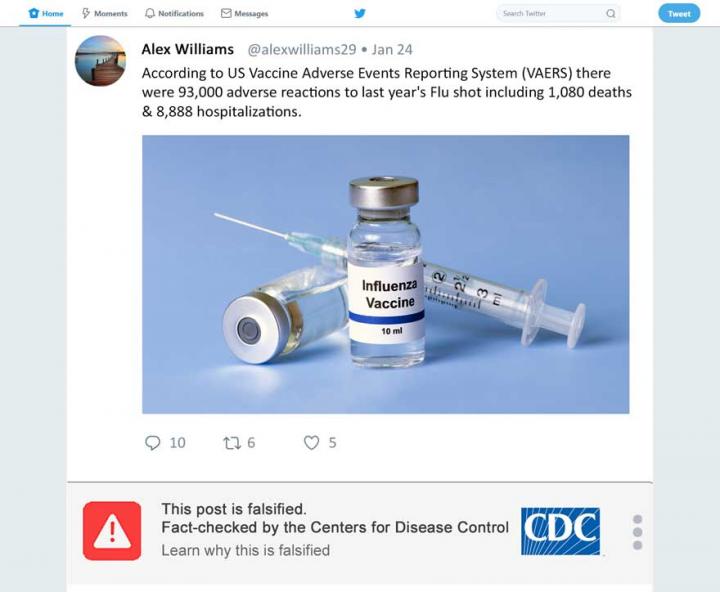
Using a mock twitter account, one post, for example, consisted of a misinformation claim on a specific vaccine and a picture of a vaccine bottle. It read: “According to a US Vaccine Adverse Events Reporting System (VAERS) there were 93,000 adverse reactions to last year’s Flu Shot including 1,080 deaths & 8,888 hospitalizations.”
Researchers then used alternating fact-checking labels from various sources in media, health organizations such as the Centers for Disease Control and Prevention, Johns Hopkins University, and algorithms. One read, for example, “This post is falsified. Fact-checked by the Centers For Disease Control. Learn why this is falsified.”
The results showed that those exposed to fact-checking labels were more likely to develop more positive attitudes toward vaccines than misinformation alone. Further, the labels’ effect was not moderated by vaccine skepticism, the type of vaccine misinformation or political ideology.
“What approaches are most effective at targeting vaccine misinformation on social media among users unlikely to visit fact-checking websites or engage with thorough corrections?” researchers asked in the paper. “This project shows that seeing a fact-checking label immediately below a misinformation post can make viewers more favorable toward vaccines.”
She explained that a tag could be as simple as a reply to a misinforming tweet that explains the information is false, and links to credible information at a university or institutional web site.
Ideally, she said, tagging should be done by social media companies such as Facebook and Twitter. She said social media companies are working with entities, such as the WHO, to correct misinformation. “We are headed in the right direction, but more needs to happen,” she said.
###
Study co-authors included Magdalena Wojcieszak, associate professor of communication, and doctoral students Jieyu Ding Featherstone (Department of Communication) and Christopher Calabrese (Department of Public Health Sciences), all of UC Davis.
Link to study: https:/
Media Contact
Karen Nikos-Rose
[email protected]
Related Journal Article
http://dx.



