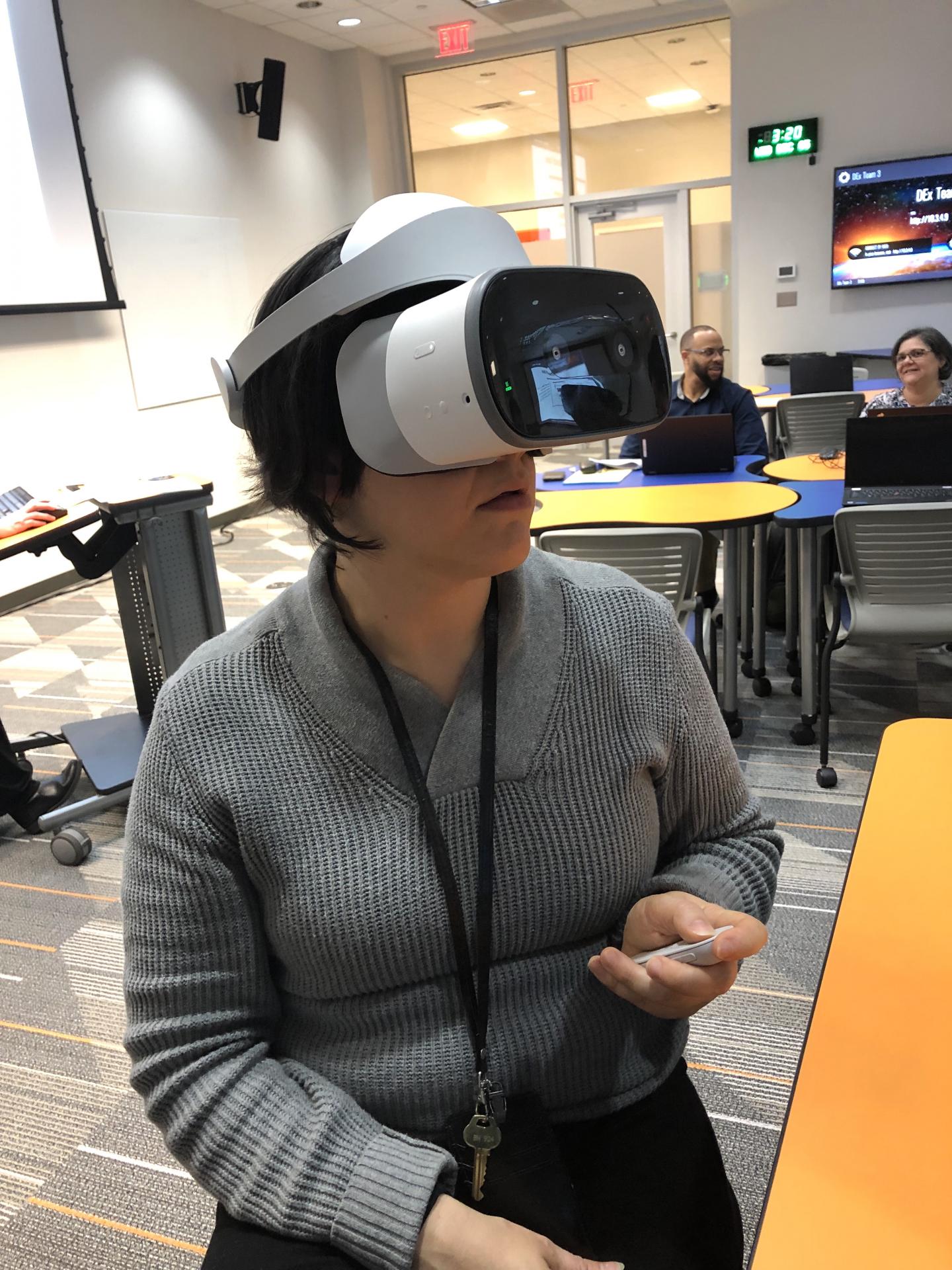
Credit: Photo courtesy of UTSA
(Dec. 17, 2018) — Persons using virtual reality may experience feelings of dizziness, nausea and even a loss of equilibrium. Although it may appear to be the onset of an illness, the real diagnosis could be cybersickness. Thanks to research by cyber experts at The University of Texas at San Antonio, this experience might be relegated to cyber past.
John Quarles, associate professor in the Department of Computer Science at UTSA, has won a grant from the Intel Corporation to create an algorithm called Cyberwell that automatically reduces the negative side effects of virtual reality on the end user.
“We are studying what is causing (cybersickness) and how we can predict it earlier,” says Quarles about the focus of the research. “What are the aspects of each individual that we can use to predict better and personalize reducing cybersickness.”
Cybersickness is similar to motion sickness and symptoms may even include dull headaches. It occurs when there is a conflict or mismatch between the visual system, what the user of VR perceives, and the vestibular system, the system that is responsible for balance and spatial orientation in a person.
“Imagine you are driving in a virtual car. You think you are driving forward in a car, but your sense of balance will tell you that you are not driving forward,” Quarles explains. “There is a conflict between two sensory systems, theoretically that’s what makes you nauseous.”
The need to mitigate the effects of cybersickness is urgent. Although heavy game users may have grown accustomed to simulated environments, it’s the rest of the population which will experience unease. According to Quarles, among non-heavy users of VR or games, between 50% to 80% of people will experience some discomfort. The high incidence of side effects in simulated realities can serve as a barrier for VR penetration which can be used beyond the gaming world and serve as a medical or educational training tool. Already, UTSA has the Dex Lab where students can simulate work with chemicals in a virtual environment to learn about lab safety.
The UTSA “Cyberwell” approach to treat cybersickness will be undertaken by Quarles with the collaboration of UTSA Professors Paul Rad, Dakai Zhu, Yufei Huang. This group, which brings multidisciplinary approaches to the work including artificial intelligence and bioinformatics, will design a series of experiments that will measure participants’ physiological responses including electrical brain activity through EEGs and galvanic skin responses during a VR simulation. The feedback will be tracked and inputted into a computer program which will then utilize deep learning models to recognize the patterns that indicate when cybersickness is about to occur. The end goal is that the virtual simulation will immediately make individual adjustments to personalize cybersickness reduction. Some of the adjustments will include reducing the field of vision or blurring the periphery in the environment.
The work will be conducted in the San Antonio Virtual Environments (SAVE) lab located in UTSA. The Intel Corporation only awarded 7 grants with UTSA receiving $200,000 for its machine learning approach. Quarles and the rest of the team expect results by the summer of 2019.
The need for a cybersickness solution is greatly needed. The virtual reality market is projected to be valued at $40 Billion by 2020 according to the Orbis Research group. Much hope is that the UTSA Cyberwell algorithm will be rolled out into any VR platforms to help grow the industry beyond its gaming scope.
“I want it to be used to teach kids and STEM,” says Quarles about why he works towards a cybersickness cure.
###
Media Contact
Milady Nazir
[email protected]
210-458-2087
Original Source
https:/