The National Science Foundation (NSF) has awarded a $2 million grant through its Emerging Frontiers in Research Initiatives (EFRI) program to investigators at the UTSA MATRIX AI Consortium for Human Well-Being for research that will help bridge the gap between human brain processing efficiency and the limitations of current artificial intelligence (AI) models.
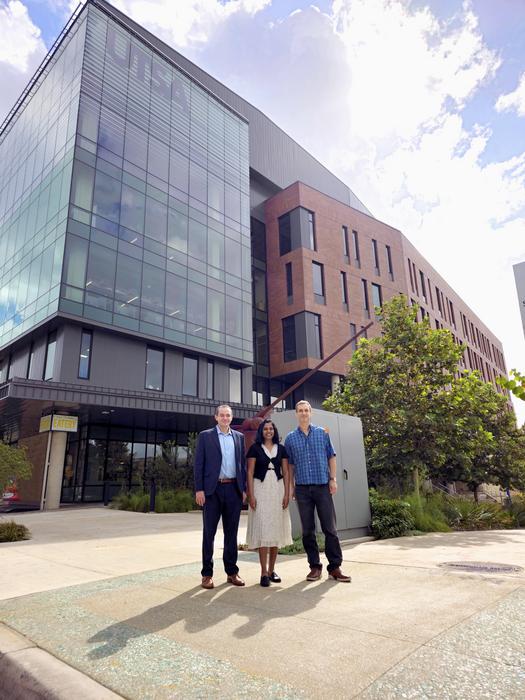
Credit: The University of Texas at San Antonio
The National Science Foundation (NSF) has awarded a $2 million grant through its Emerging Frontiers in Research Initiatives (EFRI) program to investigators at the UTSA MATRIX AI Consortium for Human Well-Being for research that will help bridge the gap between human brain processing efficiency and the limitations of current artificial intelligence (AI) models.
This endeavor seeks to create a new form of AI that rapidly learns, adapts to and operates in uncertain conditions, all while effectively addressing the energy challenge plaguing modern AI.
Dhireesha Kudithipudi, the McDermott Endowed Chair in the Department of Electrical and Computer Engineering at UTSA and founding director of MATRIX AI, is the principal investigator (PI) for the project. Her co-PIs include Christopher Kanan (University of Rochester), Garrett Rose (University of Tennessee, Knoxville), John Basl(Northeastern University) and Itamar Lerner, an assistant professor in the UTSA Department of Psychology.
“This $2 million grant for pioneering research represents a significant step toward unlocking the potential of AI, aligning it with the efficient temporal learning principles of the human brain,” said Eric Brey, interim dean of the Margie and Bill Klesse College of Engineering and Integrated Design at UTSA. “The implications are vast, promising a future where AI systems are not only efficient but also adaptive and lifelong learners, revolutionizing industries and benefiting society at large.”
The team will draw ideas from the Temporal Scaffolding Hypothesis, a theory that mirrors the human brain’s ability to process temporal patterns during both wakefulness and sleep. Unlike contemporary AI models, the human brain is great at doing lots of different things and handling information relating to different time frames, all while exerting very little energy. This stark contrast serves as the driving force behind the quest to create AI models that can emulate the human brain’s adaptability and efficiency.
According to the hypothesis, our brains are good at understanding patterns by replaying our daily experiences quickly while we sleep. The research team wants to create computer systems that work similarly, helping us solve complex problems efficiently. These systems could be used in important areas like health care, self-driving technology and national security.
“This research will help create new computer programs that quickly simulate and understand our past experiences in a simpler way. By combining brain science ideas and real-life experiments, we can test and improve how these computer programs work, changing the way we study them,” Kudithipudi said. “Copying how our brain learns about time helps AI require less power, which is a big issue in today’s AI technology.”
“We are all very proficient in detecting temporal patterns, even when we are not expecting them,” added Lerner. “For example, think about when you first realized that the number of times a church bell rings tells the current hour. This project aims to explore the possibility that sleep helps us capture such non-trivial patterns and attempts to implement it in AI systems through machine learning thus pushing forward the AI landscape informed by neuroscientific principles.”
In addition to advancing AI technology, this project seeks to empower the future workforce in artificial intelligence. The team is committed to providing new training opportunities for underrepresented students in AI fields and fostering a competitive AI workforce to maintain the nation’s leadership and competitiveness in science, technology, engineering and mathematics (STEM).