• HOME
  • NEWS
  • EXPLORE
    • CAREER
      • Companies
      • Jobs
    • EVENTS
    • iGEM
      • News
      • Team
    • PHOTOS
    • VIDEO
    • WIKI
  • BLOG
  • COMMUNITY
    • FACEBOOK
    • INSTAGRAM
    • TWITTER
Saturday, May 16, 2026
BIOENGINEER.ORG
No Result
View All Result
  • Login
  • HOME
  • NEWS
  • EXPLORE
    • CAREER
      • Companies
      • Jobs
        • Lecturer
        • PhD Studentship
        • Postdoc
        • Research Assistant
    • EVENTS
    • iGEM
      • News
      • Team
    • PHOTOS
    • VIDEO
    • WIKI
  • BLOG
  • COMMUNITY
    • FACEBOOK
    • INSTAGRAM
    • TWITTER
  • HOME
  • NEWS
  • EXPLORE
    • CAREER
      • Companies
      • Jobs
        • Lecturer
        • PhD Studentship
        • Postdoc
        • Research Assistant
    • EVENTS
    • iGEM
      • News
      • Team
    • PHOTOS
    • VIDEO
    • WIKI
  • BLOG
  • COMMUNITY
    • FACEBOOK
    • INSTAGRAM
    • TWITTER
No Result
View All Result
Bioengineer.org
No Result
View All Result
Home Headlines

UTHealth scientists help explain how dietary fat affects stem cell differentiation

Bioengineer.org by Bioengineer.org
January 20, 2018
in Headlines, Health, Science News
Reading Time: 2 mins read
0
Share on FacebookShare on TwitterShare on LinkedinShare on RedditShare on Telegram
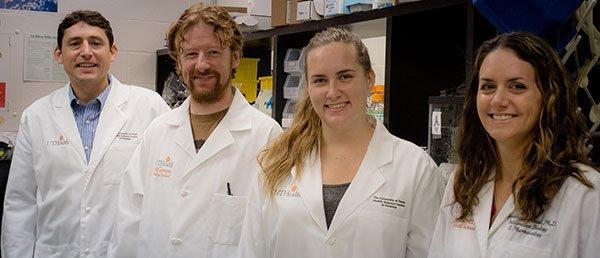
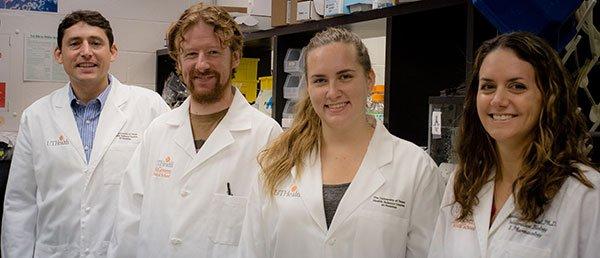
IMAGE

Credit: Maricruz Kwon, UTHealth

You are what you eat when it comes to fat, report scientists from McGovern Medical School at The University of Texas Health Science Center at Houston (UTHealth) in the journal Science Advances.

Dietary fats are converted into lipids, which make up the membranes that surround all living cells.

The type of fat a person consumes may determine whether stem cells are converted into bone cells or fat cells, said Ilya Levental, Ph.D., the study's senior author and assistant professor of integrative biology and pharmacology at McGovern Medical School at UTHealth.

"The fats that we consume such as cholesterol, unsaturated fats and fish oil become robustly incorporated into the membranes of our cells and dramatically change the composition and function of those membranes," said Levental, a Cancer Prevention & Research Institute of Texas (CPRIT) Scholar.

To test their theory, Kandice Levental, Ph.D., the study's lead author and assistant professor of integrative biology and pharmacology at McGovern Medical School, measured the lipid content of mesenchymal (connective tissue) stem cells as they transformed into bone cells or fat cells.

The Leventals found that bone cell membranes had unique compositions, being particularly high in a type of dietary fat, omega-3 polyunsaturated fat. This fat is also called DHA and is the most abundant component of fish oil, a common dietary supplement. Most importantly, they found that adding such fish oil fats to mesenchymal stem cells pushed them to transform into osteoblasts (bone-forming cells) as opposed to adipocytes (fat-storing cells).

This fundamental research helps explain why fish oil might benefit people with osteoporosis, a bone weakening disorder. More broadly, it may provide insight into the many connections between dietary fats and a variety of clinical outcomes, including healthy aging and heart disease.

"Our investigations suggest a general mechanism by which dietary fats affect cellular physiology through remodeling of membrane lipidomes, biophysical properties and signaling," the authors wrote.

###

UTHealth coauthors included Joseph Lorent, Ph.D.; Yong Zhou, Ph.D.; CPRIT Scholar Jeffrey Chang, Ph.D.; and John F. Hancock, M.B., BChir, Ph.D. Also contributing to the paper were Michael A. Surma, Ph.D., and Christian Klose, Ph.D., of Lipotype GmbH in Dresden, Germany, and Allison D. Skinkle, an undergraduate researcher from Rice University.

The study, titled "ω-3 polyunsaturated fatty acids direct differentiation of the membrane phenotype in mesenchymal stem cells to potentiate osteogenesis," was supported by CPRIT (R1215), NIH/National Institute of General Medical Sciences (1RO1GM114282) and the Volkswagen Foundation (93091).

Chang, Hancock and Ilya Levental are on the faculty of The University of Texas MD Anderson Cancer Center UTHealth Graduate School of Biomedical Sciences. Hancock is the John S. Dunn Distinguished University Chair in Physiology and Medicine at UTHealth.

Media Contact

Rob Cahill
[email protected]
713-500-3030

http://www.uthouston.edu

Share12Tweet7Share2ShareShareShare1

Related Posts

Perinatal and Early Childhood Factors in PFAPA Persistence — Technology and Engineering

Perinatal and Early Childhood Factors in PFAPA Persistence

May 16, 2026

New Actinomycin Derivatives Target Malaria More Selectively

May 16, 2026

Mobile App Enhances Exercise for Older Adults’ Cognition

May 16, 2026

Botulinum Toxin Reduces Urinary Retention Post-Hemorrhoidopexy

May 16, 2026
Please login to join discussion

POPULAR NEWS

  • Research Indicates Potential Connection Between Prenatal Medication Exposure and Elevated Autism Risk

    843 shares
    Share 337 Tweet 211
  • New Study Reveals Plants Can Detect the Sound of Rain

    730 shares
    Share 291 Tweet 182
  • Salmonella Haem Blocks Macrophages, Boosts Infection

    62 shares
    Share 25 Tweet 16
  • Breastmilk Balances E. coli and Beneficial Bacteria in Infant Gut Microbiomes

    58 shares
    Share 23 Tweet 15

About

We bring you the latest biotechnology news from best research centers and universities around the world. Check our website.

Follow us

Recent News

Perinatal and Early Childhood Factors in PFAPA Persistence

New Actinomycin Derivatives Target Malaria More Selectively

Mobile App Enhances Exercise for Older Adults’ Cognition

Subscribe to Blog via Email

Enter your email address to subscribe to this blog and receive notifications of new posts by email.

Join 82 other subscribers
  • Contact Us

Bioengineer.org © Copyright 2023 All Rights Reserved.

Welcome Back!

Login to your account below

Forgotten Password?

Retrieve your password

Please enter your username or email address to reset your password.

Log In
No Result
View All Result
  • Homepages
    • Home Page 1
    • Home Page 2
  • News
  • National
  • Business
  • Health
  • Lifestyle
  • Science

Bioengineer.org © Copyright 2023 All Rights Reserved.