

• HOME
  • NEWS
  • EXPLORE
    • CAREER
      • Companies
      • Jobs
    • EVENTS
    • iGEM
      • News
      • Team
    • PHOTOS
    • VIDEO
    • WIKI
  • BLOG
  • COMMUNITY
    • FACEBOOK
    • INSTAGRAM
    • TWITTER
Friday, June 12, 2026
BIOENGINEER.ORG
No Result
View All Result
  • Login
  • HOME
  • NEWS
  • EXPLORE
    • CAREER
      • Companies
      • Jobs
        • Lecturer
        • PhD Studentship
        • Postdoc
        • Research Assistant
    • EVENTS
    • iGEM
      • News
      • Team
    • PHOTOS
    • VIDEO
    • WIKI
  • BLOG
  • COMMUNITY
    • FACEBOOK
    • INSTAGRAM
    • TWITTER
  • HOME
  • NEWS
  • EXPLORE
    • CAREER
      • Companies
      • Jobs
        • Lecturer
        • PhD Studentship
        • Postdoc
        • Research Assistant
    • EVENTS
    • iGEM
      • News
      • Team
    • PHOTOS
    • VIDEO
    • WIKI
  • BLOG
  • COMMUNITY
    • FACEBOOK
    • INSTAGRAM
    • TWITTER
No Result
View All Result
Bioengineer.org
No Result
View All Result
Home NEWS Science News Chemistry

UTA preps giant particle detectors for neutrino project

Bioengineer by Bioengineer
March 14, 2024
in Chemistry
Reading Time: 3 mins read
0
Physicists shown at CERN inside the prototype detector
Share on FacebookShare on TwitterShare on LinkedinShare on RedditShare on Telegram

With excavation work complete at the site where four gigantic particle detectors for the international Deep Underground Neutrino Experiment (DUNE) will be installed, scientists are preparing to begin construction on first detector. Part of that work is taking place at The University of Texas at Arlington.
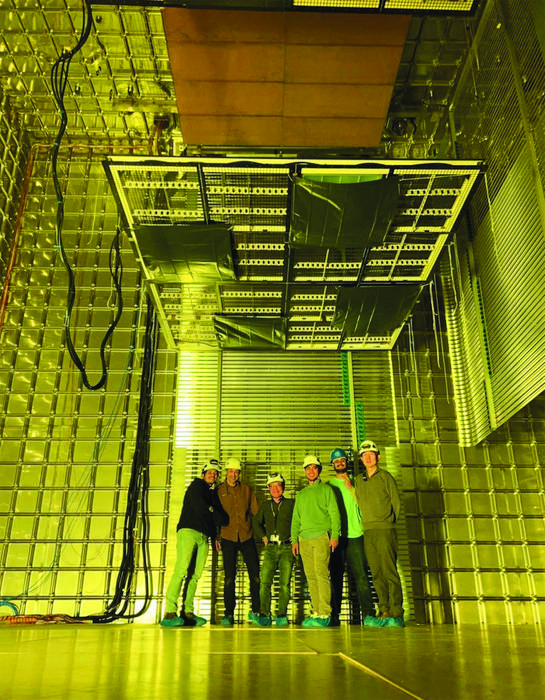
Physicists shown at CERN inside the prototype detector

Credit: Photo credit UT Arlington

With excavation work complete at the site where four gigantic particle detectors for the international Deep Underground Neutrino Experiment (DUNE) will be installed, scientists are preparing to begin construction on first detector. Part of that work is taking place at The University of Texas at Arlington.

Located a mile below the surface at the Sanford Underground Research Laboratory in Lead, South Dakota, the three colossal caverns serve as the core of a new research facility that spans an underground area about the size of eight soccer fields.

Hosted by the U.S. Department of Energy’s Fermi National Accelerator Laboratory (Fermilab), DUNE scientists will study the behavior of mysterious particles known as neutrinos to solve some of the biggest questions about the universe. These include why the universe is composed of matter, how an exploding star creates a black hole and if neutrinos are connected to dark matter or other undiscovered particles.

Jaehoon Yu, professor of physics, and Jonathan Asaadi, associate professor of physics, are leading UTA’s involvement with the project.

“The actual excavation took only a year, which is amazing,” Yu said. “It’s great that the excavation work is finished and now preparations can be made for the installation of the detectors. This is an exciting time.”

The caverns provide space for four large neutrino detectors—each one about the size of a seven-story building. The detectors will be filled with liquid argon and record the rare interaction of neutrinos with the transparent liquid.

With DUNE, scientists will look for neutrinos from exploding stars and examine the behavior of a beam of neutrinos produced at Fermilab, located near Chicago, about 800 miles east of the underground caverns. The beam, produced by the world’s most intense neutrino source, will travel straight through earth and rock from Fermilab to the DUNE detectors in South Dakota. No tunnel is necessary for its path.

UTA’s Department of Physics has been involved with the DUNE project since its earliest stages. In January 2016, UTA hosted a four-day international planning conference, organized by Yu.

UTA physicists will now build portions of the first two detectors to be installed at the South Dakota site. Specifically, they will construct modules of the field cage—100 modules for the first detector and all 200 of the modules for the second detector. The work will take place in the Chemistry and Physics Building.

“We’re going to need to recruit a lot of students to help with this work,” Yu said. “We need to bring them in as freshmen and sophomores so we can train them, and they can be with the project as long as possible, including for the installation.”

Yu will lead UTA’s efforts for construction of parts for the “far” detector in South Dakota. Asaadi is working on portions of the “near” detector at Fermilab.

The DUNE collaboration includes more than 1,400 scientists and engineers from over 200 institutions in 36 countries.



Share12Tweet8Share2ShareShareShare2

Related Posts

Copper Catalysts Enable Precise Pyrazole Arylation — Chemistry

Copper Catalysts Enable Precise Pyrazole Arylation

June 12, 2026
Dual-action catalyst harnesses single photon to convert CO₂ and biowaste simultaneously — Chemistry

Dual-action catalyst harnesses single photon to convert CO₂ and biowaste simultaneously

June 12, 2026

Adaptive Countermeasures: Tackling Future Black-Market Drugs Beyond Fentanyl

June 12, 2026

HKU Chemists Crack the Code to Creating Ultra-Tough, Highly Responsive “Smart” Materials

June 12, 2026

POPULAR NEWS

  • ESMO 2025: mRNA COVID Vaccines Enhance Efficacy of Cancer Immunotherapy

    324 shares
    Share 130 Tweet 81
  • Saying Goodbye to PGY-6: Pediatric Fellowship Realities

    96 shares
    Share 38 Tweet 24
  • Multi-Hospital Study Reveals Long Covid Burden Is Twice as High as Current Estimates

    90 shares
    Share 36 Tweet 22
  • Common Food Preservatives Associated with Elevated Blood Pressure and Increased Heart Disease Risk

    58 shares
    Share 23 Tweet 15

About

We bring you the latest biotechnology news from best research centers and universities around the world. Check our website.

Follow us

Recent News

Industrial Overcapacity Boosts Seasonal Electricity Flexibility

Gut Phage Molecular Anchors: A New Frontier for Therapeutic Innovation

Copper Catalysts Enable Precise Pyrazole Arylation

Subscribe to Blog via Email

Enter your email address to subscribe to this blog and receive notifications of new posts by email.

Join 82 other subscribers
  • Contact Us

Bioengineer.org © Copyright 2023 All Rights Reserved.

Welcome Back!

Login to your account below

Forgotten Password?

Retrieve your password

Please enter your username or email address to reset your password.

Log In
No Result
View All Result
  • Homepages
    • Home Page 1
    • Home Page 2
  • News
  • National
  • Business
  • Health
  • Lifestyle
  • Science

Bioengineer.org © Copyright 2023 All Rights Reserved.