• HOME
  • NEWS
  • EXPLORE
    • CAREER
      • Companies
      • Jobs
    • EVENTS
    • iGEM
      • News
      • Team
    • PHOTOS
    • VIDEO
    • WIKI
  • BLOG
  • COMMUNITY
    • FACEBOOK
    • INSTAGRAM
    • TWITTER
Monday, August 24, 2026
BIOENGINEER.ORG
No Result
View All Result
  • Login
  • HOME
  • NEWS
  • EXPLORE
    • CAREER
      • Companies
      • Jobs
        • Lecturer
        • PhD Studentship
        • Postdoc
        • Research Assistant
    • EVENTS
    • iGEM
      • News
      • Team
    • PHOTOS
    • VIDEO
    • WIKI
  • BLOG
  • COMMUNITY
    • FACEBOOK
    • INSTAGRAM
    • TWITTER
  • HOME
  • NEWS
  • EXPLORE
    • CAREER
      • Companies
      • Jobs
        • Lecturer
        • PhD Studentship
        • Postdoc
        • Research Assistant
    • EVENTS
    • iGEM
      • News
      • Team
    • PHOTOS
    • VIDEO
    • WIKI
  • BLOG
  • COMMUNITY
    • FACEBOOK
    • INSTAGRAM
    • TWITTER
No Result
View All Result
Bioengineer.org
No Result
View All Result
Home NEWS Science News Chemistry

USTC reports in-situ growth of Crown Ether@UiO- 66 membranes at mild condition

by
July 24, 2024
in Chemistry
Reading Time: 3 mins read
0
USTC Reports In-situ Growth of Crown Ether@UiO- 66 Membranes at Mild Condition
Share on FacebookShare on TwitterShare on LinkedinShare on RedditShare on Telegram

Research groups led by Prof. XU Tongwen and Prof. LI Xingya from the University of Science and Technology of China (USTC) have proposed the concept of total dehydration of ions, and prepared metal-organic framework (MOF) confined crown ether membranes, which solved the problem of precise separation of ions in complex systems. The research results were published in Science Advances.
USTC Reports In-situ Growth of Crown Ether@UiO- 66 Membranes at Mild Condition

Credit: ustc

Research groups led by Prof. XU Tongwen and Prof. LI Xingya from the University of Science and Technology of China (USTC) have proposed the concept of total dehydration of ions, and prepared metal-organic framework (MOF) confined crown ether membranes, which solved the problem of precise separation of ions in complex systems. The research results were published in Science Advances.

The efficient and precise separation of ions involves important chemical processes such as lithium extraction from salt lakes, seawater refining, and high-salt wastewater resource utilization. The ions in these systems have complex compositions, and their sizes are all at the angstrom level, which is a technical challenge that needs to be solved in the current chemical separation industry.

According to the team’s previous research results, the angstrom-scale membrane channels helped ions undergo partial dehydration and promoted ion transfer and sieving. In order to further enhance the flux and selectivity of monovalent ions, the researchers continued the work.

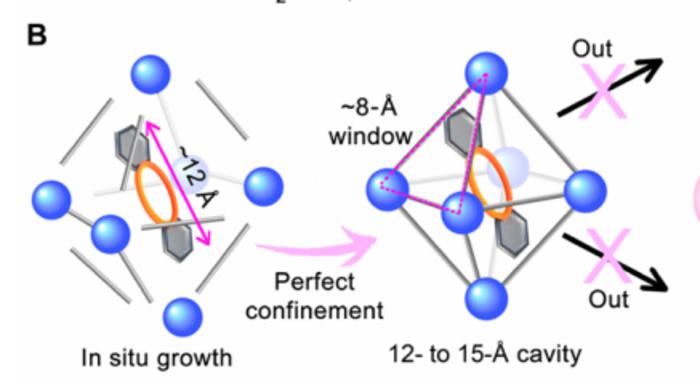
Researchers aimed to realize the in-situ growth of MOF confinement crown ether (CE@UiO-66) membranes under mild conditions (30 ℃), where there was “perfect confinement” of crown ether molecules by utilizing the window-cavity structure of UiO-66.

The UiO-66 had a window of ~8 Å and a cavity of ~12-15 Å. Based on the size-matching effect, it was possible to restrict dibenzo-15-crown-5 (DB15C5) or dibenzo-18-crown-6 (DB18C6) with a molecular size of ~12 Å. The UiO-66 membrane had a window of ~8 Å and a cavity of ~12-15 Å.

Compared to pristine UiO-66 membranes, CE@UiO-66 membranes exhibited higher monovalent ion permeation rates and selectivity due to the synergistic effect of UiO-66 window size screening and crown ether interaction screening that allowed complete dehydration of monovalent ions.

In the concentration-driven binary ion separation system, the flux of monovalent cations (e.g., K+) and the selectivity of monovalent/divalent cations (e.g., K+/Mg2+) were in the range of 0.9 ~ 1.2 mol m2h-1 and 30 ~ 60, respectively.

First-principles calculations and molecular dynamics simulations showed that the monovalent ions were completely dehydrated when passing through the DB18C6@UiO-66 cavity, which prompted the rapid transfer of monovalent ions with a lower energy barrier (transfer energy barrier: K+< Na+< Li+< Mg2+), and the final ionic transmembrane rate was: K+> Na+> Li+> Mg2+.

The study provides theoretical guidance for the construction of precise separation membranes for ions in complex systems.


Journal

Science Advances

DOI

10.1126/sciadv.adn0944

Article Title

Perfect confinement of crown ethers in MOF membrane for complete dehydration and fast transport of monovalent ions

Article Publication Date

8-May-2024

Share12Tweet8Share2ShareShareShare2

Related Posts

KAIST discovers pathway to faster-charging, longer-lasting electric vehicle batteries

KAIST discovers pathway to faster-charging, longer-lasting electric vehicle batteries

August 24, 2026
Scientists uncover design rules for high-performance thermoelectric materials

Scientists uncover design rules for high-performance thermoelectric materials

August 22, 2026

Bringing Optical Fibre Materials to Photonic Chips

August 22, 2026

Nanoscience and Liquid Crystals Unite in Functional Hybrids With Transformative Applications

August 22, 2026

POPULAR NEWS

  • Cochrane Map Reveals Major Evidence Gaps in Dengue Prevention Research

    Cochrane Map Reveals Major Evidence Gaps in Dengue Prevention Research

    29 shares
    Share 12 Tweet 7
  • Study reveals surge in type 2 diabetes among people under 20

    29 shares
    Share 12 Tweet 7
  • KAIST discovers pathway to faster-charging, longer-lasting electric vehicle batteries

    29 shares
    Share 12 Tweet 7
  • Blocking glucosylceramide production kills cancer cells via lysosomal dysfunction, not ceramide buildup

    29 shares
    Share 12 Tweet 7

About

We bring you the latest biotechnology news from best research centers and universities around the world. Check our website.

Follow us

Recent News

Cochrane Map Reveals Major Evidence Gaps in Dengue Prevention Research

Study reveals surge in type 2 diabetes among people under 20

KAIST discovers pathway to faster-charging, longer-lasting electric vehicle batteries

Subscribe to Blog via Email

Enter your email address to subscribe to this blog and receive notifications of new posts by email.

Join 85 other subscribers
  • Contact Us

Bioengineer.org © Copyright 2023 All Rights Reserved.

Welcome Back!

Login to your account below

Forgotten Password?

Retrieve your password

Please enter your username or email address to reset your password.

Log In
No Result
View All Result
  • Homepages
    • Home Page 1
    • Home Page 2
  • News
  • National
  • Business
  • Health
  • Lifestyle
  • Science

Bioengineer.org © Copyright 2023 All Rights Reserved.