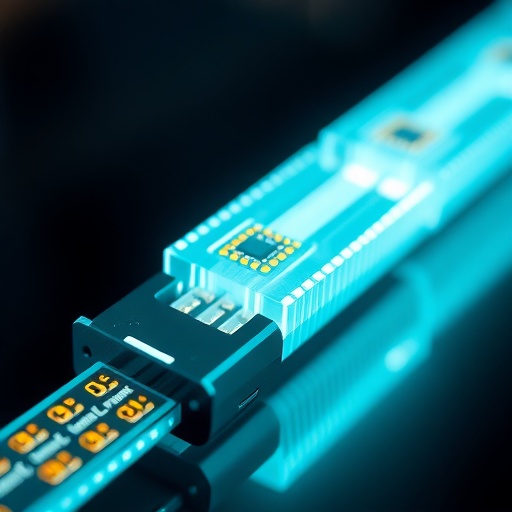
Optical fibres have carried the world’s internet traffic across oceans and continents because they can guide light for astonishing distances with remarkably little loss. Now, researchers are bringing a similar low-loss capability onto silicon chips, creating integrated optical resonators with quality factors high enough to support demanding applications in artificial intelligence, quantum information, precision sensing and next-generation communications.
A team led by Professor Kerry Vahala of the California Institute of Technology, working with Professor James Gates of the University of Southampton and colleagues, has demonstrated ultrahigh-quality-factor germano-silicate microresonators fabricated directly on silicon wafers. The results, published in Light: Science & Applications, show that a manufacturing method traditionally associated with optical-fibre production can be adapted to create high-performance photonic circuits at wafer scale.
The process is known as flame hydrolysis deposition. In conventional fibre manufacturing, gaseous chemical precursors are introduced into an oxygen-hydrogen flame. The flame converts these compounds into extremely pure particles of glass soot, which are deposited onto a rotating structure. The accumulated material is then consolidated and drawn into an optical fibre preform. The new work modifies this approach for oxidized silicon wafers, depositing thin films of germano-silicate that can later be patterned into integrated optical devices.
Germano-silicate is silica containing germanium oxide, or GeO₂. It is already widely used in optical-fibre technology because germanium increases the refractive index of silica, allowing engineers to confine light within the fibre core. Standard fibre cores typically contain only a few mol% of GeO₂, while the researchers used a concentration of approximately 50 mol%. That much higher concentration produces stronger refractive-index contrast, enabling light to be confined in smaller structures and making compact photonic circuits possible.
The high germanium content also changes the material’s thermal behaviour in a crucial way. Germano-silicate with this composition softens at a lower temperature than pure silica, allowing the patterned structures to undergo controlled thermal reflow in a conventional furnace. During reflow, the material behaves like a highly viscous liquid. Surface tension pulls sharp corners and irregularities into smoother, rounded shapes, healing imperfections that would otherwise scatter light and degrade the performance of a microresonator.
That capability addresses one of the central challenges in integrated photonics. When light circulates inside a microscopic resonator, it may travel around the structure thousands or millions of times. A defect that appears insignificant under an electron microscope can therefore become a powerful source of optical scattering. Sidewall roughness left behind by plasma etching is particularly damaging, because every irregular feature can redirect a small portion of the circulating light and reduce the resonator’s quality factor.
The researchers demonstrated that thermal reflow can substantially reduce this sensitivity to fabrication defects. Devices produced with deliberately poor initial etching showed low performance immediately after fabrication, but their quality factors increased by almost two orders of magnitude after reflow. In the best devices, the team measured an intrinsic quality factor of 566 million at a wavelength of 1064 nanometres. This corresponds to a propagation loss as low as 0.07 decibels per metre, an exceptional result for an integrated photonic platform.
The quality factor, commonly called Q, describes how efficiently a resonator stores light. A high-Q cavity confines optical energy for a long time relative to the oscillation period, allowing even weak interactions to accumulate. That makes such resonators valuable for frequency references, optical clocks, narrow-linewidth lasers, nonlinear optics, sensing and quantum experiments. The team also recorded Q factors above 100 million across a broad spectral range extending from the telecommunications band toward violet wavelengths, indicating that the platform is not limited to a single specialised colour of light.
The achievement does not yet mean that photonic chips have matched the best commercial optical fibres. Fibre loss can be around 0.2 decibels per kilometre, while the demonstrated on-chip propagation loss is measured per metre. Nevertheless, the work establishes a new route for reducing that gap while retaining the scalability of wafer manufacturing. By transferring a mature fibre-deposition technology to integrated photonics and combining it with post-fabrication reflow, the researchers have created a platform in which optical performance and manufacturing tolerance improve together. Future optimisation of deposition chemistry, film uniformity, lithography and reflow conditions could enable much longer low-loss optical paths on compact wafers, potentially bringing kilometre-scale functionality into palm-sized systems. Such progress could support more efficient AI data-centre interconnects, smaller quantum technologies and precision instruments that depend on stable, coherent light. The broader significance is a shift in how photonic chips are manufactured: instead of treating every nanoscale defect as a potentially fatal limitation, engineers may be able to design processes that deliberately repair those defects after fabrication, making ultrahigh-Q devices more repeatable and accessible to large-scale production.
Subject of Research:
Ultrahigh-Q integrated germano-silicate optical resonators fabricated on silicon using flame hydrolysis deposition and wafer-scale thermal reflow.
Article Title:
Ultrahigh-Q integrated flame-hydrolysis-deposited germano-silicate resonators on silicon
Web References:
https://doi.org/10.1038/s41377-026-02353-y
References:
Light: Science & Applications, “Ultrahigh-Q integrated flame-hydrolysis-deposited germano-silicate resonators on silicon,” DOI: 10.1038/s41377-026-02353-y.
Image Credits:
Hao-Jing Chen et al.
Keywords
Integrated photonics, optical fibres, germano-silicate, flame hydrolysis deposition, thermal reflow, silicon photonics, microresonators, ultrahigh-Q resonators, low-loss optics, quantum technology, AI data centres, precision measurement
Tags: artificial intelligence optical interconnectsflame hydrolysis deposition for photonicsgermano-silicate microresonatorshigh-quality-factor photonic circuitsintegrated optical resonatorslow-loss optical fibre materials on chipsnext-generation communications photonic integrationoptical fibre manufacturing techniques in chip productionprecision sensing with integrated opticsquantum information processing photonicssilicon wafer photonics fabricationultrahigh-Q silicon photonics