• HOME
  • NEWS
  • EXPLORE
    • CAREER
      • Companies
      • Jobs
    • EVENTS
    • iGEM
      • News
      • Team
    • PHOTOS
    • VIDEO
    • WIKI
  • BLOG
  • COMMUNITY
    • FACEBOOK
    • INSTAGRAM
    • TWITTER
Sunday, August 16, 2026
BIOENGINEER.ORG
No Result
View All Result
  • Login
  • HOME
  • NEWS
  • EXPLORE
    • CAREER
      • Companies
      • Jobs
        • Lecturer
        • PhD Studentship
        • Postdoc
        • Research Assistant
    • EVENTS
    • iGEM
      • News
      • Team
    • PHOTOS
    • VIDEO
    • WIKI
  • BLOG
  • COMMUNITY
    • FACEBOOK
    • INSTAGRAM
    • TWITTER
  • HOME
  • NEWS
  • EXPLORE
    • CAREER
      • Companies
      • Jobs
        • Lecturer
        • PhD Studentship
        • Postdoc
        • Research Assistant
    • EVENTS
    • iGEM
      • News
      • Team
    • PHOTOS
    • VIDEO
    • WIKI
  • BLOG
  • COMMUNITY
    • FACEBOOK
    • INSTAGRAM
    • TWITTER
No Result
View All Result
Bioengineer.org
No Result
View All Result
Home NEWS Science News Chemistry

Using waves to move droplets

Bioengineer by Bioengineer
June 14, 2019
in Chemistry
Reading Time: 3 mins read
0
IMAGE
Share on FacebookShare on TwitterShare on LinkedinShare on RedditShare on Telegram

IMAGE

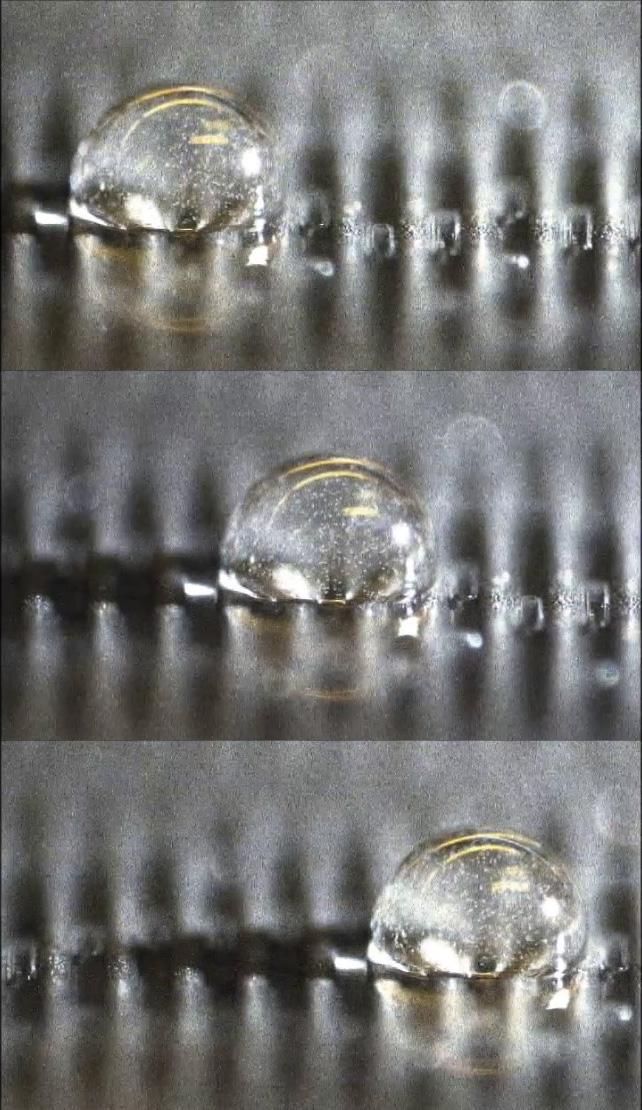
Credit: De Jong et al., Sci. Adv. 2019;5: eaaw0914

Self-cleaning surfaces and laboratories on a chip become even more efficient if we are able to control individual droplets. University of Groningen professor Patrick Onck, together with colleagues from Eindhoven University of Technology, have shown that this is possible by using a technique named mechanowetting. ‘We have come up with a way of transporting droplets by using transverse surface waves. This even works on inclined or vertical surfaces’. The research was published in Science Advances on 14 June.

The idea of mechanowetting is basically very simple: put a droplet on a transverse surface wave, and the droplet will move with the wave. ‘One of the properties of water droplets is that they always try to stay on top of a wave. If that top runs ahead, the droplet will run with it’, Onck explains. It is possible to move the droplets by using mechanical deformation to create surface waves. ‘The remarkable thing about this is that it also works on inclined or vertical surfaces: drops can even move upwards against gravity.’

Theory and practice

Edwin de Jong, PhD candidate in Onck’s group and first author of the paper, tested the concept of mechanowetting by means of a computer model. ‘When it seemed to work in theory, our colleagues from Eindhoven University of Technology devised an experiment to test it. Our model turned out to be right: in practice, the drops moved exactly as we had imagined.’

Lab-on-a-chip

One of the applications of mechanowetting is in lab-on-a-chip systems, complete laboratories the size of a credit card, which are used to analyze biological fluids such as blood or saliva. This allows the samples to be tested outside the lab, e.g. directly at the bedside, with a much faster response rate. ‘If we are able to direct each drop separately, it is possible to perform a lot of different tests at high speed with a very small volume of fluid’, says Onck. Transporting droplets separately was already possible by means of electrowetting. ‘Electrowetting is able to transport droplets by applying electric fields. However, these fields can change the biochemical properties of the sample, and that is something you don’t want when doing blood tests.’

Light waves

In the meantime, Onck’s group is exploring new possibilities. ‘We have performed computer simulations that show that mechanowetting also works by using light-responsive materials to create waves. Light is especially interesting because of its precision and its ability to control the movement of drops remotely.’ In addition to lab-on-a-chip systems, mechanowetting has several other interesting applications, such as self-cleaning surfaces, where water droplets actively absorb and remove the dirt. It also offers opportunities for harvesting moisture from the air, by collecting dew drops for use as drinking water.

###

Reference: De Jong, E., Wang, Y., Toonder, J. M. J. den, Onck, P. R. (2019). Climbing droplets driven by mechanowetting on transverse waves. Science Advances 14 June 2019.

Media Contact
Rene Fransen
[email protected]

Related Journal Article

http://dx.doi.org/10.1126/sciadv.aaw0914

Tags: Chemistry/Physics/Materials SciencesDiagnosticsIndustrial Engineering/ChemistryMaterialsNanotechnology/Micromachines
Share12Tweet8Share2ShareShareShare2

Related Posts

Butterfly-Inspired Technology Could Transform Air Quality Monitoring

August 15, 2026
Artesunate Targets GBA, Triggering Apoptosis in Liver Cancer Cells

Artesunate Targets GBA, Triggering Apoptosis in Liver Cancer Cells

August 15, 2026

New molecule may enable cleaner, more efficient metal recovery

August 15, 2026

Controlled sulfidation enhances supercapacitor electrode performance

August 15, 2026
Please login to join discussion

POPULAR NEWS

  • KAIST develops semiconductor neuron that harnesses noise to selectively process signals

    29 shares
    Share 12 Tweet 7
  • Imagining natural and extra robotic thumbs together strengthens kinesthetic sensorimotor networks

    29 shares
    Share 12 Tweet 7
  • PARP1 Drives Neuropathic Pain Through GPX4-Dependent Ferroptosis in Injured Mice’s Sensory Neurons

    29 shares
    Share 12 Tweet 7
  • Strubbelig–NHL3 Receptor Complex Helps Arabidopsis Respond to Cellulose Deficiency

    29 shares
    Share 12 Tweet 7

About

We bring you the latest biotechnology news from best research centers and universities around the world. Check our website.

Follow us

Recent News

KAIST develops semiconductor neuron that harnesses noise to selectively process signals

Imagining natural and extra robotic thumbs together strengthens kinesthetic sensorimotor networks

PARP1 Drives Neuropathic Pain Through GPX4-Dependent Ferroptosis in Injured Mice’s Sensory Neurons

Subscribe to Blog via Email

Success! An email was just sent to confirm your subscription. Please find the email now and click 'Confirm' to start subscribing.

Join 85 other subscribers
  • Contact Us

Bioengineer.org © Copyright 2023 All Rights Reserved.

Welcome Back!

Login to your account below

Forgotten Password?

Retrieve your password

Please enter your username or email address to reset your password.

Log In
No Result
View All Result
  • Homepages
    • Home Page 1
    • Home Page 2
  • News
  • National
  • Business
  • Health
  • Lifestyle
  • Science

Bioengineer.org © Copyright 2023 All Rights Reserved.