


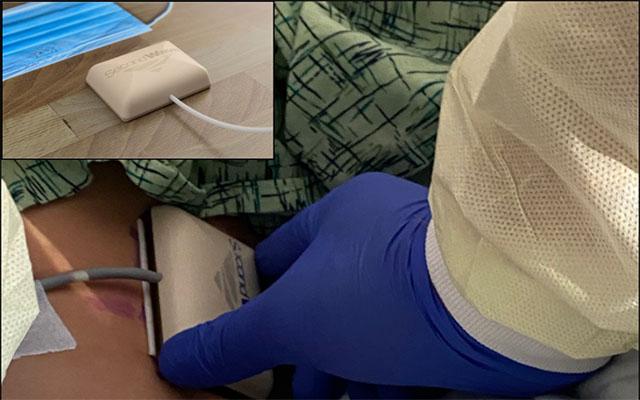
Credit: Photo courtesy of SecondWave Systems.
Researchers at University of California San Diego School of Medicine have begun a pilot clinical trial to test the efficacy of using ultrasound to stimulate the spleen and reduce COVID-19-related inflammation, decreasing the length of hospital stays.
“It’s a pilot study to evaluate whether ultrasound stimulation focused on the spleen can reduce inflammatory biomarkers in hospital patients infected with SARS-CoV-2,” said Imanuel Lerman, MD, associate professor of anesthesiology at UC San Diego School of Medicine and an affiliate of Qualcomm Institute at UC San Diego, where his lab is based. “This will allow us to determine whether treating patients this way can really affect clinical outcomes in COVID-19 infections.”
The two- to three-month study, called Ultrasound Neural and Immunomodulation Treatment Evaluation Study for COVID-19 or UNITE Study, will recruit 40 patients with severe COVID-19 symptoms, all admitted to Jacobs Medical Center at UC San Diego Health. Half of the patients in the trial will be given ultrasound treatment daily for up to seven days, in addition to receiving anti-inflammatory drugs, such as remdesivir and dexamethasone, which are currently part of standard medical care. The other half — the control group — will receive only standard medical care.
“We will be watching to see how quickly the ultrasound patients can be discharged from the hospital compared to the control group,” said Lerman. “While we are planning to do the ultrasound treatments up to seven days, we’re hoping that ultrasound stimulation of the spleen can get them home even sooner and also prevent patients from experiencing more severe symptoms while in the hospital.”
In earlier rodent studies, stimulating the spleen with a non-invasive ultrasound device was shown to reduce inflammation. Researchers have also demonstrated the anti-inflammatory value of spleen stimulation in healthy human subjects and in human patients with rheumatoid arthritis (RA).
Both RA and COVID-19 patients can suffer from a hyperinflammatory response driven by over-production of cytokines — proteins that signal and spur an inflammatory immune response. The resulting “cytokine storm” in COVID-19 patients can lead to acute respiratory distress syndrome, known as ARDS, which can be fatal.
In a July 2020 study on medRXiv, an online site that posts papers that have not yet undergone peer review, General Electric Research and University of Minnesota scientists described the effects of splenic stimulation in RA and healthy patients, and its potential in COVID-19 patients:
“Non-invasive ultrasound activation of the splenic neuroimmune pathway may provide an alternative method to combat the cytokine storm without compromising the adaptive immune response in COVID-19 patients, ultimately reducing the high mortality and morbidity rates confronting this worldwide pandemic that currently has limited treatment options.”
Prior studies have also shown that electrical stimulation of the vagus nerve, which runs from the brain to the gut, using a cervical implant, reduces inflammation. Stimulating the spleen may activate the same anti-inflammatory pathways.
The clinical trial will use an investigational device developed by SecondWave Systems. Strategically placed on patients’ skin, the device generates low-intensity, focused ultrasound waves targeting the spleen. Treatment occurs daily for approximately 18 minutes for up to seven days.
###
The UNITE study is funded through an award from the U.S. Department of Defense’s Joint Program Executive Office for Chemical, Biological, Radiological and Nuclear Defense in collaboration with the Defense Health Agency and SecondWave Systems, Inc.
For more information on the clinical trial, visit ClinicalTrials.gov.
Media Contact
Scott LaFee
[email protected]



