Credit: IIASA
Batteries are rapidly becoming less expensive and might soon offer a cheap short-term solution to store energy for daily energy needs. However, the long-term storage capabilities of batteries, for example, in a yearly cycle, will not be economically viable. Although pumped-hydro storage (PHS) technologies are an economically feasible choice for long-term energy storage with large capacities – higher than 50 megawatts (MW) – it becomes expensive for locations where the demand for energy storage is often smaller than 20 MW with monthly or seasonal requirements, such as small islands and remote locations.
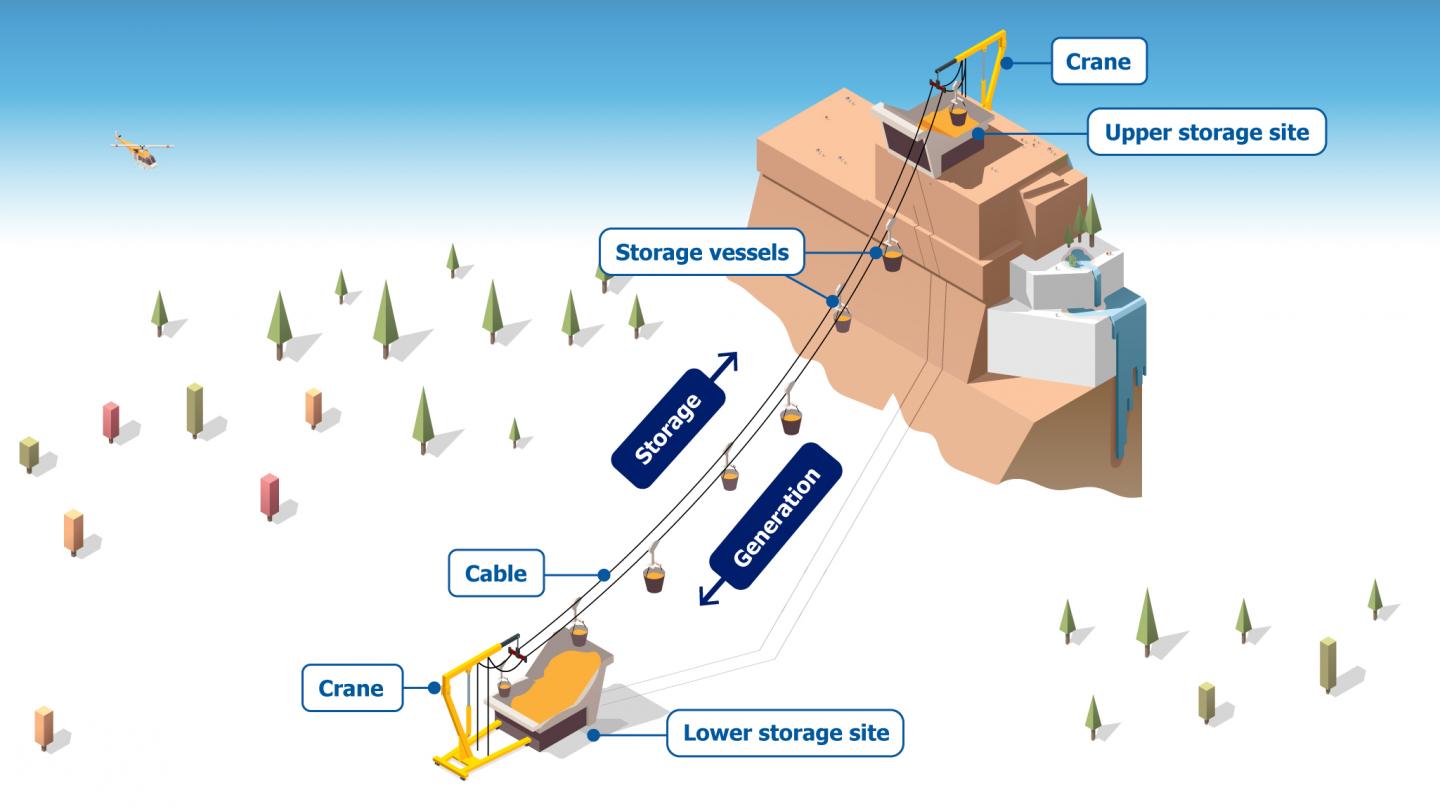
In a study published in the journal Energy, IIASA researcher Julian Hunt and his colleagues propose MGES to close the gap between existing short- and long-term storage technologies. MGES constitutes of building cranes on the edge of a steep mountain with enough reach to transport sand (or gravel) from a storage site located at the bottom to a storage site at the top. A motor/generator moves storage vessels filled with sand from the bottom to the top, similar to a ski lift. During this process, potential energy is stored. Electricity is generated by lowering sand from the upper storage site back to the bottom. If there are river streams on the mountain, the MGES system can be combined with hydropower, where the water would be used to fill the storage vessels in periods of high availability instead of the sand or gravel, thus generating energy. MGES systems have the benefit that the water could be added at any height of the system, thereby increasing the possibility of catching water from different heights in the mountain, which is not possible in conventional hydropower.
“One of the benefits of this system is that sand is cheap and, unlike water, it does not evaporate – so you never lose potential energy and it can be reused innumerable times. This makes it particularly interesting for dry regions,” notes Hunt. “Additionally, PHS plants are limited to a height difference of 1,200 meters, due to very high hydraulic pressures. MGES plants could have height differences of more than 5,000 meters. Regions with high mountains, for example, the Himalayas, Alps, and Rocky Mountains, could therefore become important long-term energy storage hubs. Other interesting locations for MGES are islands, such as Hawaii, Cape Verde, Madeira, and the Pacific Islands with steep mountainous terrain.”
In the paper, the authors propose a future energy matrix for the Molokai Island in Hawaii, using only wind, solar, batteries, and MGES to supply the island’s energy demand. Hunt emphasizes that the MGES technology should not be used for peak generation or storing energy in daily cycles – instead it fills a gap in the market for locations with long-term storage. MGES systems can, for instance, store energy continuously for months and then generate power continuously for months or when there is water available for hydropower, while batteries deal with the daily storage cycles.
“It is important to note that the MGES technology does not replace any current energy storage options but rather opens up new ways of storing energy and harnessing untapped hydropower potential in regions with high mountains,” Hunt concludes.
###
Reference
Hunt J, Zakeri B, Falchetta G, Nascimento A, Wada Y, & Riahi K (2019). Mountain Gravity Energy Storage: A new solution for closing the gap between existing short- and long-term storage technologies. Energy DOI: https:/
Contacts:
Researcher contact
Julian Hunt
Research Scholar
Water
Energy
+43(0) 2236 807 675
[email protected]
Communications Officer
Bettina Greenwell
IIASA Press Office
Tel: +43 2236 807 282
[email protected]
About IIASA:
The International Institute for Applied Systems Analysis (IIASA) is an international scientific institute that conducts research into the critical issues of global environmental, economic, technological, and social change that we face in the twenty-first century. Our findings provide valuable options to policymakers to shape the future of our changing world. IIASA is independent and funded by prestigious research funding agencies in Africa, the Americas, Asia, and Europe. http://www.
Media Contact
Julian Hunt
[email protected]
43-022-368-07675
Original Source
https:/
Related Journal Article
http://dx.