• HOME
  • NEWS
  • EXPLORE
    • CAREER
      • Companies
      • Jobs
    • EVENTS
    • iGEM
      • News
      • Team
    • PHOTOS
    • VIDEO
    • WIKI
  • BLOG
  • COMMUNITY
    • FACEBOOK
    • INSTAGRAM
    • TWITTER
Thursday, June 11, 2026
BIOENGINEER.ORG
No Result
View All Result
  • Login
  • HOME
  • NEWS
  • EXPLORE
    • CAREER
      • Companies
      • Jobs
        • Lecturer
        • PhD Studentship
        • Postdoc
        • Research Assistant
    • EVENTS
    • iGEM
      • News
      • Team
    • PHOTOS
    • VIDEO
    • WIKI
  • BLOG
  • COMMUNITY
    • FACEBOOK
    • INSTAGRAM
    • TWITTER
  • HOME
  • NEWS
  • EXPLORE
    • CAREER
      • Companies
      • Jobs
        • Lecturer
        • PhD Studentship
        • Postdoc
        • Research Assistant
    • EVENTS
    • iGEM
      • News
      • Team
    • PHOTOS
    • VIDEO
    • WIKI
  • BLOG
  • COMMUNITY
    • FACEBOOK
    • INSTAGRAM
    • TWITTER
No Result
View All Result
Bioengineer.org
No Result
View All Result
Home NEWS Science News Chemistry

Using high energy density material in electrode design enhances lithium sulfur batteries

Bioengineer by Bioengineer
September 30, 2019
in Chemistry
Reading Time: 3 mins read
0
IMAGE
Share on FacebookShare on TwitterShare on LinkedinShare on RedditShare on Telegram

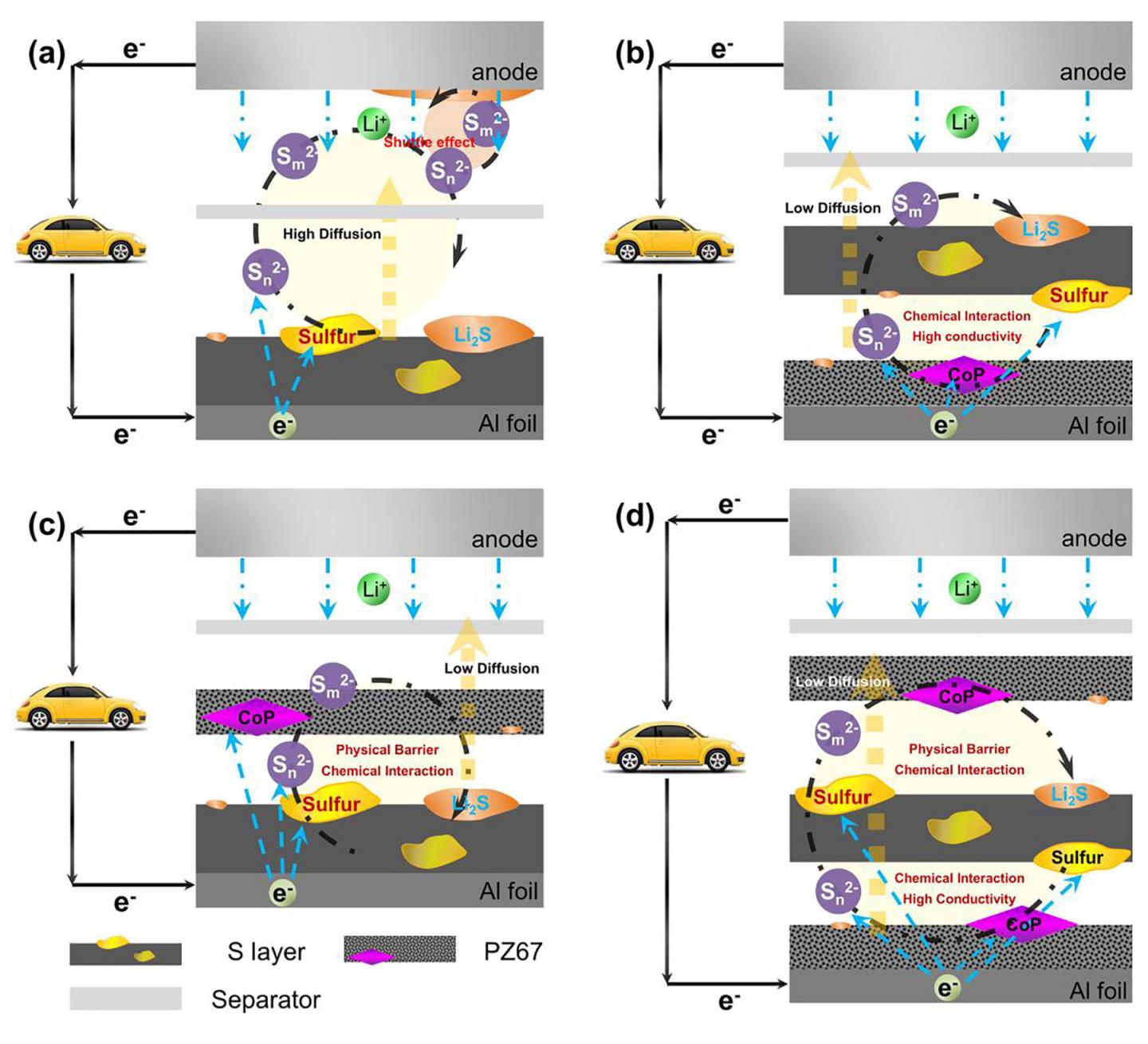
A sandwich-structured electrode enhances reaction kinetics, prohibits shuttling effect, improves lithium sulfur battery performance
IMAGE

Credit: Xing Gao, Siwu Li, Ying Du and Bo Wang

WASHINGTON, D.C., September 30, 2019 — Lithium ion batteries aren’t keeping up with energy demands from higher power electronic devices, electric vehicles and smart electric grids. To develop higher capacity batteries, researchers have looked to lithium sulfur batteries because of sulfur’s high theoretical capacity and energy density.

But there are still several problems to solve before lithium sulfur batteries can be put into practical applications, such as sulfur’s intrinsically low electrical conductivity and the rapid capacity decay caused by polysulfides escaping from the cathode.

The biggest problem is the shuttling effect that occurs during cycling. This effect causes the diffusion of polysulfides from the cathode, creating capacity loss. It also consumes a lot of fresh lithium and electrolytes, and reduces battery performance.

To solve the shuttling problem and improve lithium sulfur battery performance, the authors of a paper published in APL Materials, from AIP Publishing, created a sandwich-structured electrode using a novel material that traps polysulfides and increases the reaction kinetics.

ZIF-67 is a metal-organic framework (MOF) constructed from metal ions or metal clusters and organic ligands. It holds great promise in gas storage and separation, catalysis and energy storage. MOF-derived materials are also attractive in energy storage due to their robust structure, porous surface and high conductivity.

A sandwich-structured electrode with sulfur immobilized in between PZ67 layers, PZ67/S/PZ67, improves the practical energy density of the lithium sulfur battery to three to five times higher than that of lithium ion batteries. The PZ67 is composed of polar materials, and the porous carbon showed a synergistic effect in the chemical interaction, served as a physical barrier, offered a high conductivity to prohibit the polysulfide shuttling effect and enhanced the batteries’ cycling performance.

“The porous PZ67 can not only absorb the polysulfides to form a confinement, it can also improve the kinetics of the actual active materials’ reaction during the battery cycling,” author Siwu Li said. “That means it may also improve the discharge voltage of the battery, and that is a big contribution to improving the energy density of the batteries.”

The sandwich-structured electrode that confines soluble polysulfides could be useful for anyone working to confine soluble materials, Li said. His team plans to continue their work in order to scale up the process of fabricating the hybrid electrode using a hot pressing procedure. They also plan to address instabilities on the anode side of lithium sulfur batteries, possibly by adding a protective layer.

###

The article, “A ZIF-67-derived-sulfur sandwich structure for high performance Li-S batteries,” is authored by Xing Gao, Siwu Li, Ying Du and Bo Wang. The article will appear in the journal APL Materials on Sept. 30, 2019 (DOI: 10.1063/1.5122819). After that date, it can be accessed at https://aip.scitation.org/doi/10.1063/1.5122819.

ABOUT THE JOURNAL

APL Materials is an open access journal that features original research on significant topical issues within all areas of materials science. See https://aip.scitation.org/journal/apm.

Media Contact
Larry Frum
[email protected]

Related Journal Article

http://dx.doi.org/10.1063/1.5122819

Tags: Chemistry/Physics/Materials SciencesElectrical Engineering/ElectronicsEnergy/Fuel (non-petroleum)MaterialsTechnology/Engineering/Computer Science
Share12Tweet8Share2ShareShareShare2

Related Posts

Magnet Bundle Milestone Heralds a New Era in Fusion Research — Chemistry

Magnet Bundle Milestone Heralds a New Era in Fusion Research

June 11, 2026
Waste Cotton Hulls Transform into Potent Catalyst for Purifying Water — Chemistry

Waste Cotton Hulls Transform into Potent Catalyst for Purifying Water

June 11, 2026

Ligand Control Unlocks Versatile Ethylene Dicarbofunctionalization

June 10, 2026

Scientists at Brown Discover 80-Atom Boron ‘Buckyball’ in Potential Nanoscale Breakthrough

June 10, 2026
Please login to join discussion

POPULAR NEWS

  • ESMO 2025: mRNA COVID Vaccines Enhance Efficacy of Cancer Immunotherapy

    324 shares
    Share 130 Tweet 81
  • Saying Goodbye to PGY-6: Pediatric Fellowship Realities

    92 shares
    Share 37 Tweet 23
  • Multi-Hospital Study Reveals Long Covid Burden Is Twice as High as Current Estimates

    90 shares
    Share 36 Tweet 22
  • Common Food Preservatives Associated with Elevated Blood Pressure and Increased Heart Disease Risk

    58 shares
    Share 23 Tweet 15

About

We bring you the latest biotechnology news from best research centers and universities around the world. Check our website.

Follow us

Recent News

Furmonertinib and Bevacizumab Tackle Resistant Leptomeningeal Metastasis

Creating User-Focused Climate Adaptation Tools

Resistive Memory Boosts Neural-Field Reconstruction Efficiency

Subscribe to Blog via Email

Enter your email address to subscribe to this blog and receive notifications of new posts by email.

Join 82 other subscribers
  • Contact Us

Bioengineer.org © Copyright 2023 All Rights Reserved.

Welcome Back!

Login to your account below

Forgotten Password?

Retrieve your password

Please enter your username or email address to reset your password.

Log In
No Result
View All Result
  • Homepages
    • Home Page 1
    • Home Page 2
  • News
  • National
  • Business
  • Health
  • Lifestyle
  • Science

Bioengineer.org © Copyright 2023 All Rights Reserved.