UC Riverside-led team looks back to find life beyond
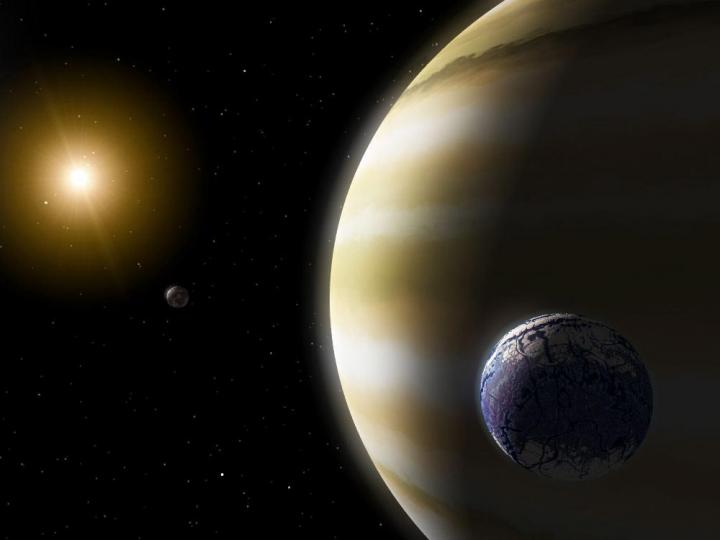
Credit: NASA/JPL-Caltech
UC Riverside is leading one of the NASA Astrobiology Program’s eight new research teams tackling questions about the evolution and origins of life on Earth and the possibility of life beyond our solar system.
The teams comprise the inaugural class of NASA’s Interdisciplinary Consortia for Astrobiology Research program. The UCR-led team is motivated by the fundamental question of how to detect planets that could host life and remain habitable despite tremendous change over time, which requires hunting for biological gases in the atmospheres of planets light years beyond our solar system.
“To achieve this goal, our research focuses on the many diverse chapters of Earth’s history — or alterative Earths — that span billions of years and offer critical templates for examining exoplanets far beyond our solar system,” said UCR biogeochemist Timothy Lyons, the project leader.
Because of their immense distance from us, humans will likely never visit those planets, at least not soon, Lyons said. However, in the near future, scientists will be able to analyze the compositions of these planets’ atmospheres, looking for gases like oxygen and methane that could come from life.
Earth has undergone dramatic changes over the last 4.5 billion years, with major transitions occurring in plate tectonics, climate, ocean chemistry, the structure of our ecosystems, and composition of our atmosphere.
“These changes represent an opportunity,” Lyons said. “The different periods of Earth’s evolutionary history provide glimpses of many, largely alien worlds, some of which may be analogs for habitable planetary states that are very different from conditions on modern Earth.”
Exciting new research frontiers for Lyons’ team include studies of Earth’s first 500 million years, as well as predictions about our planet and its life billions of years in the future.
Studying biosignature gases in Earth’s past will allow the team to design telescopes and refine interpretative models for potential traces of life in distant exoplanet atmospheres, noted Georgia Tech biogeochemist Christopher Reinhard.
Once the researchers understand how Earth and its star — the sun — changed together to maintain liquid oceans teeming with life over billions of years, the team can predict how other planetary systems might also have developed and maintained life and better understand how to search for it.
“Such a ‘mission to early Earth’ must include broad interdisciplinarity within the team, impactful synergy within and across the Research Coordination Networks, or RCNs, of the NASA Astrobiology Program, and a commitment to deliverables that will help steer NASA science for decades to come,” said UCR astrobiologist Edward Schwieterman.
Success in this mission will require biological, chemical, geological, oceanographic, and astronomical expertise. Yale University biogeochemist Noah Planavsky said, “our team brings all that to the table.” Accordingly, the diverse expertise within the team includes astronomers, planetary scientists, geologists, geophysicists, oceanographers, biogeochemists, and geobiologists.
The team will collect ancient rock samples and modern sediments from around the world spanning billions of years and use the data they generate to drive wide-ranging computational models for Earth’s ancient and future oceans and atmospheres.
“The models will allow the team to evaluate whether different periods in Earth’s history were characterized by gases that would have been detectable from a distant vantage as products of life, much the way oxygen fingerprints life on our planet today,” said Purdue University Earth and exoplanetary scientist Stephanie Olson.
This work requires a multipronged view of the Earth as a complex system that has varied dramatically over time. Yet despite all the change, Earth has remained persistently habitable, with liquid water oceans teeming with life.
How Earth became and remained habitable and whether its life would have been detectable to a distant observer are the questions that will ultimately define and refine the search for life on exoplanets.
“In short,” said Lyons, “the exciting goal of our team is to provide a new and more holistic view of Earth’s evolutionary history in order to help guide NASA’s mission-specific search for life on distant worlds.”
The RCNs are the new face of astrobiology at NASA, following 20 years of exciting research under the umbrella of the NASA Astrobiology Institute, which supported the UCR-led team previously.
The $4.6 million new award from NASA will span five years and includes team members from Georgia Tech, Yale University, Purdue University, UCLA, NASA Ames Research Center and collaborators from around the world.
###
Media Contact
Jules Bernstein
[email protected]
Original Source
https:/