• HOME
  • NEWS
  • EXPLORE
    • CAREER
      • Companies
      • Jobs
    • EVENTS
    • iGEM
      • News
      • Team
    • PHOTOS
    • VIDEO
    • WIKI
  • BLOG
  • COMMUNITY
    • FACEBOOK
    • INSTAGRAM
    • TWITTER
Saturday, February 7, 2026
BIOENGINEER.ORG
No Result
View All Result
  • Login
  • HOME
  • NEWS
  • EXPLORE
    • CAREER
      • Companies
      • Jobs
        • Lecturer
        • PhD Studentship
        • Postdoc
        • Research Assistant
    • EVENTS
    • iGEM
      • News
      • Team
    • PHOTOS
    • VIDEO
    • WIKI
  • BLOG
  • COMMUNITY
    • FACEBOOK
    • INSTAGRAM
    • TWITTER
  • HOME
  • NEWS
  • EXPLORE
    • CAREER
      • Companies
      • Jobs
        • Lecturer
        • PhD Studentship
        • Postdoc
        • Research Assistant
    • EVENTS
    • iGEM
      • News
      • Team
    • PHOTOS
    • VIDEO
    • WIKI
  • BLOG
  • COMMUNITY
    • FACEBOOK
    • INSTAGRAM
    • TWITTER
No Result
View All Result
Bioengineer.org
No Result
View All Result
Home NEWS Science News Biology

Using DNA to predict schizophrenia and autism

Bioengineer by Bioengineer
August 30, 2017
in Biology
Reading Time: 2 mins read
0
Share on FacebookShare on TwitterShare on LinkedinShare on RedditShare on Telegram
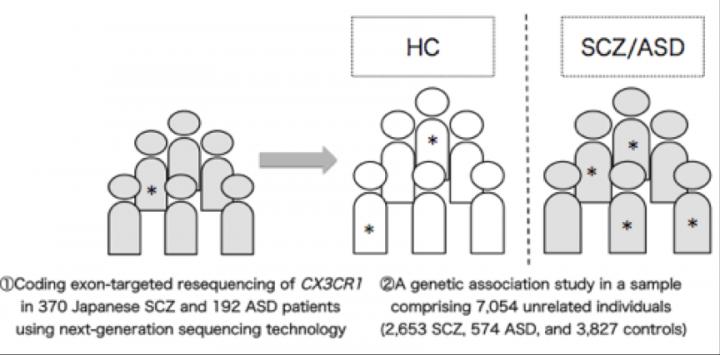
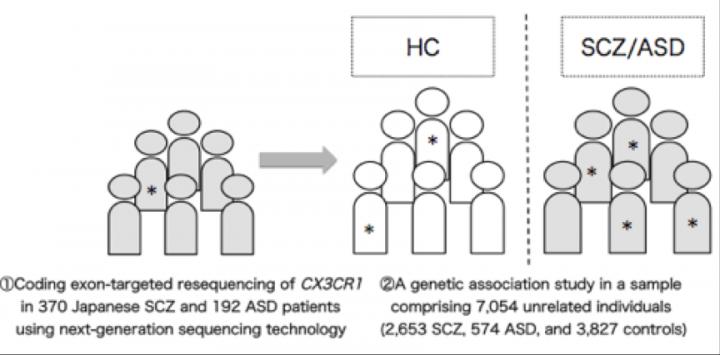
IMAGE

Credit: Osaka University

(Osaka, Japan) Huntington's disease, cystic fibrosis, and muscular dystrophy are all diseases that can be traced to a single mutation. Diagnosis in asymptomatic patient for these diseases is relatively easy – You have the mutation? Then you are at risk. Complex diseases, on the other hand, do not have a clear mutational footprint. A new multi-institutional study by Japanese researchers shows a potential rare gene mutation that could act as a predictor for two neurodevelopmental disorders, schizophrenia and autism.

"Aberrant synapse formation is important in the pathogenesis of schizophrenia and autism," says Osaka University Professor Toshihide Yamashita, one of the authors of the study. "Microglia contribute to the structure and function of synapse connectivities."

Microglia are the only cells in the brain that express the receptor CX3CR1. Mutations in this receptor are known to affect synapse connectivity and cause abnormal social behavior in mice. They have also been associated with neuroinflammatory diseases such as multiple sclerosis, but no study has shown a role in neurodevelopment disorders.

Working with this hypothesis, the researchers conducted a statistical analysis of the CX3CR1 gene in over 7000 schizophrenia and autism patients and healthy subjects, finding one mutant candidate, a single amino acid switch from alanine to threonine, as a candidate marker for prediction.

"Rare variants alter gene function but occur at low frequency in a population. They are of high interest for the study of complex diseases that have no clear mutational cause," said Yamashita, who added the alanine threonine substitution was a rare variant.

The structure of CX3CR1 includes a domain known as Helix 8, which is important for initiating a signaling cascade. Computer models showed that one amino acid change is enough to compromise the signaling.

"The variant changes the region from hydrophobic to hydrophilic and destabilize Helix 8. We overexpressed the mutation in cells and found Akt signaling was disrupted," explains Yamashita.

According to Yamashita, the findings are the first to connect a genetic variation in microglia with neurodevelopment disorders. Moreover, he hopes that the discovery could become a basis for predictive diagnostics.

"There is no reliable way to diagnose schizophrenia or autism in asymptomatic patients. Deeper understanding of the genetic risk factors will help us develop preventative measures."

###

Media Contact

Saori Obayashi
[email protected]
81-661-055-886
@osaka_univ_e

http://www.osaka-u.ac.jp/en

Original Source

http://resou.osaka-u.ac.jp/en/research/2017/20170801_1 http://dx.doi.org/10.1038/tp.2017.173

Share12Tweet7Share2ShareShareShare1

Related Posts

New Study Uncovers Mechanism Behind Burn Pit Particulate Matter–Induced Lung Inflammation

New Study Uncovers Mechanism Behind Burn Pit Particulate Matter–Induced Lung Inflammation

February 6, 2026

DeepBlastoid: Advancing Automated and Efficient Evaluation of Human Blastoids with Deep Learning

February 6, 2026

Navigating the Gut: The Role of Formic Acid in the Microbiome

February 6, 2026

AI-Enhanced Optical Coherence Photoacoustic Microscopy Revolutionizes 3D Cancer Model Imaging

February 6, 2026
Please login to join discussion

POPULAR NEWS

  • Robotic Ureteral Reconstruction: A Novel Approach

    Robotic Ureteral Reconstruction: A Novel Approach

    82 shares
    Share 33 Tweet 21
  • Digital Privacy: Health Data Control in Incarceration

    63 shares
    Share 25 Tweet 16
  • Study Reveals Lipid Accumulation in ME/CFS Cells

    57 shares
    Share 23 Tweet 14
  • Breakthrough in RNA Research Accelerates Medical Innovations Timeline

    53 shares
    Share 21 Tweet 13

About

We bring you the latest biotechnology news from best research centers and universities around the world. Check our website.

Follow us

Recent News

Succinate Receptor 1 Limits Blood Cell Formation, Leukemia

Palmitoylation of Tfr1 Drives Platelet Ferroptosis and Exacerbates Liver Damage in Heat Stroke

Oxygen-Enhanced Dual-Section Microneedle Patch Improves Drug Delivery and Boosts Photodynamic and Anti-Inflammatory Treatment for Psoriasis

Subscribe to Blog via Email

Enter your email address to subscribe to this blog and receive notifications of new posts by email.

Join 73 other subscribers
  • Contact Us

Bioengineer.org © Copyright 2023 All Rights Reserved.

Welcome Back!

Login to your account below

Forgotten Password?

Retrieve your password

Please enter your username or email address to reset your password.

Log In
No Result
View All Result
  • Homepages
    • Home Page 1
    • Home Page 2
  • News
  • National
  • Business
  • Health
  • Lifestyle
  • Science

Bioengineer.org © Copyright 2023 All Rights Reserved.