• HOME
  • NEWS
  • EXPLORE
    • CAREER
      • Companies
      • Jobs
    • EVENTS
    • iGEM
      • News
      • Team
    • PHOTOS
    • VIDEO
    • WIKI
  • BLOG
  • COMMUNITY
    • FACEBOOK
    • INSTAGRAM
    • TWITTER
Friday, December 19, 2025
BIOENGINEER.ORG
No Result
View All Result
  • Login
  • HOME
  • NEWS
  • EXPLORE
    • CAREER
      • Companies
      • Jobs
        • Lecturer
        • PhD Studentship
        • Postdoc
        • Research Assistant
    • EVENTS
    • iGEM
      • News
      • Team
    • PHOTOS
    • VIDEO
    • WIKI
  • BLOG
  • COMMUNITY
    • FACEBOOK
    • INSTAGRAM
    • TWITTER
  • HOME
  • NEWS
  • EXPLORE
    • CAREER
      • Companies
      • Jobs
        • Lecturer
        • PhD Studentship
        • Postdoc
        • Research Assistant
    • EVENTS
    • iGEM
      • News
      • Team
    • PHOTOS
    • VIDEO
    • WIKI
  • BLOG
  • COMMUNITY
    • FACEBOOK
    • INSTAGRAM
    • TWITTER
No Result
View All Result
Bioengineer.org
No Result
View All Result
Home NEWS Science News Science

Ushering in ultrafast cluster electronics

Bioengineer by Bioengineer
April 4, 2019
in Science
Reading Time: 2 mins read
0
IMAGE
Share on FacebookShare on TwitterShare on LinkedinShare on RedditShare on Telegram

IMAGE

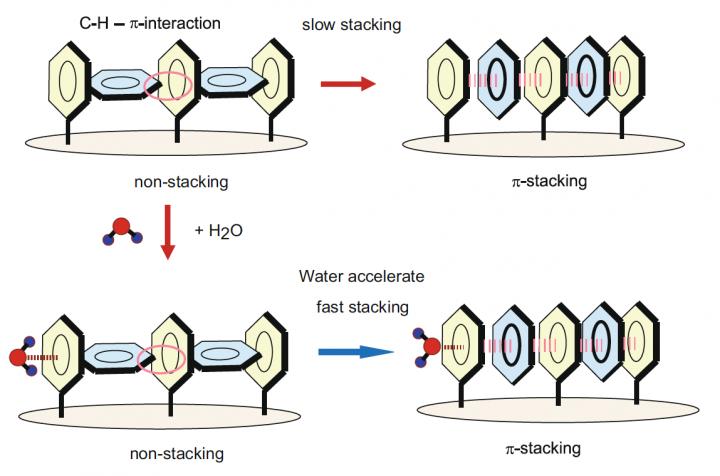
Credit: Tachikawa H., et al. Scientific Reports, Feb. 20, 2019

A new computational method can help fast track the development of tiny, ultrafast electronic devices made from small clusters of molecules.

Hokkaido University researchers have developed a computational method that can predict how clusters of molecules behave and interact over time, providing critical insight for future electronics. Their findings, published in the journal Scientific Reports, could lead to the creation of a new field of science called cluster molecular electronics.

Single molecule electronics is a relatively new, rapidly progressing branch of nanotechnology using individual molecules as electronic components in devices. Now, Hiroto Tachikawa and colleagues at Hokkaido University in Japan have developed a computational approach that can predict how clusters of molecules behave over time, which could help launch a new field of study for cluster molecule electronics. Their approach combines two methods traditionally used for quantum chemical and molecular dynamic calculations.

They used their method to predict the changes in a computer-simulated cluster of benzene molecules over time. When light is applied to the T-shaped benzene clusters, they reorganize themselves into a single stack; an interaction known as pi-stacking. This modification from one shape to another changes the cluster’s electrical conductivity, making it act like an on-off switch. The team then simulated the addition of a molecule of water to the cluster and found that pi-stacking happened significantly faster. This pi-stacking is also reversible, which would allow switching back and forth between the on and off modes.

In contrast, previous studies had shown that the addition of a molecule of water to a single molecule electronic device impedes its performance.

“Our findings could usher in a new field of study that investigates the electronic performance of different numbers, types and combinations of molecular clusters, potentially leading to the development of cluster molecule electronic devices,” Tachikawa commented.

###

Media Contact
Naoki Namba
[email protected]

Original Source

https://www.global.hokudai.ac.jp/blog/ushering-in-ultrafast-cluster-electronics/

Related Journal Article

http://dx.doi.org/10.1038/s41598-019-39319-7

Tags: Chemistry/Physics/Materials SciencesMaterialsMolecular PhysicsNanotechnology/MicromachinesTechnology/Engineering/Computer Science
Share12Tweet8Share2ShareShareShare2

Related Posts

Five or more hours of smartphone usage per day may increase obesity

July 25, 2019
IMAGE

NASA’s terra satellite finds tropical storm 07W’s strength on the side

July 25, 2019

NASA finds one burst of energy in weakening Depression Dalila

July 25, 2019

Researcher’s innovative flood mapping helps water and emergency management officials

July 25, 2019
Please login to join discussion

POPULAR NEWS

  • Nurses’ Views on Online Learning: Effects on Performance

    Nurses’ Views on Online Learning: Effects on Performance

    70 shares
    Share 28 Tweet 18
  • NSF funds machine-learning research at UNO and UNL to study energy requirements of walking in older adults

    70 shares
    Share 28 Tweet 18
  • Unraveling Levofloxacin’s Impact on Brain Function

    53 shares
    Share 21 Tweet 13
  • MoCK2 Kinase Shapes Mitochondrial Dynamics in Rice Fungal Pathogen

    72 shares
    Share 29 Tweet 18

About

We bring you the latest biotechnology news from best research centers and universities around the world. Check our website.

Follow us

Recent News

Healthy Behaviors, Social Ties Reduce Veteran Suicide Risk

Streptococcus Protein Triggers PBP1a for Cell Division

Nanostructured LiMPO4 Cathodes: Synthesis and Properties

Subscribe to Blog via Email

Success! An email was just sent to confirm your subscription. Please find the email now and click 'Confirm' to start subscribing.

Join 70 other subscribers
  • Contact Us

Bioengineer.org © Copyright 2023 All Rights Reserved.

Welcome Back!

Login to your account below

Forgotten Password?

Retrieve your password

Please enter your username or email address to reset your password.

Log In
No Result
View All Result
  • Homepages
    • Home Page 1
    • Home Page 2
  • News
  • National
  • Business
  • Health
  • Lifestyle
  • Science

Bioengineer.org © Copyright 2023 All Rights Reserved.