

• HOME
  • NEWS
  • EXPLORE
    • CAREER
      • Companies
      • Jobs
    • EVENTS
    • iGEM
      • News
      • Team
    • PHOTOS
    • VIDEO
    • WIKI
  • BLOG
  • COMMUNITY
    • FACEBOOK
    • INSTAGRAM
    • TWITTER
Thursday, March 26, 2026
BIOENGINEER.ORG
No Result
View All Result
  • Login
  • HOME
  • NEWS
  • EXPLORE
    • CAREER
      • Companies
      • Jobs
        • Lecturer
        • PhD Studentship
        • Postdoc
        • Research Assistant
    • EVENTS
    • iGEM
      • News
      • Team
    • PHOTOS
    • VIDEO
    • WIKI
  • BLOG
  • COMMUNITY
    • FACEBOOK
    • INSTAGRAM
    • TWITTER
  • HOME
  • NEWS
  • EXPLORE
    • CAREER
      • Companies
      • Jobs
        • Lecturer
        • PhD Studentship
        • Postdoc
        • Research Assistant
    • EVENTS
    • iGEM
      • News
      • Team
    • PHOTOS
    • VIDEO
    • WIKI
  • BLOG
  • COMMUNITY
    • FACEBOOK
    • INSTAGRAM
    • TWITTER
No Result
View All Result
Bioengineer.org
No Result
View All Result
Home NEWS Science News Health

USask researchers find face masks don’t hinder breathing during exercise

Bioengineer by Bioengineer
November 5, 2020
in Health
Reading Time: 3 mins read
0
IMAGE
Share on FacebookShare on TwitterShare on LinkedinShare on RedditShare on Telegram

IMAGE

Credit: John Ko

SASKATOON – A new University of Saskatchewan (USask) study has found that exercise performance and blood and muscle oxygen levels are not affected for healthy individuals wearing a face mask during strenuous workouts.

Questions have been raised as to whether mask wearing during vigorous exercise might compromise oxygen uptake or increase the rebreathing of carbon dioxide, leading to a condition (hypercapnic hypoxia) whereby increased carbon dioxide displaces oxygen in the blood.

But the study, published Nov. 3 in the research journal International Journal of Environmental Research and Public Health, did not find evidence to support these concerns.

“Our findings are of importance because they indicate that people can wear face masks during intense exercise with no detrimental effects on performance and minimal impact on blood and muscle oxygenation,” the researchers state.

“This is important when fitness centers open up during COVID-19 since respiratory droplets may be propelled further with heavy breathing during vigorous exercise and because of reports of COVID-19 clusters in crowded enclosed exercise facilities.”

The study evaluated use of a three-layer cloth face mask–the type recommended recently by Dr. Theresa Tam, Canada’s Chief Public Health Officer. “Results using a single-layer cloth mask may differ,” the researchers note.

The study, involving 14 physically active and healthy men and women, controlled for the effects of diet, previous physical activity, and sleep during the 24 hours prior to the test.

“If people wear face masks during indoor exercise, it might make the sessions safer and allow gyms to stay open during COVID,” said Phil Chilibeck, a professor in the USask College of Kinesiology, who was a co-author of the study. “It might also allow sports to continue, including hockey, where transmission of COVID-19 appears to be high.”

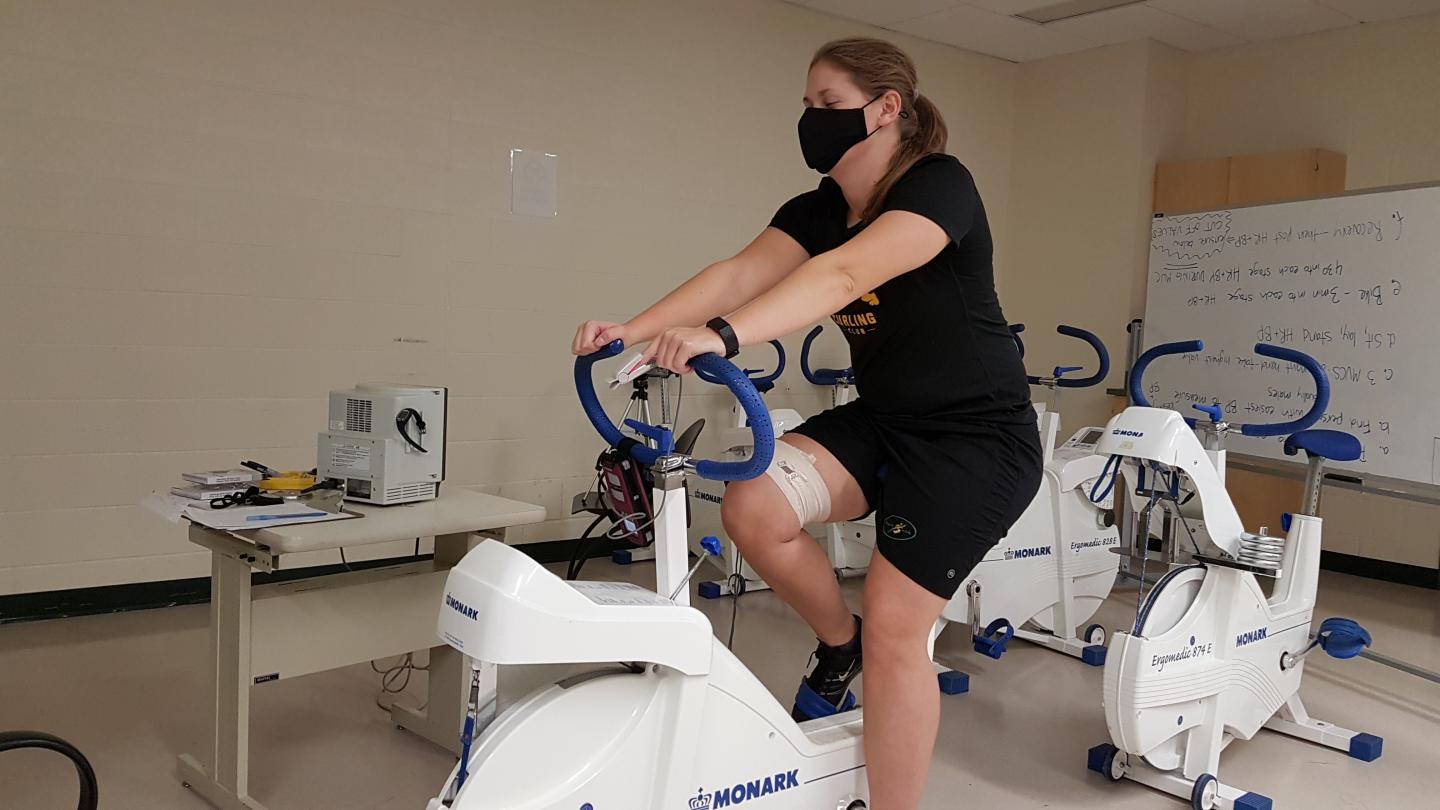
Participants were required to do a brief warm-up on a stationary bike. The exercise test involved a progressive increase in the intensity on the bike while they maintained a required pedal rate. Once they could not sustain the pedal rate the test was over.

“Usually a participant reaches exhaustion on this test in six to 12 minutes depending on their fitness level,” said Chilibeck.

The team assessed the participants, who did the test three times each, once wearing a surgical face mask, once wearing a cloth face mask and once with no face mask. The team recorded the participants’ blood oxygen levels and muscle oxygen levels throughout the test using non-invasive measurement tools.

Chilibeck notes the study is timely, as Saskatchewan has recently issued new public health orders that go into effect this week making masks mandatory in indoor public spaces in Regina, Saskatoon and Prince Albert to help curb the spread of COVID-19.

While the new provincial mask rules state that persons working out in a gym, ice rink or other recreational space are exempt, Chilibeck recommends that people wear masks in these facilities to keep safe, especially in these areas where people may be breathing harder due to vigorous exercise.

###

The USask research team also included kinesiology alumni Keely Shaw and John Ko, Scotty Butcher from the School of Rehabilitation Medicine, and Gordon Zello from the College of Pharmacy and Nutrition.

The study can be found here:
https://www.mdpi.com/1660-4601/17/21/8110

Media Contact
Victoria Dinh
[email protected]

Original Source

https://news.usask.ca/media-release-pages/2020/usask-researchers-find-face-masks-dont-hinder-breathing-during-exercise.php

Related Journal Article

http://dx.doi.org/10.3390/ijerph17218110

Tags: CardiologyEnvironmental HealthEpidemiologyHematologyInfectious/Emerging DiseasesMedicine/HealthPublic HealthPulmonary/Respiratory MedicineSports MedicineSports/Recreation
Share12Tweet8Share2ShareShareShare2

Related Posts

Aversive Learning Hijacks Brain Sugar Sensor

March 25, 2026

Can Psychosocial Factors Influence Cancer Risk?

March 23, 2026

Depression Factors in Elderly: Pre vs. Post-COVID Analysis

March 23, 2026

Hidden Health Crises Among US and UK Volunteers in Ukraine Uncovered in New Study

March 23, 2026
Please login to join discussion

POPULAR NEWS

  • blank

    Revolutionary AI Model Enhances Precision in Detecting Food Contamination

    96 shares
    Share 38 Tweet 24
  • Imagine a Social Media Feed That Challenges Your Views Instead of Reinforcing Them

    1003 shares
    Share 397 Tweet 248
  • Uncovering Functions of Cavernous Malformation Proteins in Organoids

    54 shares
    Share 22 Tweet 14
  • Promising Outcomes from First Clinical Trials of Gene Regulation in Epilepsy

    51 shares
    Share 20 Tweet 13

About

We bring you the latest biotechnology news from best research centers and universities around the world. Check our website.

Follow us

Recent News

In-Sensor Cryptography Links Physical Process to Digital Identity

Can Psychosocial Factors Influence Cancer Risk?

Depression Factors in Elderly: Pre vs. Post-COVID Analysis

Subscribe to Blog via Email

Success! An email was just sent to confirm your subscription. Please find the email now and click 'Confirm' to start subscribing.

Join 78 other subscribers
  • Contact Us

Bioengineer.org © Copyright 2023 All Rights Reserved.

Welcome Back!

Login to your account below

Forgotten Password?

Retrieve your password

Please enter your username or email address to reset your password.

Log In
No Result
View All Result
  • Homepages
    • Home Page 1
    • Home Page 2
  • News
  • National
  • Business
  • Health
  • Lifestyle
  • Science

Bioengineer.org © Copyright 2023 All Rights Reserved.


