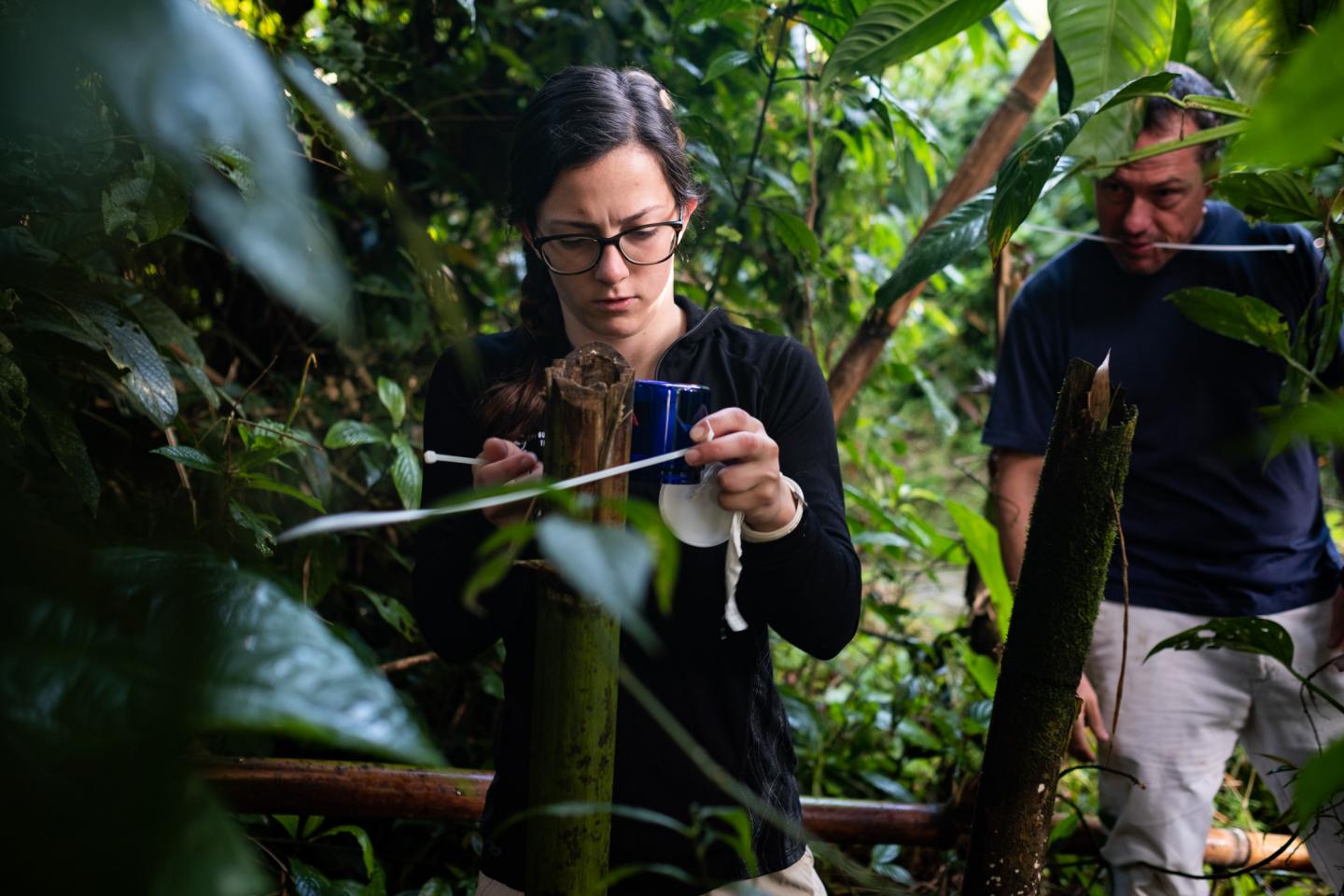
Credit: Jason Houston
Wake Forest University’s Center for Amazonian Scientific Innovation (CINCIA) has received $2.14 million in additional funding from the U.S. Agency for International Development (USAID), supporting the expansion of the research center’s study of mercury pollution and reforestation in the Peruvian Amazon.
CINCIA’s research has become a touchstone for policymakers, businesses and residents in Peru’s Madre de Dios region, where illegal artisanal-scale gold mining has ravaged the rainforest. This spring, government forces raided an illegal gold-mining center called La Pampa – and CINCIA’s scientists were among the first to measure the damage gold mining has caused to the surrounding rainforest. They’re now taking the scientific and technical knowledge developed in CINCIA’S first three years and using it as a base to scale-up reforestation and restoration efforts there.
“We will leverage as many tools as we have at our disposal to assess what has been lost around La Pampa, and then determine what we can regain and the timeline for restoration,” said Luis Fernandez, CINCIA co-founder and executive director. Satellite and drone imagery show a region scarred by sand dunes and pock-marked with ponds where virgin rainforest once thrived, a legacy of artisanal-scale gold mining throughout the region. “Some of the trees we have lost to gold mining are hundreds if not thousands of years old.” said Fernandez. Wake Forest founded CINCIA in 2016 through its Center for Energy, Environment and Sustainability (CEES) through an initial award by USAID and an international consortium of donors and partners that included the World Wildlife Fund-Peru, ESRI, and the Peruvian Amazon Research Institute, the research arm of the Peruvian Ministry of the Environment. USAID new funding bringing the total amount of support received for CINCIA to more than $12.5 million, including cash and in-kind contributions from other key partners. Using scientific collaborations and educational programs, CINCIA aims to build the ability to understand and address the environmental threats to the region and the people who live there, and to help develop a new generation of Peruvian scientists who will carry on the research needed to understand opportunities and threats and implement sustainable solutions. CINCIA’s science also offers a long-term pathway to restoring the global benefits of one of the world’s most biodiverse ecosystems currently in peril as a result of climate change and deforestation. “This award is a recognition of the effectiveness of the program we and our partners have built in Madre de Dios,” said Miles Silman, CINCIA co-founder and Wake Forest’s Andrew Sabin Presidential Chair of Conservation Biology. “This is an example of real-world sustainability, and it’s something that doesn’t always happen in scientific and academic endeavors. We’re connecting what we do at the university – using the foundations of a liberal arts education to put science to its practical uses and make a difference in the real world.
“USAID funding continues through 2021. CINCIA will build on its groundbreaking research and fieldwork in rainforest reforestation, mercury pollution detection, biochar and agroforestry experimentation, drone and satellite monitoring, and environmental education and outreach. It also helps build among local people an understanding of scientific research that effects them and provides hands-on environmental journalism experience to Wake Forest students. From the start, CINCIA has worked with stakeholders at all levels, from the Peruvian government to the miners themselves, to put in place policies and practices based on science and aimed at improving peoples’ livelihoods while preserving and restoring the world’s largest tropical wilderness. “Our focus is trying to get our research adopted by the Peruvian people and government at all levels – national, state and municipal – so that these tools for repairing the rainforest and preventing further damage are at the disposal of every decision maker,” Fernandez said.Wake Forest in PeruHow a team of scientists is trying to help save the Peruvian rainforest from the devastation of artisanal-scale gold mining.
Students embrace a rare opportunity to experience one of the wildest places on Earth, where science guides their study of the Peruvian Amazon.
###
Media Contact
Katie Neal
[email protected]
Original Source
https:/