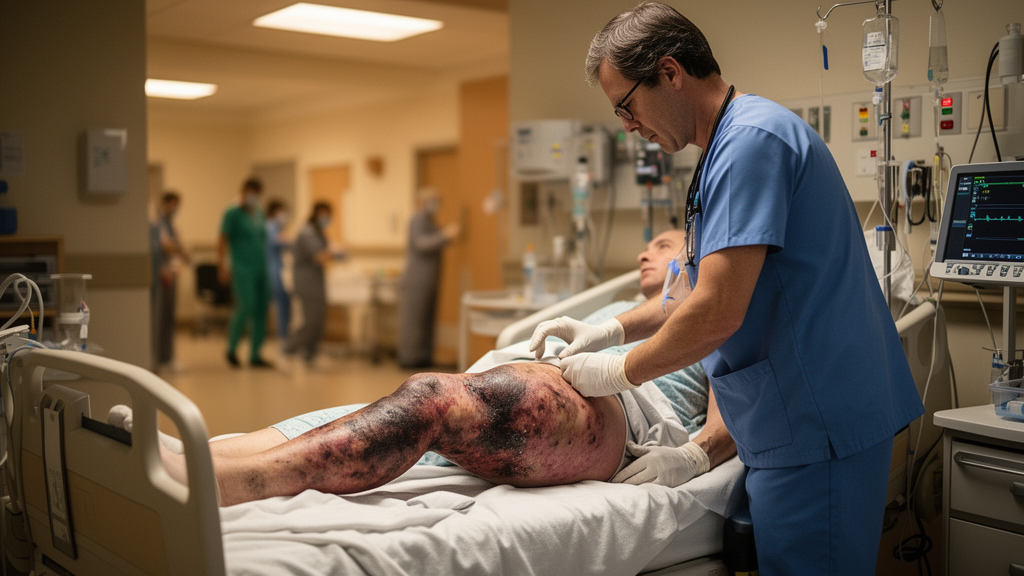
Deaths of US adults associated with necrotizing fasciitis, a rare but life-threatening bacterial soft-tissue infection, rose sharply after 2020 and peaked in 2022, according to a national death-certificate study published in BMC Infectious Diseases. The analysis counted 1,506 adult deaths in 2019, 2,056 in 2022, and 1,995 in 2024, with the highest observed annual age-adjusted mortality rate of 0.795 per 100,000 recorded in 2022.
The study used final CDC WONDER and National Center for Health Statistics Multiple Cause of Death data for US adults aged 25 years or older covering 2003 through 2024. The researchers identified deaths with the ICD-10 code M72.6 anywhere on the death certificate, a method that captures deaths in which necrotizing fasciitis was mentioned but not necessarily the underlying cause. Annual age-adjusted mortality rates were calculated per 100,000 using year-specific population denominators and the 2000 US standard population.
To characterize the post-2020 trajectory, the authors fitted exploratory interrupted time-series models estimating level and slope differences beginning in 2020, with sensitivity analyses addressing baseline shape and serial correlation. The primary segmented model estimated a 2020 level difference of 0.223 per 100,000 (95% confidence interval, 0.142 to 0.304), with a slope difference of -0.002 per 100,000 per year (95% confidence interval, -0.021 to 0.017).
Positive level estimates persisted across the sensitivity models, but the estimated 2024 difference from the projected pre-2020 trend depended on the baseline specification chosen. The authors emphasize that these models are exploratory and that the longer-term trajectory after 2020 is model-dependent rather than a settled finding.
Secondary comparisons placed the 2024 rate against earlier years. The 2024-to-2019 rate ratio was 1.27 (95% confidence interval, 1.18 to 1.36), meaning the 2024 rate was about 27 percent higher than the 2019 rate. The 2024-to-2022 rate ratio was 0.93 (95% confidence interval, 0.87 to 0.99), indicating a modest but statistically detectable decline from the 2022 peak.
In plain terms, adult mortality in 2024 was lower than in 2022 but remained higher than in 2019. The fitted level of mortality from 2020 onward sat above the level projected from the pre-2020 trend, even though the direction of the trend after that shift was not clearly resolved by the models.
The authors are explicit about the limits of interpretation. The findings do not establish pandemic causation, and they do not establish 2022 as a turning point. Because the analysis relies on death certificates, it reflects deaths associated with necrotizing fasciitis as recorded in the ICD-10 coding system, and the interrupted time-series design is exploratory rather than confirmatory.
Previous US mortality analyses of this condition had reported findings only through 2013 and 2020, leaving the subsequent national trajectory uncharacterized. By extending the death-certificate record through 2024, the new analysis documents that the elevated post-2020 level persisted through the most recent year of data, while the peak year remains 2022 and the longer-term path remains an open question for future data.
Subject of Research: Adult necrotizing fasciitis-associated mortality trends in the United States from 2003 to 2024
Article Title: Post-2020 trajectory of adult necrotizing fasciitis-associated mortality in the United States, 2003–2024: a national death-certificate study
Article References: Raja, A. R., Hassan, H. F., Harp, T., & Sethi, A. (2026). Post-2020 trajectory of adult necrotizing fasciitis-associated mortality in the United States, 2003–2024: a national death-certificate study. BMC Infectious Diseases. https://doi.org/10.1186/s12879-026-14740-2
Image Credits: AI Generated
DOI: 10.1186/s12879-026-14740-2
Keywords: necrotizing fasciitis, mortality, CDC WONDER, death certificates, United States, age-adjusted mortality rate, interrupted time series, ICD-10 M72.6, BMC Infectious Diseases, epidemiology, Post-2020, trajectory
News Source: Kristina Jarvis. (October 27, 2026). US adult necrotizing fasciitis deaths rose after 2020, national death-certificate study finds. Scienmag.