Results have implications for life on Mars
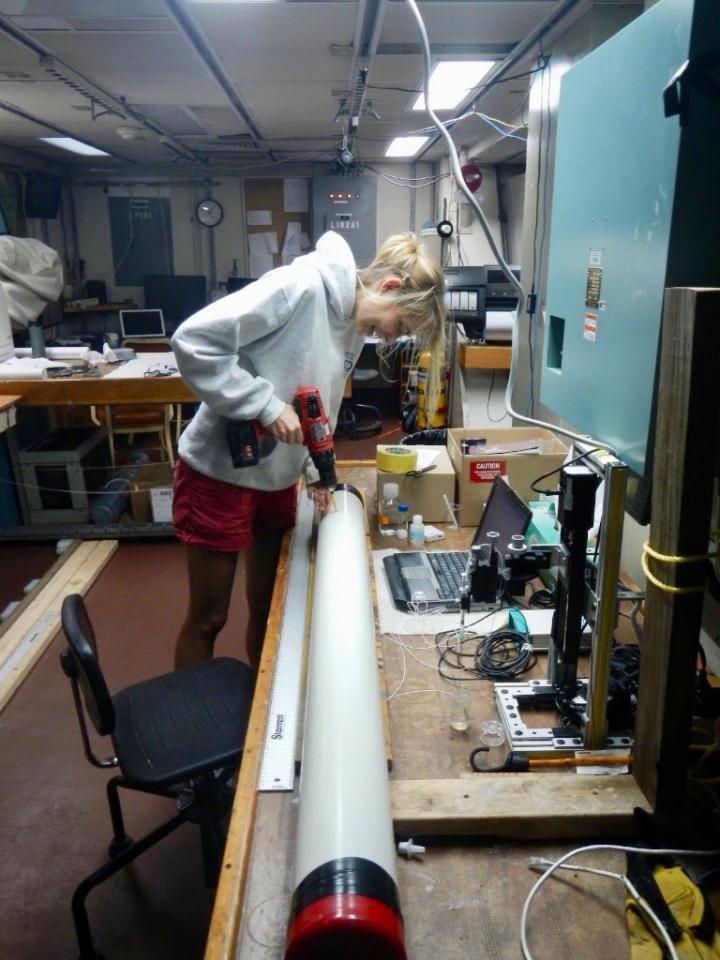
Credit: Photo courtesy Justine Sauvage
NARRAGANSETT, R.I. – February 26, 2021 – A team of researchers from the University of Rhode Island’s Graduate School of Oceanography and their collaborators have revealed that the abundant microbes living in ancient sediment below the seafloor are sustained primarily by chemicals created by the natural irradiation of water molecules.
The team discovered that the creation of these chemicals is amplified significantly by minerals in marine sediment. In contrast to the conventional view that life in sediment is fueled by products of photosynthesis, an ecosystem fueled by irradiation of water begins just meters below the seafloor in much of the open ocean. This radiation-fueled world is one of Earth’s volumetrically largest ecosystems.
The research was published today in the journal Nature Communications.
“This work provides an important new perspective on the availability of resources that subsurface microbial communities can use to sustain themselves. This is fundamental to understand life on Earth and to constrain the habitability of other planetary bodies, such as Mars,” said Justine Sauvage, the study’s lead author and a postdoctoral fellow at the University of Gothenburg who conducted the research as a doctoral student at URI.
The process driving the research team’s findings is radiolysis of water – the splitting of water molecules into hydrogen and oxidants as a result of being exposed to naturally occurring radiation. Steven D’Hondt, URI professor of oceanography and a co-author of the study, said the resulting molecules become the primary source of food and energy for the microbes living in the sediment.
“The marine sediment actually amplifies the production of these usable chemicals,” he said. “If you have the same amount of irradiation in pure water and in wet sediment, you get a lot more hydrogen from wet sediment. The sediment makes the production of hydrogen much more effective.”
Why the process is amplified in wet sediment is unclear, but D’Hondt speculates that minerals in the sediment may “behave like a semiconductor, making the process more efficient.”
The discoveries resulted from a series of laboratory experiments conducted in the Rhode Island Nuclear Science Center. Sauvage irradiated vials of wet sediment from various locations in the Pacific and Atlantic Oceans, collected by the Integrated Ocean Drilling Program and by U.S. research vessels. She compared the production of hydrogen to similarly irradiated vials of seawater and distilled water. The sediment amplified the results by as much as a factor of 30.
“This study is a unique combination of sophisticated laboratory experiments integrated into a global biological context,” said co-author Arthur Spivack, URI professor of oceanography.
The implications of the findings are significant.
“If you can support life in subsurface marine sediment and other subsurface environments from natural radioactive splitting of water, then maybe you can support life the same way in other worlds,” said D’Hondt. “Some of the same minerals are present on Mars, and as long as you have those wet catalytic minerals, you’re going to have this process. If you can catalyze production of radiolytic chemicals at high rates in the wet Martian subsurface, you could potentially sustain life at the same levels that it’s sustained in marine sediment.”
Sauvage added, “This is especially relevant given that the Perseverance Rover has just landed on Mars, with its mission to collect Martian rocks and to characterize its habitable environments.”
D’Hondt said the research team’s findings also have implications for the nuclear industry, including for how nuclear waste is stored and how nuclear accidents are managed. “If you store nuclear waste in sediment or rock, it may generate hydrogen and oxidants faster than in pure water. That natural catalysis may make those storage systems more corrosive than is generally realized,” he said.
The next steps for the research team will be to explore the effect of hydrogen production through radiolysis in other environments on Earth and beyond, including oceanic crust, continental crust and subsurface Mars. They also will seek to advance the understanding of how subsurface microbial communities live, interact and evolve when their primary energy source is derived from the natural radiolytic splitting of water.
###
This study was supported by the U.S. National Science Foundation and the U.S. National Aeronautics and Space Administration. The project is also affiliated with the Center for Dark Energy Biosphere Investigations.
Media Contact
Todd McLeish
[email protected]
Original Source
https:/
Related Journal Article
http://dx.